When UFOs Were for Crazy People

Now the government calls them UAPs and holds press conferences.

Belief in Unidentified Flying Objects (UFOs) for decades occupied the exclusive domain of conspiracy theorists, late-night AM radio callers, and guys who stored canned beans in underground bunkers.

Back then, if you talked about flying saucers in public, people looked at you the same way they’d look at someone claiming Bigfoot stole their lawnmower.

Today they call them Unidentified Aerial Phenomena (UAP), which sounds a lot more respectable and government-funded. Somewhere along the line, UFOs got a promotion.

I’ll admit it. My fascination started when I read Erich von Däniken and his wildly popular book “Chariots of the Gods?” Von Däniken argued that extraterrestrials have been visiting Earth since ancient times and that many of the “angels” described in holy writings like the Bible and Torah may have been visitors from somewhere beyond our galaxy.

Was it far-fetched? Absolutely.

Did teenage me eat it up like Buford gas station beef jerky on a Wyoming road trip? Also absolutely.

I tend to trust my own observations more than theories. That brings me to one unforgettable weekend in 1980.

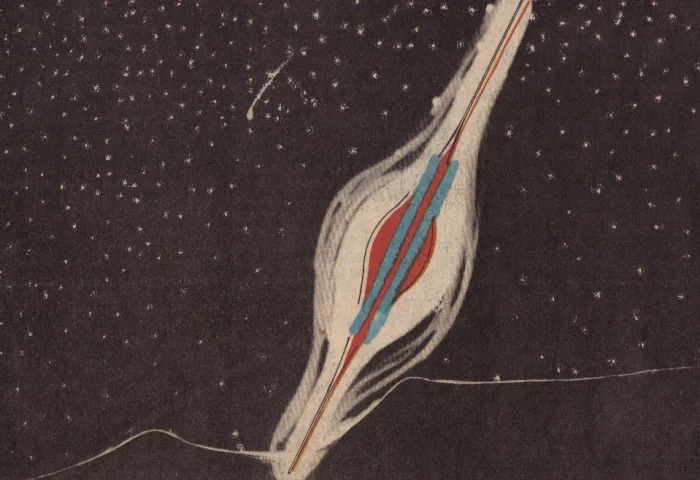
I was reading the front page of the “Casper Star-Tribune” when I came across a story about strange UFO sightings at the Morton Pass area along Wyoming Highway 34 between Wheatland and Laramie. The property belonged to Pat McGuire and his family.

The sketch by Marina Wormus illustrated the story by Greg Bean.
Now this wasn’t your standard “my cousin saw lights after six Coors Banquets” kind of story.

McGuire claimed he’d been abducted multiple times. According to reports, hypnotic regression sessions conducted by Professor Leo Sprinkle at the University of Wyoming revealed encounters with alien beings who supposedly instructed him to drill a water well on otherwise useless land.

The result? A gusher that provided enough to irrigate alfalfa fields.

No UFO story is complete without at least one detail that makes everybody tilt their head sideways. McGuire flew an Israeli flag over the well because he said the Star of David adorned the aliens’ belt buckles.

You can’t make this stuff up.

Naturally, I talked a few friends from Gillette to load into a van and headed south in search of extraterrestrials.

We camped out on the property and, sure enough, saw strange lights moving in the distance over the prairie sky. Were they spacecraft? Military exercises? Reflections? Atmospheric weirdness?

I’ll tell you this. When you’re standing in the middle of the Wyoming night with nothing around but wind, sagebrush, and stars the size of dinner plates, your imagination becomes very open-minded.

I’d call it a close encounter of the “pretty darn interesting” kind.

Over the years, I’ve become less interested in little green men and more interested in the spiritual side of the phenomenon.

Oddly enough, evangelist Billy Graham wrote in his book “Angels: God’s Secret Agents,” speculated that extraterrestrials could be part of God’s creation.

I’ve wondered if what ancient people described as angels might overlap with what modern people describe as UFO encounters.

It’s harder to laugh the subject off now that the Department of Defense has released footage and reports from military pilots describing UAP. When fighter pilots start saying, “Yeah, we saw something weird moving at impossible speeds,” suddenly the old UFO crowd doesn’t seem quite so crazy.

Well, slightly less crazy.

I still don’t know what I saw over Morton Pass all those years ago, but it made for one heck of a Wyoming weekend.

Unlike the aliens, the memories have never disappeared.

‘Beyond Heart Mountain’ book and movie are for sale

Featured

Buy Beyond Heart Mountain memoir published by Winter Goose Publishing. It is available as a printed book and ebook. Signed copies can be purchased from the author. The book was released February 27th. That week coincided with the 80th anniversary of President Roosevelt’s signing of Executive Order 9066 that sent 120,000 Japanese to 10 war relocation camps, that included Heart Mountain in northwest Wyoming.

Beyond Heart Mountain book and related are now for sale.

Remember to download the Beyond Heart Mountain promotional information booklet.

Boulder Community Media (BCM) produced a documentary that aired on PBS that aired in December 2021. The Nishigawa Neighborhood is a coffee table book that will soon be released.

During World War II, Cheyenne native Alan O’Hashi’s family avoided life in internment camps such as Heart Mountain.

As a Baby Boomer, Alan documents the overt and quiet racism pervasive in Wyoming and throughout the United States during and following World War II. He relates his experiences to current violence towards Asians and the issue of civility within society.

The backdrop to Alan’s account is the history of the once vibrant Japanese community in the 400 and 500 blocks of West 17th Street in the downtown area of my hometown, Cheyenne, Wyoming.

*****

“My grandmother and grandfather Ohashi and their large family lived in worked in that neighborhood where I spent quite a bit of time between elementary and high school. Having been away from Cheyenne for many years, I stashed those two blocks in the back of my mind until I learned that two classmates of mine were planning to build a housing development at 509 W. 17th St. The biggest obstacle was obtaining permission to tear down an old building. It was the last structure in the Japanese neighborhood. It was the site of a rooming house operated by Mrs. Yoshio Shuto.”

Buy the Beyond Heart Mountain movie

Buy the Beyond Heart Mountain DVD is mainly about the West 17th Street Japanese community history and a general overview of Executive Order 9066 that President Franklin Roosevelt signed that relocated 120,000 Japanese into 10 internment camps, including Heart Mountain in northwest Wyoming.

I interviewed four childhood friends for the documentary. Robert Walters formerly worked at the City Cafe. He still lives in Cheyenne, where he practices law.

Terie Miyamoto and her family-owned Baker’s Bar. It was the only racially-integrated bar in Cheyenne at the time. She now lives in the Denver Metro area.

Brian Matsuyama now lives in Seattle, Washington. He resided in Cheyenne during his childhood. His family owned the California Fish Market. Carol Lou Kishiyama-Hough is in Cheyenne. She and her family purchased the Fish Market from the Matsuyamas.

Buy the Nishigawa Neighborhood coffee table book. It’s a 11 x 8.5-inch hard-cover coffee table book with over 100 color, black and white images of the neighborhood. Signed copies are available from thanks author.

Nishigawa Neighborhood coming soon

Mrs. Shuto’s tenants were mainly Japanese residents who made their way to Cheyenne. She later opened the City Cafe across the street which became a gathering place for the Japanese in town.

My grandmother was a cook at the City Cafe. Next door, my grandfather was the third owner of a pool hall.

Whenever we went out to eat, the restaurant of choice was the City Cafe. It was a gathering place for the Japanese in Cheyenne. My friends enlisted me to do a cultural and historical survey of the Japanese residents who lived and worked there from the 1920s through the 1970s.

Buy a Beyond Heart Mountain cap are also available. They are low-profile baseball-style hats. Select Beyond Heart Mountain from the dropdown menu.

The logo is an adapted version of the Wyoming state flag. One size fits most.

1. Where were you?

ground zero 2001

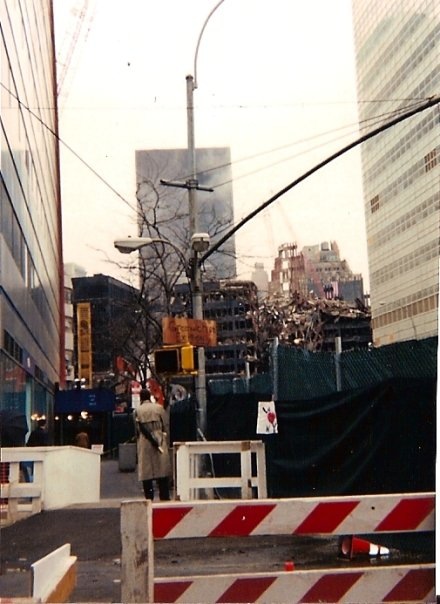
The Yankees hosted the Arizona Diamondbacks for games 3 to 5 in the 2001 World Series that was delayed because of the attacks on September 11th, a little more than a month earlier. I went to two of the games and visited “ground zero” in October 2001.

It was an unusually hot day in September. I must have been in a hurry because I didn’t bother to turn on the Today Show or the Morning Edition on Colorado Public Radio while getting ready for my commute to work in Denver.

This particular morning I took the Regional Transportation District (RTD) route 205 bus from the stop near my Boulder condo to the RTD Walnut Street station in downtown Boulder.

The bus stop was next to the convenience store where I stopped most days for a cup of coffee.

“Looks like it’s going to be a good one out there,” I don’t think the dark-skinned clerk understood a word I said about the great weather predicted for the day. He grinned and handed over my change. I clunked a couple cents into the plastic leave-a-penny take-a-penny tray on the counter and cut through the gas pumps to the bus stand.

From the downtown Boulder bus station, few passengers waited to catch the B Express bus to Denver. There’s no free parking. I was okay with transferring from a local bus downtown so as to get the seat of my choice, which was one with extra legroom toward the middle of the cabin a couple rows ahead of where a wheel chair would be parked – similar to the exit row seats on an airplane.

By the time we reached the last Boulder stop at the Table Mesa Park ‘n Ride, the seats were filled with commuters rattling their morning papers, cramming for college classes at the Auraria campus, reading books, listening to music on iPods, catching up on sleep.

This was well before laptops internet hot spots and smartphones. I was one of the few who had a cell phone. It was the size of a small box of Velveeta cheese. I didn’t think to call anyone.

“Did you hear what happened in New York,” the guy sitting to me asked. “No, I hadn’t heard anything.”

“An airplane crashed into one of the Twin Towers,” he said. “No, I hadn’t heard. What kind of plane?” The guy shrugged.

Other passengers murmured about the news and I overheard, “It was a small plane, like a Cessna.” Hmmm, small plane, nothing to see here, folks, and soon we all returned to being immersed in ourselves.

The bus pulled up to a stall in Market Street Station. We disembarked and made our ways up the stairs and escalators to the 16th Street Mall.

My connection on 17th Street was for the eastbound RTD 20 bus that dropped me off near my work in a converted single-family home in an older neighborhood.

I walked up the steps and creaked open the wrought iron screen door before winding my way up the stair case towards my office.

“You can go home if you want,” my boss greeted me at the top of the stairs. “Two planes hit the World Trade Center. There isn’t much more information but all the air traffic is grounded.”

“There was talk on the bus about a plane hitting one of the towers,” I said.

My colleagues had all gone. I had the longest commute to and from Boulder and the last to hear.

I walked back to the bus station and noticed the eerily quiet streets – no car engines, no airplane noise, not many people out and about. When I stood waiting for the light at Broadway and the 16th Street Mall, I glanced up at the Denver World Trade Center that I later learned was a similar target as its namesake in Lower Manhattan.

The bus back to Boulder was a-buzz with rumor, but I didn’t engage.