How normal is marijuana? The story of a card carrying pothead

Most places, day-to-day conversations do not include any mention of marijuana – not even in jest, since possession is a crime in all states. Weed continues to be demonized and I’m not sure I should even be writing about the topic.
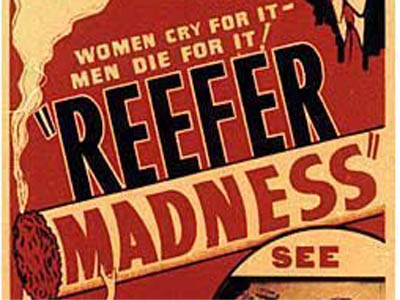
Marijuana is classified by the US government as a narcotic. It has been demonized since the 1940s.

Marijuana is classified by the US government as a narcotic. It has been demonized since the 1940s.

In Colorado, that’s not the case since the voters exercised its “state right” and legalized use of marijuana as recreational vice.

Move over gambling, booze and prescription uppers and downers.

Needless to say pot is still classified as a narcotic by the US government and if Colorado weed is transported across state lines it is a federal offense under the commerce clause. The DEA has backed off Colorado and Washington, but likely won’t mess with the small fish, but focus on mass quantities that leave the state from approved weed farms. I’d say those out of state markets sould be reserved for the bad guys and international drug cartels.

In Colorado, legal weed started out as a medicinal and health issue and crept into the mainstream with Amendment 64 passing by a wide margin in 2012. That was a presidential election year with a relatively high voter turnout, so to speak.

I wondered about the age breakdown and was able to find in Arizona, the largest group of men and women with medical marijuana cards are aged 51 – 80 (approximately 24,000). Compare that to the 13,000 Arizonans aged 16 to 30.

In Colorado, medical marijuana sales outpaces recreational marijuana sales. Out of town tourists sustain the recreational weed market, according to the Colorado Marijuana Market Demand study.

I was location scouting with a camera guy from San Francisco who was curious. He wondered if cannabis use was restricted to hookah bar – type places like in Amsterdam. I explained that it is more like stopping by the liquor store and buying a six pack to take home after work. Around Boulder smoking of any kind in public isn’t allowed, but here are vapor wands that are smokeless and weed oil cartridges sell for around $30 and the vapor wands for under $20.

Some of you may know that I was pretty sick in 2013 starting with shingles in June and ending with a weird form of pneumonia in December that landed me in the hospital for six weeks, physical rehab for two weeks and home rehab for another six weeks into 2014.
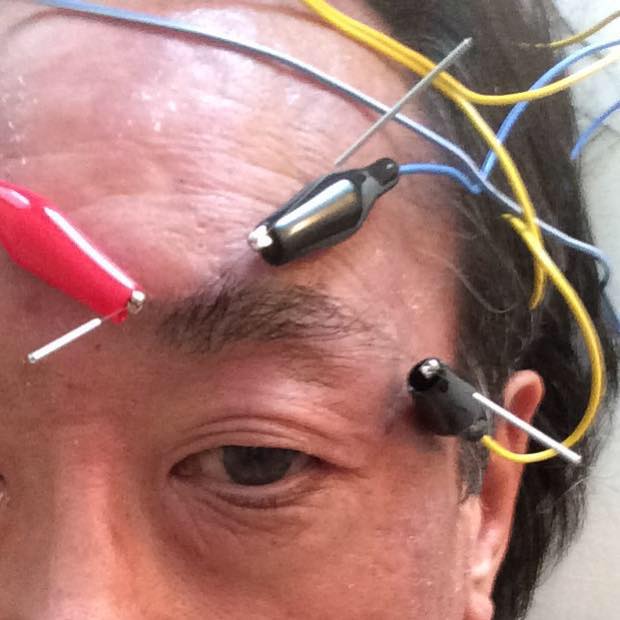
I've been taking a variety of acupuncture treatments for post herpetic neuralgia pain, including the more drastic 3-stim treatment.

I’ve been taking a variety of acupuncture treatments for post herpetic neuralgia pain, including the more drastic 3-stim treatment.

Just before the Bolder Boulder in 2014, I started acupuncture treatments at the Southwest Acupuncture College clinic in Gunbarrel for my lungs and shingles. I initially went to my regular acupuncturist. He first treated me for gout many years ago. I tried him out again and wasn’t satisfied with his treatment and tried the SWAC. By the way, I did finish the Bolder Boulder in 2014 on supplemental oxygen, but only needed a swig to make it up the Folsom hill that enters the stadium. This year, I hope to run part of it.

I’ve been going for acupuncture once a week since then getting a variety of treatments recently for the aftermath of shingles – Post Herpetic Neuralgia. I attribute my lungs clearing up to acupuncture. In fact, I went to see my pulmonologist a couple weeks ago and was released by him. He’s taking my miraculous recovery case to present at some sort of lung symposium. Maybe I’ll have a disease named after me.

Meanwhile, the PHN has improved, but still painful and I decided to try cannabis sort of as a last resort. I’m not a marijuana neophyte, having grown up in the ’60s and gone to college in the ’70s. The open weed carry here would result in a criminal record anywhere else.

When I was still in physical rehab, I was trying to regain weight and was prescribed a drug called mirtazapine (Remeron) which is the synthetic form of tetrahydrocannabidiol (THC) the hallucinogenic alkaloid produced by marijuana plants. It is an antidepressant and appetite stimulant. I took it in the evening to induce the “munchies” before dinner. It got me to eat more but not buzzed up.

CNN medical reporter Dr. Sanjay Gupta produced a series about the anecdotal benefits of cannabis for certain chronic medical conditions, like epilepsy.

CNN medical reporter Dr. Sanjay Gupta produced a series about the anecdotal benefits of cannabis for certain chronic medical conditions, like epilepsy.

There was a series of programs on CNN produced by Dr. Sanjay Gupta, MD. He started out his research wanting to discredit the medicinal value of weed, but he soon changed his mind after he saw how some patients with nervous system maladies improved – mostly convulsive conditions – after treatments with cannabidiol (CBD) which is a non-hallucenigenic alkaloid produced by the marijuana plant.

These days, a person doesn’t need a medical marijuana card, so I stopped by a couple weed stores and picked a bottle of CBD lotion and CBD plant material. The lotion was $20 for a 2 oz bottle and the shake weed was $10 / gram. Both were effective externally and internally. For the recreational user, price wise, weed is competitive with alcohol.

I asked about a medical doctor who does the medical marijuana evaluations and settled on Dr. Joe Cohen, MD. He has a clinic called Holos Health in southeast Boulder. When I walked in, there was a steady stream of people. I was the youngest one there among the other seniors using walkers and wheelchairs.

I went to Dr. Joe Cohen of Holos for my medical evaluation. The interview took about 15 minutes and cost $75 with a referral discount.

I went to Dr. Joe Cohen of Holos Health for my medical evaluation. The interview took about 15 minutes and cost $75 with a referral discount.

When Amendment 64 was being pitched, I’m thinking that there were a lot of mainstream people who thought that this was going to isolate a niche of pot users stereotyped as young, dreadlocks sporting, tie dyed T-shirt wearing rebels. Turns out, the market is much wider and deeper than imagined and includes a bunch of Baby Boomer old people like me who don’t have an aversion to pot.

The rack price copay for the medical evaluation is $85 and $75 with a $10 discount because I was referred by a dispensary. Renewals are $65. I don’t think a doc has to be an MD. One guy i read about is a DO – an optometrist. I imagine podiatrists can also evaluate. One of my acupuncture doctors may write my prescription next year. For now, Holos Health is a good fit for me.

The interview with Dr. Cohen lasted about 15 minutes and it was based on my conversation with him about my PHN pain and my risk for glaucoma (i’m 20/400 in my left eye and have to get a glaucoma test every six months by my ophthalmologist).

I imagine there were a lot of bogus health claims made when medical marijuana was all that was allowed. The state of Colorado is cracking down on this and there will be additional requirements. My primary care physician doesn’t do marijuana evaluations. There really isn’t any way to figure out pain, other than it exists. It will be interesting to see how the state will change the rules for evaluations.

Will they evaluate patients more rigorously like my primary care doc would? He’ll probably keep me for 30 minutes, take my blood pressure, weigh me, then have a nurse practitioner ask where it hurts and charge me double.
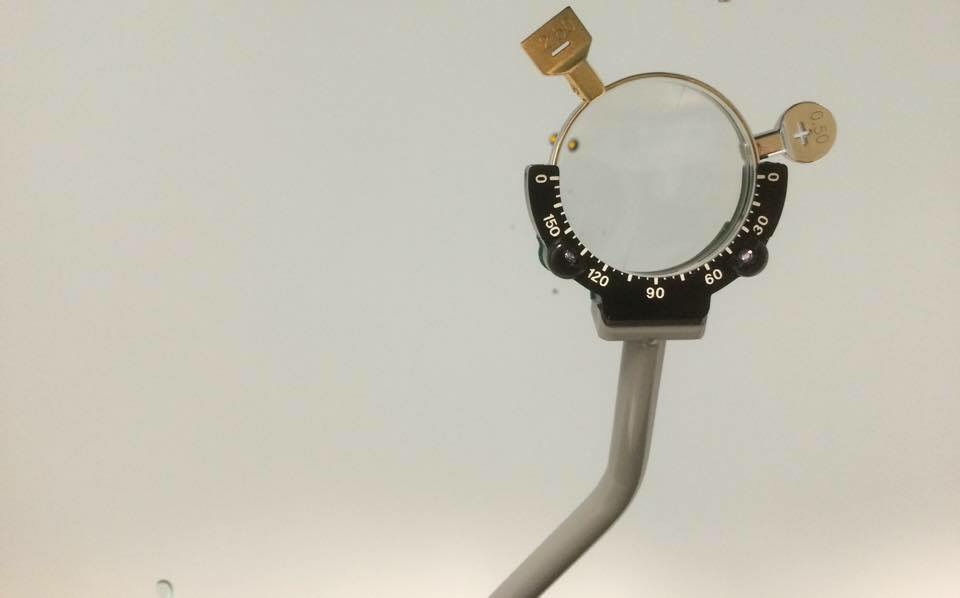
I qualified for a medical marijuana card based on post herpetic neuralgia and glaucoma risk. I recently went in for my peripheral vision test that I take every six months.

I qualified for a medical marijuana card based on post herpetic neuralgia and glaucoma risk. I recently went in for my peripheral vision test that I take every six months.

Once I was evaluated, my paperwork was processed and ready to be mailed. It was turn key – self addressed stamped envelope, copies of the evaluation.

A US Postal Service certified mail receipt and a copy of the doctor’s evaluation served as my temporary ID until the card was issued by the state of Colorado. That day in early April, I went to a medical dispensary and found that the prices were around 50 percent less than in the retail store.

This business is highly regulated – more so than the alcohol business

It’s more like a casino.

There are cameras watching every transaction – I don’t know who’s watching, though.  I had a product return for a faulty creme dispenser. This is how the return transaction went down. Stores can’t accept back product. I had to keep the bad one and buy the replacement for a penny.  The “pit boss” had to come out and monitor the sale and bagging of both the faulty product and the replacement.

Everything is in plain view, everything is sold in child-resistant containers. At the end of each day, inventory is taken to be sure it matches up with the computer printout.

It’s a total cash business – employees paid in cash, taxes paid in cash, vendors paid in cash.

“High Profits” is a reality TV show on CNN about the ups and downs of the weed business in Breckenridge. It’s an all cash business.

There’s a CNN reality program called “High Profits” that tracks a retail weed store in Breckenridge. The first day, the business took in $100,000 – of which 25% is sales tax returned to the town of Breckenridge.

Johnny Depp in

Johnny Depp in “Blow” in a room of cash from the early cocaine trade.

There’s a scene in that Johnny Depp movie “Blow” about the early cocaine trade. A room is filled with cash, which reminded me of the room of cash the two weed store owners were immersed within.

Chris Rock has a line about comments you won’t hear from a drug dealer. One is, “Oh no! I don’t know what I’m going to do with all this money!”

Around Halloween, all the TV stations had scary stories about what if kids get pot infused candy in their treat bags? It was a fresh angle to the once obligatory razor blades in apples story. Besides, no pothead is going to give out candy worth a dollar a piece to a kid as a prank. Seems there’s a bigger problem of kids eating Tide detergent packets, according to the TV news.

In NFL speak, it’s less probable than so, that an under aged kid would be allowed to enter one of these stores. If minors do get access to “candy” it’s either from their parents or a pusher. Years ago when I was in the tobacco use prevention business, at the Walnut Street RTD station, I remember seeing a guy who was the tobacco pusher. He gave out cigarettes to the middle school kids.

I don’t know this for sure, but once they became hooked on nicotine, he used that as the gateway to get them to buy other stuff from him. Law enforcement should keep an eye on places where kids gather without supervising adults around. Tobacco companies continue to target the low-self esteem market – children and adults – and the same holds true for getting kids to use weed.
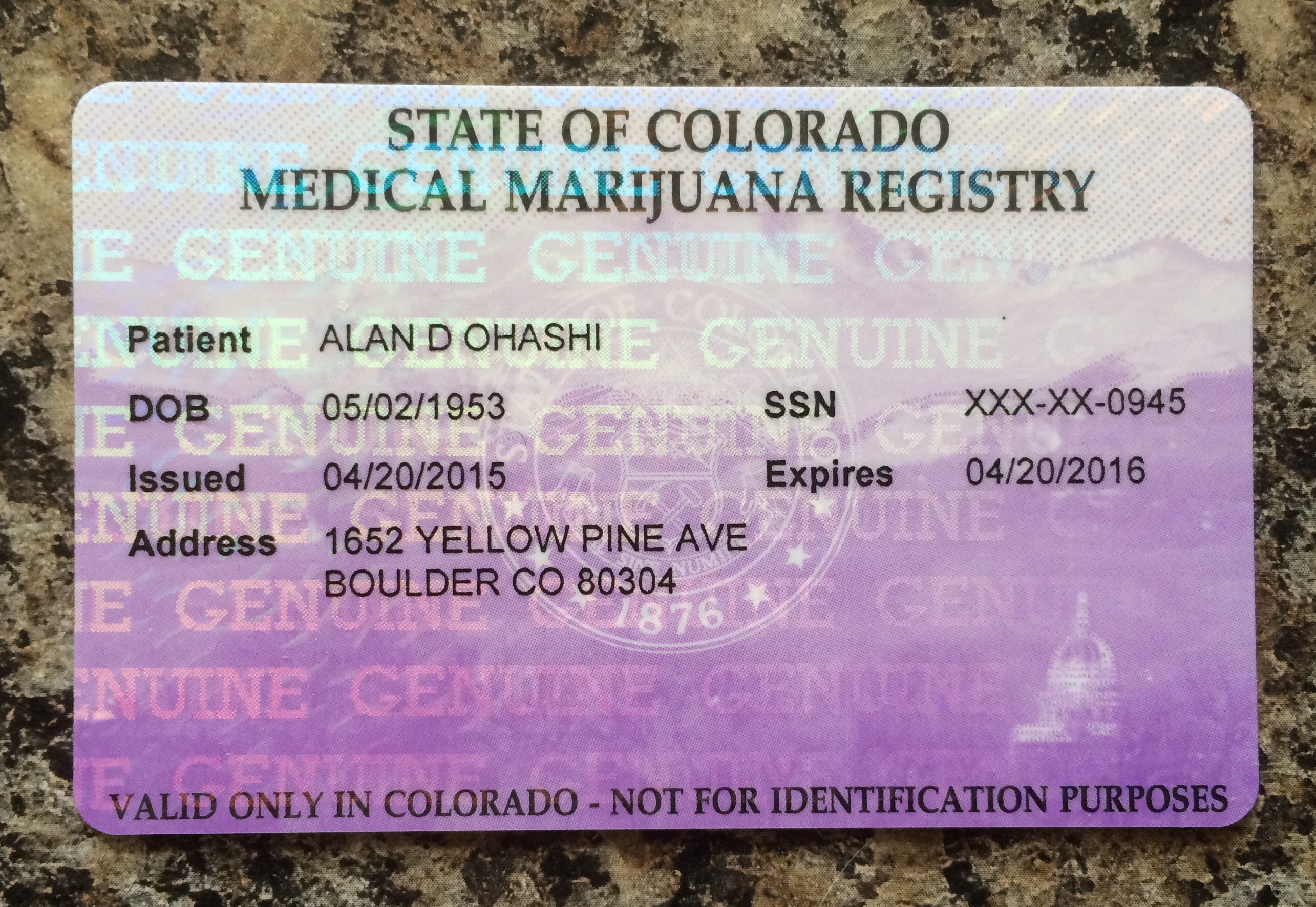
This is the medical marijuana card issued by the state of Colorado. The business is very regulated which is reassuring.

This is the medical marijuana card issued by the state of Colorado. The business is very regulated which is reassuring.

So my medical marijuana card arrived at the end of April. The Colorado Department of Health has a sense of humor – the issue date is April 20, 2015.

I haven’t used it much, the product selection is very narrow, since the same few companies supply all the dispensaries with what I buy, the lotions and patches. Marijuana and hemp can provide quite a bit of value added business and product opportunities from farm to shelf – kind of like Spruce Confections in Boulder makes all the ruby scones around town.

As a survivor of the western / traditional medical industrial complex, I learned that chronic conditions are tough to diagnose and treat. Similarly, eastern / nontraditional treatments varies based on each patient and is hit and miss, too.

If THC can be synthesized in the laboratory, it should be possible to make pharmaceutical grade CBD. There is research happening in England and what those labs are making, I don’t know. The current labs in Colorado are able to extract the alkaloids, but not accurately. I’m surprised the tobacco and pharmaceutical companies haven’t jumped into this business.

For recreational weed, the exact percentages of this or that isn’t important, other than to inform the customer of the strength. I noticed that the microbreweries rank their beers by alcohol content.

Who would have thought that once maligned marijuana use would be legal. What about the iPhone 6? Phones were small and not big. I saw someone holding one to their ear the other day – it reminded me of those huge Motorola gray brick phones from the 1980s. The culture is moving forward to the past and legal weed is the new NORML.

2015 Wyoming road trip for the arts – trek 1

Anyone who has spent any time in Wyoming knows that road trip organization is key. I have been known to travel two hours for a 10 minute meeting. This week, I plotted out a six day trip that started on Monday May 4. Two years ago, my health took a hit when I made a series of road trips to the East Coast at the end of May to a long Wyoming trek in early June.

The Wyoming Cultural Trust Fund Board met in Pinedale and approved the digital Art of the Hunt project.

The Wyoming Cultural Trust Fund Board met in Pinedale and approved the digital Art of the Hunt project.

I was a little concerned that two years later, I didn’t want to push my luck, but decided to anyway. This trip, acording to my new mileage app called Mileage IQ, I logged 1, 554 miles.

I’m working on a couple projects and now that the weather has finally broken – more on this – it was a good time to take off. I found out at the last minute late last week that the Wyoming Cultural Trust Fund would be meeting in Pinedale in western Wyoming on May 6-7. My production company, Boulder Community Media, has a project the WCTR board would be considering a proposal called the “Digital Art of the Hunt”.

Being a veteran grant writer I know that a project’s chances are better, if applicants show up in person. I made a bunch of phone calls and set up an excursion. Sitting through meetings like this is very informative and when I have other proposals considered, I will show up. The board approved the project. It was the 19th ranked application out of 45 and received the second highest grant award.

The weather was mostly bad. This is snow south of Lander.

The weather was mostly bad. This is snow south of Lander overlooking Red Canyon.

Boulder to Laramie 109 miles: I was funded by the Wyoming Humanities Council and the Wyoming Arts Council to produce a documentary about Wyoming Progress Administration cultural projects that include large murals in Riverton, Kemmerer, Greybull and Powell. I learned that one of my former University of Wyoming college professors Herb Dieterich was the last guy who did any research about this topic back in 1980.

My call to him was a blast from the past. He agreed to meet me on Monday afternoon. He turned 90 May 3rd. He spent a summer in the National Archives in DC researching it and gave me a copy of his paper, which is helpful. He was mostly checking out the project funding sources than about the artists.

We had a nice visit. I’ll be back to talk to Joe Russin, the son of Robert Russin who was a UW art professor and WPA muralist in Illinois.

I filled up and headed to Riverton.

Some barracks from the Heart Mountain Relocation Camp were moved to the Cottonwood Court in Riverton.

Some barracks from the Heart Mountain Relocation Camp were moved to the Cottonwood Court in Riverton. This is the former sheep ranch that inspired the WPA mural in the Riverton Post Office.

Laramie to Riverton 236 miles: I support the Northern Arapaho Tribe and stay at the Wind River Casino Hotel. They don’t serve alcohol, but allow smoking. Of course all casinos allow smoking, it must be a habit of gamblers. When the casino originally opened, there was a smoke free room of slots, but that didn’t last long.

Food prices in the Red Willow Restaurant have gone up. In my opinion, If I spend $25 on a steak, I’ll go down the road to Svilar’s in nearby Hudson. On Cinco de Mayo, I ate Indian huevos rancheros, which substitutes fry bread for the tortilla.

I interviewed Karline from the Riverton Museum who was knowledgeable about George Vander Sluice. He painted the mural in the Riverton Post Office. The mural is of sheep shearing that happened at a ranch on the road to Shoshoni which is now the Cottonwood Court, which is now abandoned. Turns out that the bungalows there were formerly housing barracks at the Heart Mountain Relocation Camp near Powell.

I headed out to Pinedale, but wanted to nail down a couple key components of the Art of the Hunt project which includes an Eastern Shoshone deer hunt and Northern Arapaho bison hunt. I stopped by the Shoshone Cultural Center and Glenda Trosper was still open to setting up the hunt in October. I went over to Ethete and talked to JT Trosper about the bison hunt and that will be set up in July.

The Log Cabin Motel in Pinedale is very cozy.

The Log Cabin Motel in Pinedale is very cozy.

Riverton to Pinedale 186 miles: I stayed at the Log Cabin Motel. There are a bunch of small fishing cabins. It was raining the two days I was there. The WCTF meeting started Wednesday at the BOCES building. Wyoming government meetings are long, drawn out, but very folksy. There’s decorum, but very informal. This funding cycle, there were a million dollars in requests and $200,000 in available funds. After two days of project evaluation, Art of the Hunt was ranked 19th out of 45 projects and awarded funding that will guarantee it’s completion. Had I not attended, to answer questions and defend the idea, there’s no telling how much or if the project would be approved.

Meanwhile, I had a plan to drive to Kemmerer to see the murals in the post office there or go to Powell. In February, I provided production assistance for an interview session with Mark and Ardith Junge. The producer, Samantha Cheng. She mentioned that a colleague of hers, Sharon Yamato, may need a videographer in Powell. I contacted Sharon and decided to head north to record her interviews and check out the murals in Powell and Greybull.

Evaline George, 97, is one of the subjects of a documentary by Sharon Yamoto.

Evaline George, 97, is one of the subjects of a documentary by Sharon Yamato.

Pinedale to Powell 318 miles: The WCTF meeting finished at 1:30pm and I headed out to points north. There was snow on South Pass and sputtering rain the rest of the way through Lander, Riverton, Shoshoni, Thermopolis, Meeteetse, Cody then Powell. I stayed at the Super 8 in Powell. Mostly fracking workers staying there. Sharon is working on a documentary about the post World War II veteran homesteaders who came to Powell and repurposed some of the Hearth Mountain Relocation Camp housing barracks – some of those were repositioned to the Cottonwood Court in Riverton.

During a break in the action, I went over to the Powell Post Office and checked out the mural there by Manuel Bromberg. Nobody seemed to know much about it. I was referred to the local museum and will likely make another trip back through there. Bromberg is still alive and lives in Woodstock, New York. I may make a trip out there if he’s able to talk to me – he’s 98.

We interviewed three 97-year olds who still live in their remodeled barracks. These three nonagenarians still had their wits about them and had some good stories to tell. It was a long day. I stayed over and headed back home via Greybull.

Smoking is still allowed in most places in Wyoming. Cough, Cough.

Smoking is still allowed in most places in Wyoming. Cough, Cough. Including at this short order place in Greybull.

Powell to Greybull 48 miles: The last time I was through Greybull two years ago, I was stopped in one of those 45 mph to 30 mph speed traps. The cop let me off. The post office was about the only place open on Saturday. The postal clerks didn’t know much about the painting. The postmaster was to return later. I killed an hour at the Uptown Cafe for some breakfast. Smoking is still allowed here, which was a little strange. I went back to the PO and the postmaster hadn’t returned yet.  The clerk called her boss and he pointed her toward an old typewritten narrative on the wall.  Manuel Bromberg is in the book and I’ll see if he’s up for an interview.

I’ve been hearing about the storm in southern Wyoming and headed out again. I got gas in Thermopolis.

Manuel Bromberg painted the mural in the Greybull Post Office

Manuel Bromberg painted the mural in the Greybull Post Office.

Greybull to Boulder 478 miles: My gut reaction was to avoid I-80 and took the second worst route through Casper. There was sputtering rain and snow from Shoshoni to Casper. Casper to Douglas wasn’t too bad, but from there to Chugwater was slow going. The most snow was between Wheatland and Chugwater. Snow and slush started to build up on the highway. I know why there are crazy crashes – four wheel drive pickups that think they are invincible. I’ve driven in worse conditions by Elk Mountain.

I have to turn around on Monday for a meeting and job in Cheyenne Monday and Tuesday. It’s a labor of love having several projects in various stages of development. I’ll be heading to Kemmerer, Powell and Greybull, later in June enroute to my Devil’s Tower climbing trip over the 4th of July.

Hard copy still the best evidence of the present to inform the future

I've been sorting through my stuff and it's more like rearranging the deck chairs on the Titanic.

I’ve been sorting through my stuff and it’s more like rearranging the deck chairs on the Titanic.

I used to think hard copy would clutter up the world and everything would be digitized by now. Turns out, that’s not really the case. There will be plenty of hard copy carrying forth into the future.

Lot’s of history is “preserved” that way. I’m testament to that and sorting through boxes of papers and artifacts from my previous lives. I don’t know why I’ve held on to this stuff for so long.

Don’t be surprised if you get a mysterious envelope filled with some tangible tie between us.

Literal shared memories.

The main reason I like making historic documentaries is the research. I’ve gotten to know my way around the state of Wyoming archives, on three projects, most recently one about modern expressionism in Wyoming.

I like handling old photographs and learning about things past and assembling it all into a story.

I have an iPod with 80GB of memory. It will soon be out of date.

I have an iPod with 80GB of memory. It will soon be out of date.

A few years ago when iPods came out, I early-adopted one of the huge 80 gigabyte models.

Back in the days of cassettes, the rage was compiling a variety of music mixes on tape from LP vinyl records.

We used to borrow each others albums and copy them for our own collections. Not only had I accumulated vinyl, cassette tape music mixes, but also started buying CDs.

The iPod was supposed to revolutionize music storage. That it did, but they also sterilized memory making.

Hard copy.

A friend of mine posted on facebook recently about some problem he was having with his iPod hard drive – we have the same model – about cracking the case to get at it and the battery.

Backing up information continues to be a headache, not to mention batteries going dead. There’s a company that makes an adapter to replace the hard drives with high capacity SD cards, which is a pretty good idea. I’m looking into bumping mine up to 256GB.

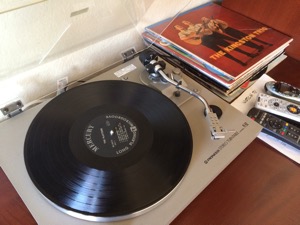
My turntable still plays records, but I got rid of all of them in favor of CDs. My neighbor still has some discs to spin.

My turntable still plays records, but I got rid of all of them in favor of CDs. My neighbor still has some discs to spin.

Gone are the days of turntables, memorable scratches on certain songs, beer-stained 8-track labels, the residual aroma of pot on double album jackets. They take up space, but no fear of loss due to battery failure of out-of-date operating systems.

Kids must be learning different things in school. Metaphors must be changing, too, with way fewer industrial references.

I don’t think talkative people sound like broken records, or those with disagreements are now on the same wave length.

Carhartt jeans are still inspected by people, including these three in a factory in Mexico. They add that personal touch.

Carhartt jeans are still inspected by people, including these three in a factory in Mexico. They add that personal touch.

I put on a new pair of jeans the other day and there were these paper inspection labels in the pockets.

We’re led to believe that everything is automated and made by high tech machines.

There are still some items that have the human touch, including my Carhartts made in Mexico.

Not only were my trousers inspected three times, but one of the inspectors saved on paper by changing their ID number using a Magic Marker.

I don’t know what I expected the future to be like by now. When I was a kid there was the Hanna Barbera cartoon sit-com “The Jetsons.”

The Jetsons TV family was the view of a typical 1960s family if portrayed in the distant future.

The Jetsons TV family was the view of a typical 1960s family if portrayed in the distant future.

The Jetsons traveled around in hover craft, their house was cleaned by a robot named Rosie. George worked at the Spacely Sprockets office, Jane puttered around the house, Judy was in high school and Elroy was in elementary school.

Middle class and All-American for the future as envisioned in the early 1960s, which was the same present portrayed in Leave it to Beaver.

For 99 percent of us, we did become mass society – most everyone has a TV, microwave oven, internal combustion engine car.

Carhartt is one of those companies that has purged it’s guilt with a “Made in the USA” line and also stuff made elsewhere. Regardless, it’s good to know there are humans involved in the manufacturing quality control.

There’s plenty of esoteria that goes into making smart refrigerators and smart coffee pots, but the basic purposes remain the same – keep food cold and water hot.

After the Star Ship Enterprise blew up, Picard was able to retrieve his family album as he took over the Star Fleet command.

After the Star Ship Enterprise blew up, Picard was able to retrieve his family album as he took over the Star Fleet command.

Remember “Star Trek Generations”, the movie set in the 25th century when the Star Ship Enterprise is destroyed? Captain Kirk turns the keys over to Jean Luc Picard. Picard manages to save his hard copy family album.

Some of the photos and papers dated back to the 18th century. If it was digitized, the electromagnetic pulse would have wiped the disc clean.

Hard copy isn’t safe from disaster. The library at Alexandria was the book repository for the world at that time and it was supposedly destroyed by a big fire – no copies left of any of that.

Grocery store plastic bags cost a dime in Boulder, Colorado. The hope is to reduce the amount of trash that will be preserved for future generations to find and learn about our culture.

Grocery store plastic bags cost a dime in Boulder, Colorado. The hope is to reduce the amount of trash that will be preserved for future generations to find and learn about our culture.

I tossed out the trash today. It was in a plastic bag. I always dump it out so the organics will deteriorate and not leave any evidence of my diet in the landfill.

My neighbors use those nuclear war-proof bags with the draw strings. Archaeologists and paleontologists of the future will have a pretty good idea about our 21st century culture and determine that we inhabitants revered our detritus as evidenced by the stockpiles of leftover food, old papers and various containers hidden in large altars excavated into hill sides surrounding urban areas.