
How Acronyms Shape Xenophobia in America

The Alphabet of Exclusion: The bureaucratic lexicon included “acronyms” to save time. In the history of American xenophobia, acronyms save face. Three-letter shorthand compresses the jagged edges of state power into something smooth, portable, and easy to swallow.

Today, we see ICE (Immigration and Customs Enforcement) and DHS (Department of Homeland Security) dominating the headlines.
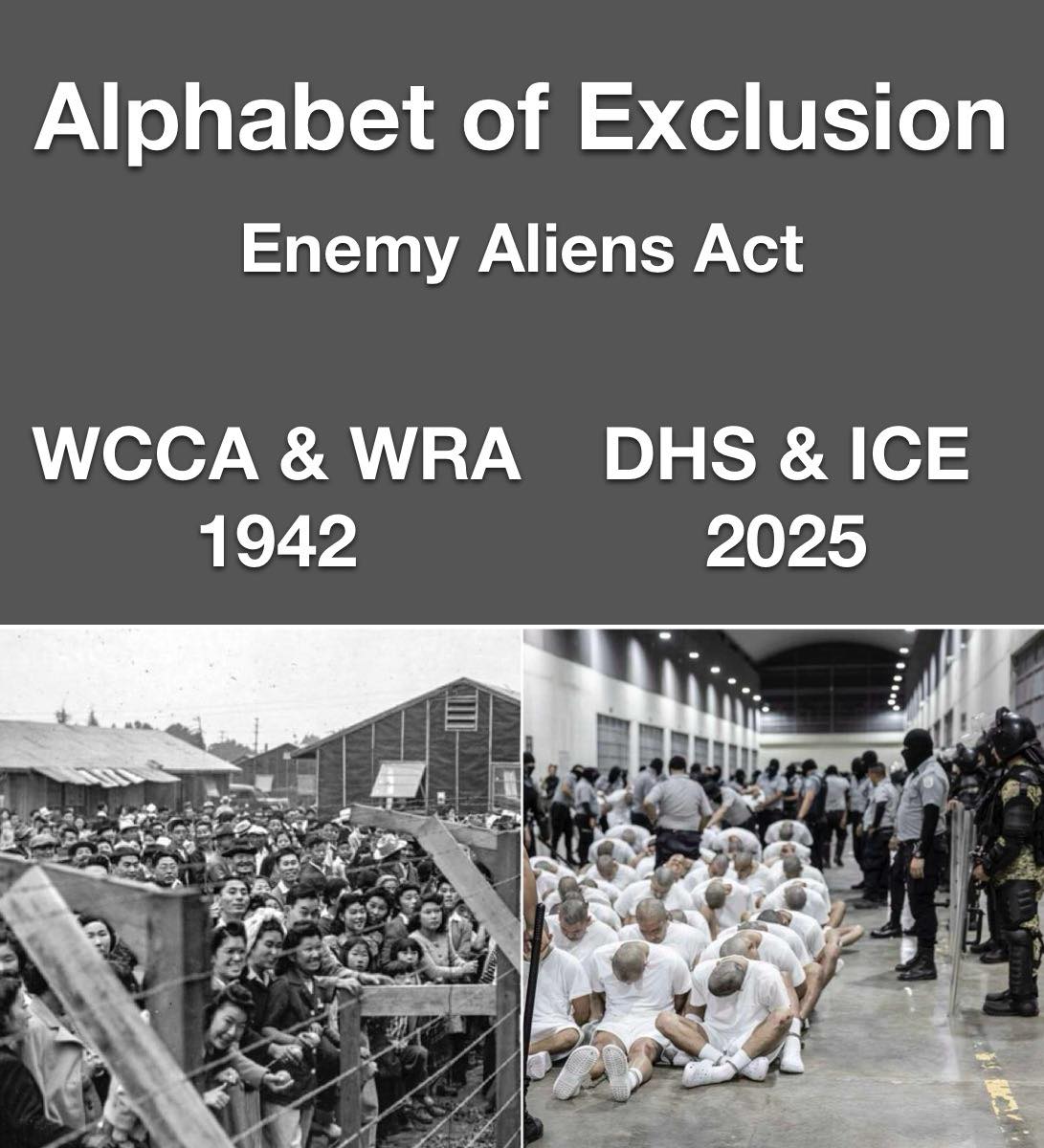
These acronyms are the latest entries in a century-long glossary of exclusion.

Our Long Memory of Othering: Linguistic distancing is an ingrained feature of American domestic and foreign policy.

The names change, but the grammar of “the outsider” remains consistent.

• The Precedent – The Chinese Exclusion Act (1882): Before the era of modern acronyms, this was the first significant law that restricted immigration based on a specific race.

The Act codified the idea that certain people wouldn’t assimilate, establishing a legal basis for the federal government to exclude anyone deemed a threat to the nation’s homogeneity.

• The Prototype – EO (Executive Order) 9066 (1942): Eighty-four years ago, on February 19, 1942, the ink dried on EO 9066. With a stroke of a pen, FDR (Franklin Delano Roosevelt) authorized a military action and birthed a new “alphabet soup” of exclusion.

The WCCA (Wartime Civil Control Administration) and the WRA (War Relocation Authority) were established as wartime agencies for prison management.

By World War II, the language had become clinical. EO 9066 did not mention Japanese people or any specific ethnic group.


Instead, it authorized the Secretary of War to define “military areas” from which “any or all persons” could be excluded, a neutral phrase that allowed the WCCA and the WRA (War Relocation Authority) to operate with stoic efficiency.

By the time the public learned to say these new initials, 125,000 Japanese Americans had been rounded up from the West Coast, and filed away under the euphemistic labels of “evacuees” in “relocation centers.”

• The Modern Pivot – 9/11 and the Muslim Ban: The 21st-century xenophobia found its shorthand in the wake of 9/11. We saw the DHS implement NSEERS (National Security Entry-Exit Registration System), which targeted men from predominantly Muslim countries.

Later, the “Muslim Ban” (EO 13769) echoed the 1942 rationale and used the national security blanket to cover the profiling of a specific faith.

• The Present – ICE and the DHS Deportation Machine: Currently, the conversation centers on ICE and the DHS’s overly aggressive deportation tactics.

A three-letter enforcement agency reduced the complexity of migration and the history of Latin American labor by stripping away human dignity.

History suggests that when we stop using names and start using initials, take actions, and hold beliefs we’d rather not hold to account.

The WRA and WCCA have been abolished, replaced by DHS and ICE.

The letters changed, and digital databases replaced the paper files.

The underlying belief that certain populations must be registered, monitored, and managed for the safety of the collective “us” remains the durable dark side of the American grand experiment.

Lessons from Meathead: Fighting Prejudice in America

I grew up in Wyoming in the 1960s when Superman’s American Way was pounded in my head the moment I popped out of the womb. You know, “faster than a speeding bullet, richer is better than poorer, acceptance by assimilation, and fighting for truth, justice, and the American Way?”

In the 70s, I realized that I was surrounded by adults who rarely questioned the subtle bigotry woven into everyday conversation. That was when “All in the Family” was the rage on network TV. I watched Rob Reiner as Meathead, punching toe-to-toe with Archie Bunker about prejudice and Nixon’s politics.

Meathead and Archie changed me.

It was the first time I saw someone on TV or in real life defend fairness against ignorance.

Two worlds had collided.  Reiner’s calm conviction made his moral convictions feel achievable.

“All in the Family” proved that challenging racism and standing up for every kind of person, regardless of their circumstances, reinvented the American Way toward Superman’s reimagined American Dream. Seeing Meathead versus Archie made me realize some people refused to accept hate as normal.

I decided to be one of them.

With all the murder and mayhem happening in the world today, it seems that we’ve forgotten that kindness belongs at the heart of every political choice.

Thank you, Rob Reiner. You inspired me to make movies and write books that raise awareness about social change.

I can handle the truth.

← Back

Thank you for your response. ✨

‘Beyond Heart Mountain’ book and movie are for sale

Featured

Buy Beyond Heart Mountain memoir published by Winter Goose Publishing. It is available as a printed book and ebook. Signed copies can be purchased from the author. The book was released February 27th. That week coincided with the 80th anniversary of President Roosevelt’s signing of Executive Order 9066 that sent 120,000 Japanese to 10 war relocation camps, that included Heart Mountain in northwest Wyoming.

Beyond Heart Mountain book and related are now for sale.

Remember to download the Beyond Heart Mountain promotional information booklet.

Boulder Community Media (BCM) produced a documentary that aired on PBS that aired in December 2021. The Nishigawa Neighborhood is a coffee table book that will soon be released.

During World War II, Cheyenne native Alan O’Hashi’s family avoided life in internment camps such as Heart Mountain.

As a Baby Boomer, Alan documents the overt and quiet racism pervasive in Wyoming and throughout the United States during and following World War II. He relates his experiences to current violence towards Asians and the issue of civility within society.

The backdrop to Alan’s account is the history of the once vibrant Japanese community in the 400 and 500 blocks of West 17th Street in the downtown area of my hometown, Cheyenne, Wyoming.

*****

“My grandmother and grandfather Ohashi and their large family lived in worked in that neighborhood where I spent quite a bit of time between elementary and high school. Having been away from Cheyenne for many years, I stashed those two blocks in the back of my mind until I learned that two classmates of mine were planning to build a housing development at 509 W. 17th St. The biggest obstacle was obtaining permission to tear down an old building. It was the last structure in the Japanese neighborhood. It was the site of a rooming house operated by Mrs. Yoshio Shuto.”

Buy the Beyond Heart Mountain movie

Buy the Beyond Heart Mountain DVD is mainly about the West 17th Street Japanese community history and a general overview of Executive Order 9066 that President Franklin Roosevelt signed that relocated 120,000 Japanese into 10 internment camps, including Heart Mountain in northwest Wyoming.

I interviewed four childhood friends for the documentary. Robert Walters formerly worked at the City Cafe. He still lives in Cheyenne, where he practices law.

Terie Miyamoto and her family-owned Baker’s Bar. It was the only racially-integrated bar in Cheyenne at the time. She now lives in the Denver Metro area.

Brian Matsuyama now lives in Seattle, Washington. He resided in Cheyenne during his childhood. His family owned the California Fish Market. Carol Lou Kishiyama-Hough is in Cheyenne. She and her family purchased the Fish Market from the Matsuyamas.

Buy the Nishigawa Neighborhood coffee table book. It’s a 11 x 8.5-inch hard-cover coffee table book with over 100 color, black and white images of the neighborhood. Signed copies are available from thanks author.

Nishigawa Neighborhood coming soon

Mrs. Shuto’s tenants were mainly Japanese residents who made their way to Cheyenne. She later opened the City Cafe across the street which became a gathering place for the Japanese in town.

My grandmother was a cook at the City Cafe. Next door, my grandfather was the third owner of a pool hall.

Whenever we went out to eat, the restaurant of choice was the City Cafe. It was a gathering place for the Japanese in Cheyenne. My friends enlisted me to do a cultural and historical survey of the Japanese residents who lived and worked there from the 1920s through the 1970s.

Buy a Beyond Heart Mountain cap are also available. They are low-profile baseball-style hats. Select Beyond Heart Mountain from the dropdown menu.

The logo is an adapted version of the Wyoming state flag. One size fits most.