
Silicon Prairie: Episode 1
Alan O’Hashi, here. I’m a Wyoming native, having grown up in Cheyenne. I have a new American Outlands podcast called “Silicon Prairie” about the data center land rush in the Rocky Mountain West, although these monstrosities are popping up anywhere there’s vacant rural land.
My family moved to Laramie while I was a sophomore at Hastings College in Nebraska. Upon graduation, I had no job skills and sat out the post-Vietnam War recession in grad school at the University of Wyoming. I ended up taking a job with the city administration of Gillette, in northeast Wyoming.
There, I had my first experience with an economic boom cycle.
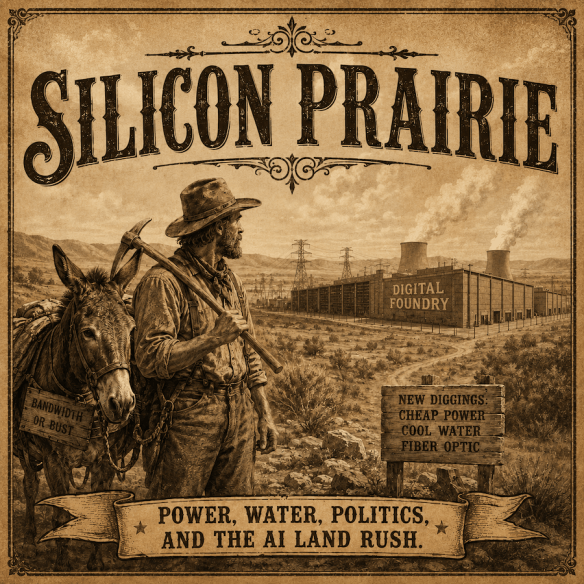
Economic booms and busts are as much a part of the Rocky Mountain West as dust storms, pickup trucks, and someone insisting this year’s growth “will be different.” The newest growth explosion thundering across the region and the nation isn’t gold or fossil fuel extraction. It’s what I call digital foundries that crunch cryptocurrency transactions, stream high-speed video content, and feed the ever-growing brain of Artificial Intelligence, otherwise known as AI.
In this five-part series, I’ll draw on my experience watching rural communities grapple with energy-driven growth spurts.
I’ll look at what happens when gigantic Digital Foundries arrive in places built for cattle, coal mines, or low-stress living, and suddenly require enormous amounts of electricity, water, land, and infrastructure.
Along with the promises of jobs and tax revenue come less glamorous realities: the constant hum of cooling fans, industrial-scale backup generators, and massive warehouse-like buildings rising from open prairie or ranchland. What looks like “the future” in a corporate brochure can feel very different when it’s humming outside your back fence at 2 a.m.
Beneath the big promises from digital economy backers, boom-and-bust questions arise: Who gets the water? Who pays for the power? And who’s left holding the bag when the boom cycle ends?
I took my first job in the Powder River Basin at the onset of the coal boom. I remember driving from Laramie to Gillette, sight unseen, after surviving the Big Thompson Flood, and dropping out of grad school to take my first job with the city government in 1977.
When I drove into town, my first stop was 611 Kendrick Street, where I crammed into the light green, one-bathroom house I shared with four other guys. The water from the tap smelled like rotten eggs, with crud floating in it.
That was just the beginning.
Welcome to what sociologists call the “Gillette Syndrome.” Too many people swarmed into a small town. The locals quit their jobs as EMTs, store clerks, and school teachers to become dump truck drivers and coal shovel operators. The rapidly expanding population outstripped the community’s ability to keep pace.
The place was nutty back then: lots of guys with a lot of money and nowhere to spend it. Then-mayor Mike Enzi dubbed Gillette the “Energy Capitol of the Nation.” Mike went on to represent Wyoming in the U.S. Senate.
I was part of a team of carpetbagging young professionals who moved to town to increase the town’s capacity to handle growth. As much as we wanted to make things better, we all became part of the juggernaut.
Governor Ed Herschler famously coined the phrase “Growth on Our Terms.” Easygoing Gov. Ed had no problem wrestling with the fossil fuels industry. In 1975, he signed the Industrial Siting Act into law and established the Industrial Siting Council (ISC). At the time, the ISC was primarily concerned with permitting energy projects and their effects on communities.
Although many viewed Gillette and Campbell County as politically conservative strongholds for a long time, these two entities took the lead in the state by developing a comprehensive regional plan early on. Gillette had approved one of the state’s strongest zoning codes.
Gillette officials worked hand in glove with the ISC as coal mines moved through the permitting process. Companies were required to construct employee housing, pay for public street improvements, and expand parkland.
Campbell County and Wyoming have reaped the benefits of the fossil fuel boom over the past 50 years and are now seeking the next commodity. As with every other bust cycle, some folks pack up, and others will stay. This time around, what are the positive benefits and negative consequences of the digital Foundry migration coming of age in Wyoming?
What can communities learn from the coal boom? Microsoft, Meta, and Google want to expand across the vast, open prairies. The digital data boom won’t require as much labor as the fossil fuels industry, but an integrated approach can address other issues, such as electricity and water consumption, and excessive noise.
With Digital Foundries as core resources rather than standalone entities, and a little foresight, Digital Foundries can anchor successful mixed-use environments.
The commercial offices and research and development facilities surrounding the Digital Foundry are a natural fit for businesses that rely on its high-speed connectivity and computational power. This creates an innovation hub where technology companies, startups, and research institutions can collocate, fostering collaboration.
What will digital foundry communities look like? The residential component of a Digital Foundry would appeal to residents who work in the tech hub, value an efficient lifestyle, and enjoy unique amenities, including year-round fresh produce from on-site greenhouses. The development would have a distinct identity, driven by its technological and ecological integration.
A Digital Foundry is a building and a foundational anchor that can generate energy and heat and provide high-speed internet connectivity. By designing with a city planning mindset, potential problems such as the need for a steady source of power, heat, cooling, and mitigating sound pollution are reimagined as opportunities that create resilient and economically vibrant communities.
I visited a data center east of Cheyenne. Inside, I saw the behemoth brains of the futuristic cloud flashing and sending information into cyberspace. The sprawling industrial machine consumed staggering amounts of electricity and water just to keep the digital world spinning.
Digital Foundries across the West are arriving faster than the infrastructure needed to support them. In Silicon Prairie Episode Two, I’ll explore what happens when the digital economy competes with towns, farms, and families for electricity.
In episode 2, I’ll explore what happens when digital-foundry carpetbaggers roll into town promising jobs and economic development, and the community isn’t prepared to handle the sudden growth.

