Unknown's avatar

About Alan O’Hashi, Whole Brain Thinker

I’ve been involved with community journalism since 1968 when I wrote for my junior school paper, the "Tumbleweed," through high school and college and then wrote for the "Wyoming State Journal." I put aside my newspaper pen and began Boulder Community Media in 2005. There wasn’t much community journalism opportunity, so I resurrected my writing career as a screenwriter. My first short screenplay, “Stardust”, won an award in the 2005 Denver Screenwriting Center contest. I've made a number of movies over the years. Filmmaking is time-consuming, labor and equipment intensive. I recently changed my workflow to first write a book and make a movie based on that content. - Electric Vehicle Anxiety and Advice - This is a memoir travelogue of three trips covering 2,600 EV miles around Wyoming (2022) - Beyond Heart Mountain - Winter Goose Publishers released my memoir in February (2022) - The Zen of Writing with Confidence and Imperfection - This is a book recounting how luck planed into my signing a book deal after a 15-minute pitch meeting. (2020) - True Stories of an Aging Baby Boomer - War stories about living in a cohousing and lessons others can learn when starting their communities (2021) - Beyond Sand Creek - About Arapaho tribal efforts to repatriate land in Colorado (PBS - TBA) - Beyond Heart Mountain - Based on my memoir about my childhood in Cheyenne facing overt and subtle racism toward the Japanese following World War II (PBS - 2021) - New Deal Artist Public Art Legacy - About artists who created work in Wyoming during the Great Depression (PBS - 2018) - Mahjong and the West - SAG indie feature which premiered at the semi-important Woodstock Film Festival (2014) Over the years, I’ve produced directed, filmed and/or edited several short movies, “Running Horses” (Runner Up – Wyoming Short Film Contest), “On the Trail: Jack Kerouac in Cheyenne” (Lowell Celebrates Kerouac Festival, Top 10 Wyoming Short Film Contest), “Gold Digger” (Boulder Asian Film Festival), “Adobo” (Boulder International Film Festival), “A Little Bit of Discipline” (Rosebud Film Series), and two feature length documentaries “Your Neighbor’s Child” (Wyoming PBS and Rocky Mountain PBS), and “Serotonin Rising” (American Film Market, Vail Film Festival). He also directed and produced the award winning stage play “Webster Street Blues” by my childhood friend Warren Kubota. Boulder Community Media is a non-profit production company dedicated to democratzing media in all their forms - large and small screens, printed page and stage by providing sustainable and community-based content. I mostly work with community-based media producers, organizations, and socially-responsible businesses to develop their content via – the written word, electronic and new media, the visual and performing arts in a culturally competent manner – I’m what’s commonly called a niche TV and movie producer. Along with all this is plying my forte’ – fund development through grant writing, sponsorship nurturing and event planning.

Part I – Diverse Personalities: Do you proactively de-escalate disruptive people in your life?

arcosanti wide

CoHoUSA is presenting a retreat September 30 – October 2 called “Dealing with Diverse Personalities in Community” at Arcosanti. Click on the image to learn more about  and register for the $175.00 retreat.

Arcosanti, Arizona is an experimental community between Flagstaff and Phoenix built by a bunch of volunteers to demonstrate sustainable alternatives to urban sprawl and also the home to a bronze bell foundry.

September 30 to October 3 Arcosanti will be the location for another experiment of sorts as the venue for the “Dealing with Diverse Personalities in Community” retreat facilitated by Jeff Zucker and myself.

“De-escalation”has been in the news lately.

Our retreat will concentrate on how individuals within communities of any ilk can learn some skills about exploring the roots of their own diverse personalities, how to become aware of others’ diverse personality traits and how to de-escalate when personalities clash.

Regardless of your community – be it in your workplace, neighborhood, place of worship – all members have personalities and quirks that are annoying or pleasant with endless traits in between.

chickendifficultAt some point in our lives, we’ve likely been annoyed by someone or been the one annoying someone else.

I live in a cohousing community which, I’m finding, is an endless source of personality war stories. I spend a very small part of my time in cohousing mode, but last week, there was a huge blow up over a festering issue.

The unsuspecting target wandered by and offered salutations only to be greeted by one retaliator who had multi-faceted tension building up in him about the ‘inciting incident’ before letting loose with a vulgar verbal barrage. A second retaliator exchanged a few words and walked away.

There were a number of bystanders, a couple intervened from a far, but that didn’t slow him down. Another in the conversation tried to establish a boundary to no avail and left.

While sympathetic to the retaliator’s perspective on the issue, I didn’t gang up on the target, but rather, intervened and sent the target on his way which ended the incident. I later went up and talked to him about what happened, and what I viewed as elements of the perfect storm that triggered it.

This was an eye opener for me. I had heard about community skirmishes, but this is the first time I’d been in the middle of one.  The timing and circumstances that brought a particular group of otherwise good people together in one spot, caused this violent outburst and what might have prevented it would be a good case study.

I can see how a routine traffic stop can escalate into gunfire between cop and citizen.

The skirmish ended, but the issues and hard feelings continue to be proverbial elephants in the room, ignored until the next perfect storm brews.

It’s impossible to predict when personality flareups will happen and the Arcosanti retreat will provide participants with three workshops purveyed by hands-on activities, visual and audio presentations about how to be better prepared for community social emergencies. Each participant will also develop an action plan to take with them.

Not only will it be information packed, but the weekend is guaranteed to provide a good time for all!

Father’s Day memories – 2016

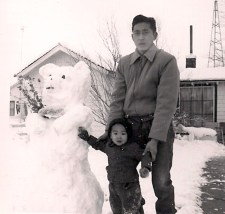
alan dad

This is a picture of my dad and me in front of our first house on 10th Street in Cheyenne, Wyoming.

My father died in 2003 and my two grandfathers passed on many years before that. I haven’t mused about them, really.

All three were sports fans, but none followed professional basketball. The NBA championship series ends on Fathers’ Day Sunday with the Warriors hosting the Cavaliers in Oakland. It’s been a weird series with a lot of blow-outs and down to game seven. I was too short for the organized game but could hold my own in pick up games. I’ve played enough to know the rules.

My paternal Grandfather Ohashi was named Toichi but known as George. I don’t know exactly when he emigrated from Japan, but it was in the later part of the 19th century. He and apparently one or more of his siblings initially ended up in Alaska.

There’s a photograph of him hustling pool someplace in Alaska, which I will dig out. When I was on a trip with the Presbyterian Church to Sitka, Alaska we took a ferry boat ride up and down the panhandle.

While in Ketchikan, my pal Sam Allen from Cody and I came upon a sign that said OHASHI Candy and Tobacco. Turns out it was owned by my Great Uncle, my grandfather’s brother who’s name escapes me. I was later at a conference in Seattle a few years ago and ran into an Ohashi who was a niece and a distant cousin of mine.
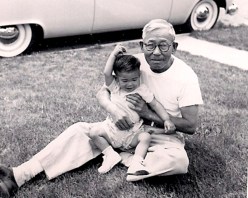
alan grandpa ohashi

This picture of my Grandfather Ohashi and me must have been taken on Fathers’ Day in front of his house.

His game of choice was billiards. I’m pretty sure he was a nine ball hustler. He owned a billiard hall on 17th Street in downtown Cheyenne. I inherited one of the pool tables when the pool hall closed and had it set up for many years, but when I moved to Colorado, I donated it to the Ethete Senior Citizen Center. I kept an old 9 ball from the rack. He was going blind, but could still hit a few trick bank shots.

My cousin Matthew from Salt Lake and his dad got me started collecting and scrounging up old stuff. He had an old Phillip Morris poster in there that I wanted, but couldn’t get freed up. I’ve wondered what happened to that item.

My Grandfather Ohashi in his downtown Cheyenne pool hall.

He developed diabetes later in life and couldn’t see very well. His spectator sport of choise was boxing. Back in the 1960s, there were only black and white TV sets. My dad and I would visit him and watch the Friday night fights. Boxers wore white or black trunks and it was easy for him to follow. He got pretty sick and moved into our house on 10th Street for a period of time. I was young but had to give up my room to my grandfather. I can’t remember how long he stayed, but he let me give him his insulin injections in his thigh. That was back in the day of those huge needles

He and my grandmother owned the Highway Cafe on the south Greeley Highway. He originally was a truck farmer from Brush, Colorado. He drove around an old panel truck and picked up produce from the farmers and sold them from a fruit and vegetable stand next to the cafe. It was nestled against a bluff where Interstate 80 would eventually pass and they moved a few blocks north. The Building still stands today, but is now a tobacco store.

Every once in a while I got the job of writing the new $1.00 specials on the black board. It was stuff like hamburger steak, egg foo yong, liver and onions. There was a Filipino guy named Carl who came in every night and had a half order of the special. The famous Cheyenne fisher Hank Okamoto came in from time to time showing off his string of fish. He was a fishing buddy of my Uncle Rich.

My dad brought my sister and I one at a time and together to the cafe. He cooked there after he finished working and after dinner. I don’t know this for fact, but it seemed to me the state Public Health Department put them out of business. The last straw was when the state required a vestibule to be constructed between the public area and the restroom, of which there was only one and not two.
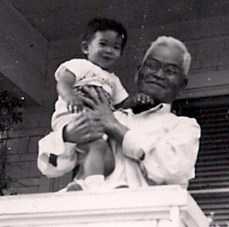
alan grandpa sakata

Likely the same Fathers’ Day visit around town. This is my Grandfather Sakata and me on the porch of their home on Capitol Avenue.

My maternal Grandfather Sakata’s name was Jusaburo, but he was called Joe. There’s a Cheyenne history book that has the details about his emigration to Wyoming, but off the top of my head he came from Japan, then returned for my grand mother who was 20 years younger. What I mostly remember is he worked for the Burlington Railroad.

Back then it was known as the Chicago, Burlington & Quincy Railroad and he was the section foreman at a place called Orpha, Wyoming. Orpha still is there and located across the road from the Fetterman Battlefield State Historic Site.

I went to visit a few years ago. Many years before when I was in junior high school, my sister and I spent the summer irrigating on the Shinmori beet farm near there. We took a tour of Orpha which included the one room school, and the house where my mom’s family lived. Only the foundation remained when I last went to look around.

He and my grandmother moved to Cheyenne. The Burlington Northern railroad used to run through Cheyenne so I’m thinking he retired there. My mom, who was the youngest of the three kids ended up in Cheyenne, too. In his retirement, he became a gardener and did yard work for some of the neighbors around their home on Capitol Avenue a couple blocks from the state capitol building. That was one of the resupply depots for soda pop that we sold along the Cheyenne Frontier Days parades.

plains dairy trip

This is a neighborhood field trip to tour the Plains Dairy in Cheyenne. Notice I’m wearing the Yankees cap given to me by my grandfather.

His game of choice was baseball. My aunt lived in Washington DC and he watched the Senators play. He went to New York and brought me back a cap and pennant from Yankee Stadium in 1960. That was the first year I followed baseball. I’ll never be a Pittsburgh Pirates fan having watched Bill Mazeroski homer in game seven to beat the Yankees.

When I graduated from high school, I remember getting his wise words in Japanese – but my grandmother reminded him that I only understood English and got the speech again in English.

Language was a barrier keeping me from knowing my grandparents better. Of course, after World War II, that was a big wake up call for the Japanese American community. Even in the middle of nowhere Wyoming, there wasn’t any Japanese spoken around the house nor were Sansei kids – third generation – expected to learn Japanese nor retain much if anything about the culture, although I still prefer rice with my eggs. The 20th Street Cafe run by a Japanese family serves eggs with rice upon request.

I learned to be self sufficient, but that may have been because I was boy. When I graduated from college, I lived at home for a couple years while in grad school at the University of Wyoming. I think my parents appreciated that.

My father, Frank, worked his entire career at the Coca Cola plant in Cheyenne eventually becoming the manager. When the business was sold to the Ludwig family in Laramie, my dad was a part of the deal. When I was a sophomore in college and away in Hastings at the time, they moved over the hill to Laramie. I remember going to that house on Downey Street for the first time. I didn’t know which drawer the forks were kept.

When I was in high school, I worked summers for him at the Coke plant. That was an eye opener for me seeing him in a capacity other than at home. He managed like it was a basketball team – he was a pretty good basketball player on the Cheyenne High School team. He didn’t ask anyone to do anything he didn’t do himself. That’s one thing that rubbed off on me. I remember him chewing out a guy, who came to work drunk and eventually was fired. It was the first time I’d heard him swear like a sailor.

One time I was caught shoplifting and the condition of my staying out of the system was fessing up to my dad and he calling the store manager. That was by far the hardest thing I’ve had to do in my 63 years. I don’t think he told my mom about it.

He was always supportive of my activities, even later in life. When I played in the Fremont County orchestra, there was a performance in Laramie. Very few people were in the audience, but my dad was there. He pushed me to get my Cub Scout activities completed. I made it up to getting my “Bear” patch before Pack 113 folded. He was asked to take over, but it wasn’t his thing.
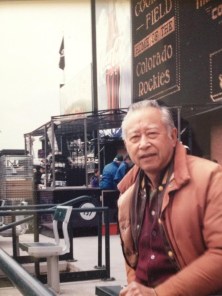
fb dad coors

My dad at the first game at Coors Field in 1995

My dad was quite athletic. He was a sports fan and knew the rules to a lot of games. He had good hand eye coordination and was a pretty good bowler, golfer and basketball player with a wicked hook shot. We played softball together in church league and had a good change up which fooled hitters even in slow pitch. As a spectator, he and my mom were avid Wyoming Cowboy fans.

He also was a Yankees fan. One of his Coca Cola plant truck drivers was a guy named Tony Rizzuto, who was related to  former Yankees 2nd baseman Phil Rizzuto. A bunch of guys from work a a guy from the air base all loaded up in my dad’s car and drove down to Denver to watch the Denver Bears play an exhibition game against the Yankees. That was in 1964. It was great seeing Mantle and Maris play. 

Definitely a big life highlight.

Coors Field opened in 1995, the replacement Rockies played the replacement Yankees in the strike-shortened year. I took my dad to watch that game. The Rockies made the playoffs that year too.

What about the name O’Hashi?

Nobody knows for sure, but the O’H is attributed to a school administrator who changed his name when he found out his birthday was March 17th – St. Patrick’s Day. Only my dad and his youngest brother Jake used the anglicized spelling.

I haven’t figured out what I’m going to do on Sunday, probably not watch the basketball game since my team, the Celtics, aren’t playing. The only tie I have to the Dubs is back in 1980 when the Warriors traded Robert Parrish and top draft pick Kevin McHale to Boston. The Celtics won the championship in 1981.

How I ended up a Celtics fan is another story, but it dates back to when Wyoming center Leon Clark was drafted by Boston in 1966.

I doubt I’ll watch the game. I did pick up a ball at the Sports Authority liquidation sale and may shoot a few hoops someplace.

Whatever your Fathers’ Day memories are, I hope they are fond ones.

My sport of the day? I’m going fishing if the water isn’t too high.
 

Anti-gun groups should take a page from the anti-abortion playbook


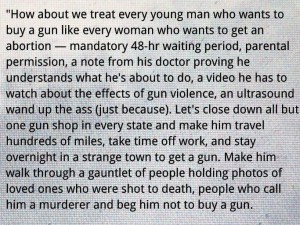
abortion like guns

My friend Barbara May posted this meme shortly after the Umqua Community College in Oregon was shot up by a guy with 14 weapons in his apartment. Click on the image for a video about changing the gun culture.

The Orlando Massacre that left 49 dead and 53 wounded reminded me of a conversation some of my classmates and I had at our Hastings College homecoming reunion with Denny Storer, one of our political science professors.

That was in October 2015 – a week after an Oregon community college was shot up by another twisted buy with 14 weapons in his apartment.

Rather than more laws, how can the culture change? There’s an excellent scenario that played out in Manhattan with huge impact. Watch it here.

After our reunion reminiscence about a poli-sci class we took on the road in Washington DC during January 1973, I had an ‘aha’ moment about the nexus between the 2nd and 14th amendments.

The anti-gun crowd should take a page out of the anti-abortion playbook.

The latter is pretty good about dancing around the constitution while the former doesn’t have a clue about how to create cultural restrictions around curbing gun sales.

The above meme is tongue-in-cheek, but tells the practical truth. There are 300,000,000 firearms circulating. I agree that laws won’t help much.

Changing the culture is the most practical and the anti-abortion crowd proves that.

Hastings College operates on a 3-1-3 class schedule that, in 1973, included a one month Interim trip on a long bus ride to Washington DC for a month-long “Legislators and Lobbyist” field trip class.

The advertised highlight of the class and trip to DC was the inauguration of President Nixon. An unadvertised highlight was the death of President Johnson. We stood in line and viewe his casket laying in state under the capitol rotunda.

What’s the upshot of this story?

Less heralded at the time, Denny reminded us about the SCOTUS Roe v. Wade decision handed down on January 22, 1973. The ruling held that women have a right to privacy and protected from unwarranted searches and seizures.
The anti-abortion lobby figured out that passing restrictive laws do stand up to constitutional scrutiny. They work hard to change the culture through grassroots efforts and pass laws that don’t ban abortions, but put roadblocks in the way coupled with strategic public shaming.

The pro-gun lobby says that more laws won’t keep guns out of the hands of anybody, let alone crazy people. I have to agree with that.

All crazy people have access to guns, but not all crazy people have access to mental health services. I don’t know how politicians decide who’s the craziest, though.

After the killing spree in Orlando, I had to quit watching TV because it was all about blood, guts (interviews with wounded people in their hospital beds) and superficial grieving (candles, flowers and facebook posts).

While I’m sure that everyone personally deals with events like this differently, there doesn’t seem to be very many who are interested in creating the social and cultural change necessary to end gun violence.

Compared to anti-abortion groups, the anti-gun groups don’t show the same long-term passion that would include protesting in the rights-of-way of gun stores or on the public sidewalks in front of the Walton family homes; grooming like-minded people to appointed and elected public offices.

I’m thinking that in the final analysis, the only people who get involved in trying to change things are those families and friends directly affected by the death or injury to a friend or loved one. That’s a pretty small number of people and they can’t do it alone.

If 27 school kids murdered in their school, nine South Carolina church goers shot in the back, another nine gunned down in a community college classroom, don’t move legislators into action, I’m not very optimistic that 49 more people killed in a night club will provide much impetus for legislative action.

Here are three ideas to help change the culture without having to take anyone’s guns away since that’s not happening any time soon:

Short Term: Feel the Bern and Get Out The Vote – The biggest thing Bernie Sanders can keep doing is get more of his supporters to keep registering more voters. The disgruntled Bernie supporters – of which I am one – need to get on with life and not support any kind of third party or write in candidate for president. If that’s too difficult, at least vote for Democrats down the ticket.

Medium Term: Limited Martial Law (for lack of another term) – I heard Matt Lauer talking about this on the Today Show this morning. He asked a Homeland Security guy about what it would take to “asterisk” civil rights laws so that anyone like the Orlando terrorist could continue to be watched and monitored even if there is no probable cause determined. I think the only time limited martial law was approved was by the antebellum Congress at the time of Abraham Lincoln.

Long Term: Reapportionment – the US Census will be completed in 2020 and new US congressional districts will be drawn as well as state legislative districts. The SCOTUS ruled in favor of independent redistricting commissions taking gerrymandering out of the political process. This is an opportune time to create competitive state and national districts.

I’m willing to participate in the short and long term ideas i’ve proposed. It will be interesting to see if there’s the political will to limit civil liberties, but I would think Donald Trump would be all over that one.

The black ops probably have the authority to do this, in any event.