Part IV – Random oddities

I said I wasn’t going to write much more about my recovery, but It’s been about a year since I started to hit the wall. No energy, lost a lot of weight. I even missed the Mighty Fudge Halloween party last year. As an update, I’ve noticed a few things lately.

My hair has become quite curly. My across the sidewalk, Jim, got a haircut, which is notice that I need a haircut. I usually let it grow out fairly long, but this time around it was curling up in the back.

I asked Riley at Super Cuts about it. She said that there isn’t any hard evidence, but she has noticed that as mens hair gets grayer, it starts to get curlier. She said, in her experience, it’s mostly men and fewer women.

The acupuncture needles 'surround the dragonn'. Notice my newly curly hair.

The acupuncture needles ‘surround the dragon’. Notice my newly curly hair.

Since I’ve been getting acupuncture every week, I thought it might have something to do with that. Apparently straight hair follicles are different that curly hair follicles and they get changed.

The last few weeks, my acupuncture treatments have included electro-stimulation for the Post Shingles Neuralgia that’s settled into my left scalp and forehead.

In my case, e-stim entails an acupuncture treatment known as “surrounding the dragon.” Needles are placed into several points – generally on the crest of my head, on the eyebrow, in the cheek and in the temple-area. Micro-power leads are attached and low current flows through.

My observation, only two of the acupuncture practitioners I’ve seen are okay with the e-stim treatment. All the others see it as “non-traditional” which couldn’t be farther from the truth. Electric fish were used by the ancient Egyptians to relieve pain. The fish were placed over wounds. In the 1930s, acupuncturists in China refined the treatment using the acupuncture needles and batteries.

It is more of a Dr. Frankenstein – type treatment, but seems to work pretty well for me, but maybe the e-stim caused my hair to curl like when getting too close to lightning causes hair to stand on end.

This is an xray taken in December 2013 when I was first admitted to the hospital.

This is an xray taken in December 2013 when I was first admitted to the hospital.

The acupuncture clinic has also been aggressively treating my Interstitial Pneumonia. According to acupuncture theory, the lungs and skin are closely related since they are both exposed to the air.

I’ve been going to acupuncture since May. I don’t know if the treatments have been doing any good, but there has been remarkable improvement based on my x-rays.

The first one was taken when I was first transported to the Intensive Care Unit before the biopsy surgery in December.

My tissue samples were sent to the University of Michigan and turned out I had some exotic but “everyday bug” that was controlled by archaic sulfa drugs. Back in the early days of HIV, it was the type of pneumonia AIDS patients would get.

This was taken in July 2014 after I started acupuncture in May and hardly on any medication.

This was taken in July 2014 after I started acupuncture in May and hardly on any medication.

This was taken in July 2014 after I started acupuncture in May and hardly on any medication.

I was on high doses of steroids when I was carried from the hospital to the ambulance and taken to rehab. When I was released and a little stronger, the March xray showed pretty good improvement.

I was then tapered off the steroids and began acupuncture.

The second X-ray was taken later this summer after I’ve had 12 weeks of acupuncture treatments. My lung doctor continues to be amazed at my recovery, since in his view at the time, I should be dead by now.

Inspired by Steven Seagal: Going all out with acupuncture

I’ve been out on my own for about eight weeks now and have largely been looking inward and assessing how to start cutting back on the event production and focusing on movie making. Meanwhile, I’ve been trying acupuncture a couple times a week at the Southwest Acupuncture College here in Boulder. I’ve been balancing out the western medical approach that patched me up with longer term eastern medicine tune ups.

Steven Seagal treated himself with acupuncture and moxa in "Hard to Kill".

Steven Seagal treated himself with acupuncture and moxa in “Hard to Kill”.

I’m no stranger to acupuncture. I went to Dr. Pao at the Ruseto Center here for many years but decided to try some others. He keeps track of his patients by first name in a big notebook. Dr. Pao treated my gout many years ago. That was a case of successfully blending western and eastern medicine.

The SWAC has students supervised by instructors develop a treatment for me. It’s sort of like going to get inexpensive haircuts at a beauty school. I’ve had a couple hack jobs there – the worst haircut was when I was talked into getting one at a beauty school in Mexico. So far, the acupuncture school has been a good experience.

I’ve been going a couple times a week for my interstitial pneumonia and the post herpes neuralgia.

The treatment room at the Ruseto Center is a little more spartan than those at the Southwest Acupuncture College.

The treatment room at the Ruseto Center is a little more spartan than those at the Southwest Acupuncture College.

So far, I’ve settled in with Ted and his students – who specialize in Japanese traditions and Michael and his students who specialize in Chinese traditions. I think mixing perspectives is a good way to see what works the best. Like Western medicine, acupuncture is a balancing act with a good share of “hit and miss.”

There’s a Steven Seagal movie called “Hard to Kill”. He comes back from being in a coma and uses acupuncture to make himself better to take on the bad the bad guys. Today, I had the moxabustion treatment, similar to what Seagal administered to himself in the movie.

The moxa is a paper stick infused with various herbs. It was stuck onto the acupuncture needle and heats up the needle and then the skin supposedly moving around my qi. That’s the Chinese approach.

I had the moxa directly burning on my back. The swelling in my ankes and hands went down after the treatment.

I had the moxa directly burning on my back. The swelling in my ankes and hands went down after the treatment.

The guy who is learning the Japanese tradition lit the moxa and applied it directly to the skin on my back. They also used a Vietnamese technique called guasha which entails scraping my skin with a baby food jar lid. It is a more general treatment, but the swelling in my ankles and wrists went down shortly thereafter.

My liver and gall bladder temperature needed to be lowered and my large intestine pulse needed to be balanced out. I have noticed a couple positive changes in my digestion from that direct moxa treatment.

I’m convinced that western medicine is pretty good at dealing with acute issues like helping broken bones heal and otherwise patching things up, but not so good at systemic tune ups.

My western docs don’t think anything is interrelated, whereas my eastern docs think everything is interrelated. For instance, eastern docs say that the lungs and skin are related in that the lungs are the internal organs closest to the “outside” because of air that gets inhaled.

That makes sense to me, but how it all works makes no sense at all.

Memorial Day 2014

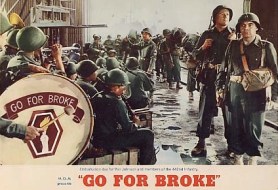
goforbrokeRlc4

My uncles George Sakata, Rich Ohashi and Vince Ichiyasu were members of the 442nd Regimental Combat Team during World War II. My uncle Jake O’Hashi also served in the U.S. Army.

CHEYENNE, WYOMING – Memorial Day is upon us again. When I was a kid growing up here, the Japanese had a big carry-in picnic at Holliday Park – lots of sushi rolls, teriyaki chicken, abalone salad – bento box type food.

I think because this park is closest to the cemetery is why we all met there.

A couple of the guys brought over boxes and boxes of flowers. After the first go-around of food, everyone went over to the Lakeview Cemetery and placed flowers on all the Japanese graves. There wasn’t much reminiscing that happened, but that was just the “inscrutable oriental” way.

The Cheyenne Japanese community used to be fairly large. One of the gathering places was the original City Cafe that was run by Mrs. Shuto and later her son, Tommy.

lakeview japanese head stone

The Japanese grave markers in the Lakeview Cemetery. I grew up in the Cheyenne suburb Cole Addition Japanese Ghetto – Nakano, Kubota, Shiba and O’Hashi. It was also the home for several Greek families – Contos, Hatanales, Talagan, Mears.

Occasionally, my family went over there to watch black and white samurai movies and listen to music. In the back, the old guys were screaming and hollering during their rousing game of hanafuda (flower cards) that also involved slapping the thick cardboard cards on the table.

I didn’t learn how to play. I don’t think the rules were written down anywhere back in those days and I didn’t understand Japanese if someone tried to explain them to me.

Since I happened to be in town, I stopped over and decorated my family’s graves at the cemetery east of Cheyenne on the old Lincoln Highway. I overshot the exit on I-80 and on my loop back on Highway 30, I picked up a hitchhiker named Chris. He’s from Huntington, WV home of Marshall University (“We Are Marshall”).

suspect hynds building

Cheyenne’s finest questioning a guy sitting in front of the Hynds Building during the Cheyenne International Film Festival earlier this week.

He was walking back to the Pioneer Hotel from his job as an irrigator on a farm east of town. it would have been at least a 10 mile walk for him. He was lamenting about the high cost of housing in Cheyenne and that the Pioneer meets the needs of men who have jobs, but can’t afford traditional housing. He’s only been in Cheyenne for a month, but has noticed the discrimination that the Pioneer Hotel residents and homeless people face.

Anyway, he went to the cemetery with me while I decorated the family graves before I dropped him off at the Pioneer. He was looking forward to the extra day off after toiling in the fields. As we passed a convoy of Wyoming Highway Patrol, we both agreed that Memorial Day weekend would be a good time to be on foot and not driving a car.

When the Issei and Nisei generations started passing on, the Memorial Day picnic tradition pretty much stopped.

I was curious about Memorial Day and how it all got started. This is what wikipedia has to say about it:

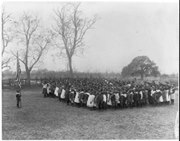
original memorial day

The first Memorial Day was observed in Charleston, SC after the Civil War.

“The first widely publicized observance of a Memorial Day-type observance after the Civil War was in Charleston, South Carolina, on May 1, 1865. During the war, Union soldiers who were prisoners of war had been held at the Charleston Race Course; at least 257 Union prisoners died there and were hastily buried in unmarked graves.

Together with teachers and missionaries, black residents of Charleston organized a May Day ceremony in 1865, which was covered by the New York Tribune and other national papers. The freedmen cleaned up and landscaped the burial ground, building an enclosure and an arch labeled,

“Martyrs of the Race Course.” Nearly ten thousand people, mostly freedmen, gathered on May 1 to commemorate the war dead. Involved were about 3,000 school children newly enrolled in freedmen’s schools, mutual aid societies, Union troops, black ministers, and white northern missionaries. Most brought flowers to lay on the burial field. Today the site is used as Hampton Park. Years later, the celebration would come to be called the “First Decoration Day” in the North.”

I don’t think Memorial Day became “official” until several years later when the politicians took hold of it.

ohashi grave

I haven’t been in town for Memorial Day. I stopped by today and decorated my parent’s and the other family head stones.

There are still a number of Sansei in Cheyenne and the surrounding area, including my sister, some cousins and myself. My uncles and aunts and the Nisei generation don’t have the energy they once had for organizing any big activities like the Memorial Day picnic. Every year, I think about getting in touch with everyone, but I don’t have the energy for it either.

This has nothing to do with honoring fallen soldiers – but from here on out, Memorial Day will be memorable for me since my autoimmune health issues began shortly after I finished the Bolder Boulder 10K foot race in 2013. I’ll let you know how the acupuncture treatments are going.

Bolder Boulder Update

alan bolder boulder 2014

I ended up taking a swig of O2 coming up the final Folsom Hill, I’m still swelled up from the steroids.

After tapering off the steroids for my lung problem, It was an unknown adventure. My neighbor Henry drove my across the sidewalk neighbor, Jim and I to the Bolder Boulder start point. I was unsure how far I could make it since my practice is NOT to train for races. The only training has been occupational therapy walking from place to place.

When I dug my shoes out of the closet last night, I noticed that they didn’t quite fit right. My ankles are still swelled up for some unknown reason and the muscle mass of my feet was also less than it was – nothing a little cinching up won’t fix The last time I trained for a race was for a 5K in Lander many years ago, when I twisted an ankle. Since then, I’ve just taken my lumps during the real thing.

After making it past the first mile, I felt like I’d be able to finish the course. My practice is to film snippets of each of the  bands along the route, which slows down my pace a bit. My mission is to complete the race before the mop-up crew gets out there.

I’m 15 pounds lighter than I have been, but carried my oxygen bottle just in case. I did have to take a few boosted breaths midway up the Folsom Hill on the way into the stadium. Other than that, I felt pretty good. In the past, even last year, around the 5K mark, the interior part of my knee joint would begin to hurt and my thighs would cramp, but not today. I attribute that to eating better and not having so much crud built up in my scrawny muscles.