The #HandsUpDontShoot and #ICantBreathe protestors in Ferguson and NYC need closers

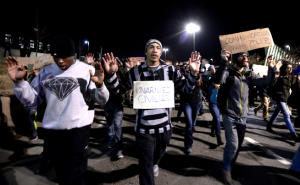
Protesters block highway 36 in Boulder, Colorado (Photo by the Daily Camera)

Protesters block highway 36 in Boulder, Colorado (Photo by the Daily Camera)

Even in white bread Boulder, Colorado protesters and marchers have taken it to the streets in the wake of the cop killings of  Michael Brown and Eric Garner.

The problem?

There’s no end game.

The movement needs closers.

Lot’s of glittering generalities scrawled on the placards – “justice for Mike”, “hands up don’t shoot”, “no killler cops” … reactionary causes like this are heavy on feel good symbolism and light on outcomes. I had high hopes for the Occupy movement, too, but that fizzled.

Already the Brown – Garner furor has waned and CNN is on to the next news cycle about CIA torture and vicious Sony emails.

That’s too bad.

About the only outlet that oppressed people have to get their larger communities to take notice is through civil and criminal disobedience and the willingness to accept the consequences of jail time and injury. The topic moved race relations to the forefront, though, even forcing Walmart to pull a TV ad.

Race riots around the country in 1964 got the nation's attention.

Race riots around the country in 1964 got the nation’s attention.

Back in the 1960s, segregation was a state’s right and legal in the south. The bus boycotts and restaurant sit-ins initially were not that successful but the 1964 riots in Chicago, Harlem and Philadelphia got people’s attention. This was also the first time there was TV news coverage.

What was the end game?

The Civil Rights Act of 1964.

This is the 50th anniversary of that legislation which passed by landslides in both houses of the US Congress and Lyndon Johnson’s trademark legislation carrying the torch for John Kennedy.

Half a century later, the country has come along way in civil rights, but what’s next?

No laws will change societal attitudes. That’s work that each person has to do on their own by looking in the mirror and deciding what kind of person they want to be; ask what values do they want to instill in their children and the children of others; decide if its work losing friends over their new outlooks.

It’s hard work.

You ask anyone and nobody will say they are “racist”.

Their rationales?

“I don’t burn churches and wear white hoods.” I hear people say they are “color blind.”

If a person is truly “color blind” they should be willing to give up personal power to people of color and oppressed people.

The work goes way beyond exchanging pleasantries at church coffees – although that’s a good start for some people.

the notion of cultural competency rears its head from time to time. It wouldn’t surprise me if there aren’t funds for this in the big federal program Obama unveiled the other day that would give money to local police departments to buy body cameras.  The problem is, cultural competency work is generally an “add-on” and not really integrated into the day to day workings. It gets discussed on a reactionary basis.

Quality of law enforcement can be plotted on a bell curve. On one end are bad cops that lie, cheat, steal and kill and on the other end are great cops that save kitties from trees, help a stranded motorist. We just need a whole bunch of okay cops, good cops. In fact, the vast majority are okay and good trying to make a living for themselves and their families. Here’s an example of a cop who caught a woman shoplifting eggs.

What were his choices?

He could embarrass her by a shake down in the store. He could call in back-up; He could see if the store wanted to press charges; or he could pay for the eggs, which he did. I doubt he got any special training to do this, but rather he’s just a nice guy.

I also think that people and police generally want to change their attitudes towards inclusion, but there aren’t any readily accessible day to day tools, other than, maybe through a church or nonprofit, or workplace.

Law enforcement officers catch the brunt of frustration and I think that’s just part of the job. If the protest groups get their acts together, what might be some outcomes for them for them to pursue? This is largely a local issue and here are a few ideas:

  • Work with civil service commissions police unions and citizen police boards to change their police testing and recruitment procedures to include stronger cultural competency indicators. Police departments do pretty good jobs weeding out the real bad apples and tests tend to be standardized and don’t control for race relations.
  • Work with police academies and college law enforcement departments to add additional training and classroom instruction about how to verbally deescalate situations. These two citizen killings escalated from stealing cigars and selling cigarettes to death. That’s a problem. There are companies that provide training about this. Deescalation classes should be a part of criminal justice college / university curricula and not just on the job workshops.
  • Develop new leadership by recruiting members for the city parks board, planning commission, housing committees. Once emerging leaders gain experience they can make runs for the city council or other elected offices.

About all the nationwide peaceful and violent demonstrations have accomplished is ruining the lives of two cops – Daniel Pantaleo and Darren Wilson – who will soon fade into oblivion and sold some newspapers. That’s not a very good return on investment, if you ask me.

The activists from the 1960s and 70s  are tired and there wasn’t much, if any, thought about passing on organizing skills to others. It’s a young people’s world now and there must be at least a few closers out in the fray …
On grand juries, police image problems and revolution

There’s been quiwizard id peasantste a bit of buzz in the popular media about the recent work of grand juries that found little probable cause to indict police officers who killed citizens in the line of duty.

I have a unique perspective on this having served on a grand jury in a past life.

Grand juries haven’t changed much over the centuries. The idea is to provide yet another control on the government for community members to keep over zealous government lawyers in check. That didn’t happen in Ferguson and Staten Island. The grand jury system was used for political cover.

In the US, the justice system is set up to favor citizens, you know – “innocent until proven guilty.” The burden of proof is on the government to provide probable cause that a crime exists. Grand juries make “probable cause” determinations via indictment. The jury that I sat, heard its fair share of bad cases, in fact, we kept asking for more information if it was lacking. We would advise the cops and county attorney what they needed to bring to strengthen their case. In Ferguson and Staten Island, those juries were actually tasked – by design or by accident, I don’t know – to find the defendants innocent.

How the DA handled these grand jury cases has been fodder for talking heads on both ends of the political spectrum. But the bottom line is, based on the information provided to them, grand jurors had no choice but to find no probable cause. In Staten Island and Ferguson, the jurors were given the prosecution’s evidence and the defense evidence. All that evidence is compounded by the great leeway cops have to show force.

Cops maim and kill people every day but these two cases in particular have raised public awareness about how the citizenry has allowed law enforcement to run amok. I get the public safety thing, but for instance, the other day I was in Loveland at the museum taking a peak at the Georgia O’Keeffe exhibit there. Sitting on a bench was a guy – probably a homeless guy – being questioned by one cop, then another pulled up and joined in on the fun. He was standing back watching.

What went through my mind was, why were they hassling this guy?  The police show of force in this case was placing their hands on their hips in front of their weapons. The next show of force move would have been unsnapping their holsters.

Cops have an image problem.

It’s been happening for generations. It’s pretty much a thankless job – the cop’s job description is looking for trouble and they have guns. I’d be scared, too, if I had to walk into a domestic violence situation not knowing how wigged out a guy might be. (70 to 80 percent of DV perps are men).

Being scared and that coupled with preconceived fears about people based on stereotypes add to the over reaction.  I’m pretty sure the vast majority of cops don’t find themselves in life and death situations or try to avoid them.

Public agencies do the best they can to screen out the real bad apples through psychological screening, but those tests need to to be tweaked to better control for attitudes about race, gender identity.

Sure, Brown was stealing cigars and Garner selling loose cigarettes and not collecting taxes, but the problem is with cops escalating minor criminal situations that end up with people shot.

I hope there continue to be public outcries about this from kids marching out of school, and communities taking it to the streets. It’s the only way for victims to get the political system to react.

It’s going to take awhile for things to change. Keep in mind it’s only been 150 years since Lincoln’s emancipation proclamation and 50 years since the Civil Rights Act was signed into law.

There’s no turning back.

Apres campaign 2014 – Democrats are their own worst enemies

The 2014 midterm election cycle was a Throwback Tuesday to the 2004 presidential election. The Democrats blew it with their finesse game. The Republicans are way better at campaigning using brute force and they have way more money.

The big quasi surprise was Mark Udall getting defeated. I think it was largely at his own hand. His ground game wasn’t good enough. I think if he had Obama come to Denver and Boulder, that would have been positive for him. Nationally, the Democrats bought into the Republican anti-Obama story. Instead of staying home, president should have been been out there making whistle stops. I don’t care what anyone says, when the President of the US shows up it is a BFD!

I wait until election day to turn in my vote.

I wait until election day to turn in my vote.

Udall let Gardner position his campaign as single issue, which it wasn’t. Udall originally was elected because of his name. He was a political carpetbagger when he first came to Boulder and ran for the U.S. House. Gardner did a good job framing Udall as a career politician with no heart.

Gardner played the “grandma card” and the “tractor card” which both played well. Plus he was only joshing about his past personhood and anti-women views. Udall didn’t show any emotion. He followed the Gore and Kerry playbooks which talked about data and votes and little about his story and about his vision for the country.

I did see a blog post on his campaign site about he being a kid in the southwest, but that didn’t do anything to show him “in touch” with Colorado. Same thing happened to John Kerry when Bush shaped the election and Kerry just followed along with being painted as a rich kid and a swift boater.

The Bill and Hillary road show helped close the gap for Udall, but their star power is fading. The Clintons showed up in Kentucky many times but Alison Grimes was thoroughly stomped there by Mitch McConnell.

Hickenlooper eked one out. That should be a wake up call. He tried to keep everyone happy, but ended up ticking everyone off. Bob Beauprez playing the “mass murderer” card backfired. I imagine families in Colorado would feel safer without edible marijuana on the market. Both Ways Bob is a sore loser and likely waiting for a recount before conceding.

Meanwhile, in Wyoming – the Republicans held serve. The state legislature lost a Democrat in Lee Filer from Cheyenne, but picked up Charles Pelky from Laramie. I think the mix in the Wyoming State House of Representatives is 51 Red to 9 Blue. The Democratic Party in Wyoming doesn’t have a candidate grooming strategy.  The Tea Party, on the other hand, is good at making all politics local by getting their folks to get on city parks boards and planning commissions. In Jefferson County, Colorado, the conservative majority members of the school board were sneaked in there and nobody really noticed until the recent flap over the move towards revisionist history.

In Wyoming, if a person gets elected to any office or appointed to a board or commission, it makes them immediately available for other elective offices. Former Mayor turned State Legislator Del McOmie at out a cycle or two and was elected as mayor Lander for his second go-around. He’s thoughtful and asks around before he makes decisions. When I worked for him it was during some tough times – the U.S. Steel mine closed, the bottom dropped out of the uranium market just after the 3-Mile Island meltdown. I hope he resurfaces in statewide politics again.

Senate Majority Leader In Waiting Mitch McConnell has been talking big after the election and it doesn’t sound like there will be any conciliatory offers. He’s already threatening Obama on immigration reform. Working with the Democrats, according to McConnell, is total capitulation to the GOP perspective. I don’t see much happening in the next two years. I doubt there will be any meaningful conference committees unless a bunch of Republicans break ranks – which is what happened when the Democrats had control of both houses. Not much got done when congress was controlled by Democrats either.

I can hardly wait until 2016 to hear about why Hillary and Jeb both are too extreme for my own good.