Views from Inside the Windshielf: Police Ride-Along Insights

I mark the arrival of fall with a tradition that’s become as much a part of my seasonal routine as watching the leaves turn between Nederland and Ward: my annual ride-along with a Boulder police officer.
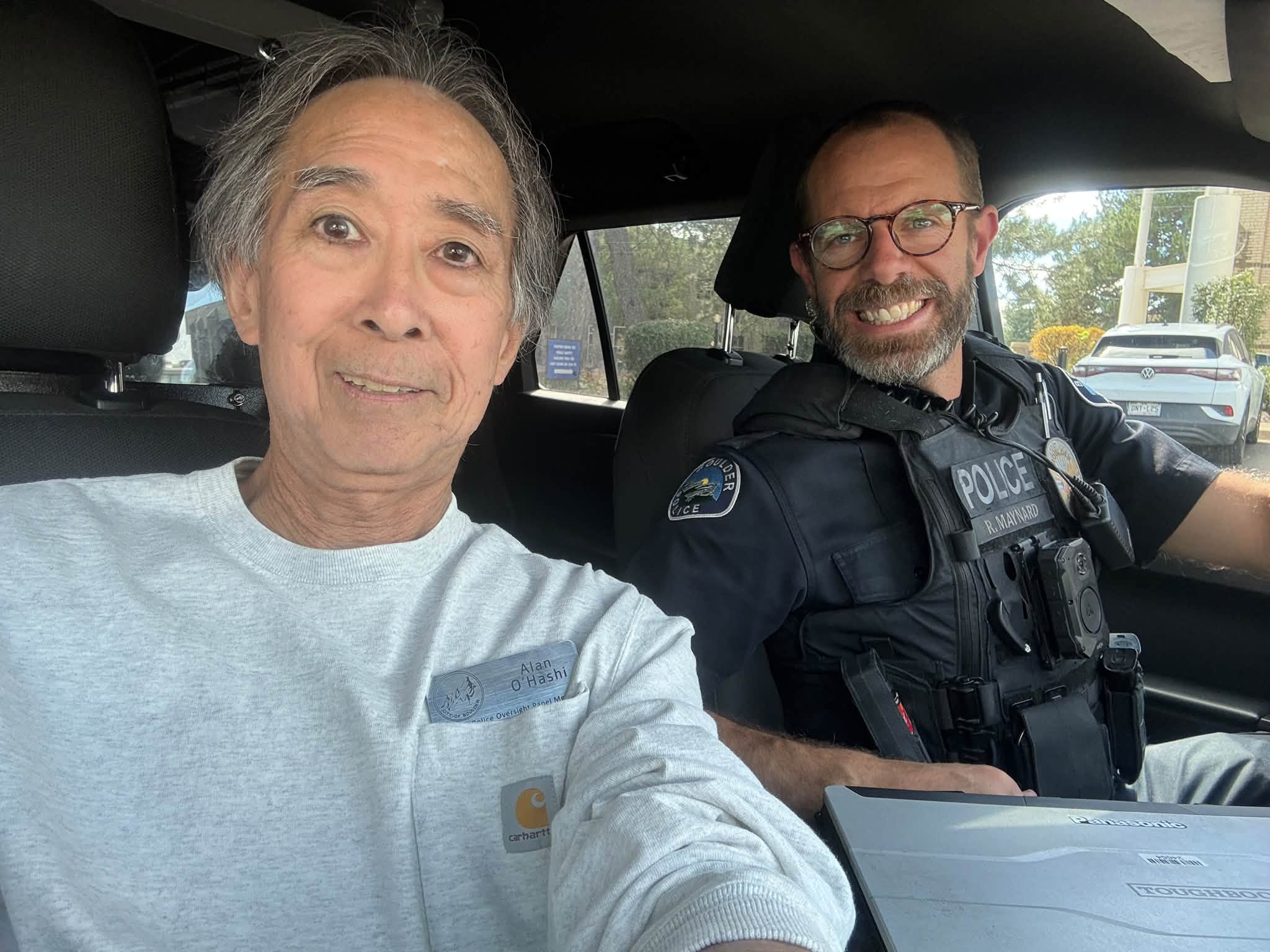
A selfie of two men inside a police vehicle; one man is wearing a gray sweatshirt and smiling, while the police officer, wearing a uniform and glasses, smiles next to him.

As a member of the City of Boulder Police Oversight Panel (BPOP), I’m required to check out our fair city from the passenger seat of a Boulder police cruiser. The city manager appoints 11 panel members, including two college students.

Many of you don’t live in Boulder. I suggest you check out police oversight in your community. They’re all different.

Fortunately, I’ve never had to experience Boulder from the backseat of a police cruiser. My only recent encounter with law enforcement involved a photo radar van that caught me speeding on Glenwood Avenue between 28th and 30th streets. I’d much rather be caught by radar and mailed a ticket than be stopped for half an hour or more.

I suspect most Boulder residents, including myself, have had little, if any, direct contact with law enforcement. A ride-along offers a glimpse into a world most of us know only through news reports, TV dramas, or the occasional flashing lights in our rearview mirrors.
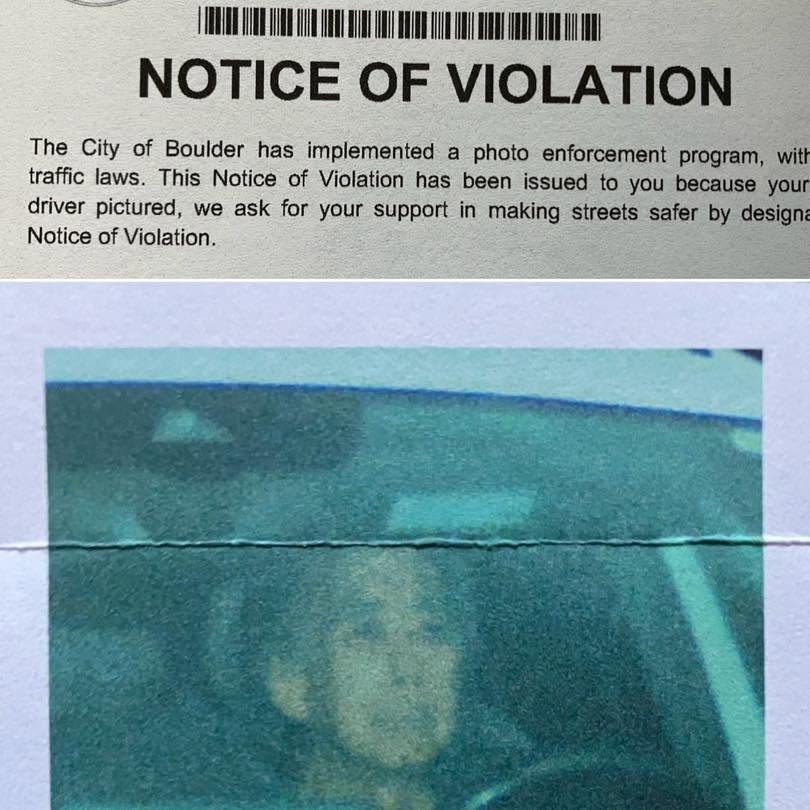
Notice of Violation issued by the City of Boulder, detailing a photo enforcement program for traffic laws, featuring an image of a driver.

This year, I signed up for Watch 1, the early-morning shift. At 6 a.m., I met Sgt. Faber in the police station lobby before roll call. I knew the drill. The shift begins with the Pledge of Allegiance, followed by general information and updates. This morning’s training covered probable cause and searches, a subject I found interesting.

The legal boundaries governing police searches have evolved considerably since the days of Eliot Ness and his “Untouchables,” the handpicked Prohibition agents who stormed into warehouses with Tommy guns, chasing after Al Capone and his bootlegged whiskey.

Today, probable cause, constitutional protections, and search rules shape what officers can and cannot do in the field. For example, there’s a big difference between an open baggie and a sealed one. A traffic stop for a busted taillight does not mean an officer can look in the trunk unless the driver gives permission.

The training reminded me that police work involves much more than responding to calls. Officers must understand the law and make decisions within its boundaries, often under difficult circumstances.
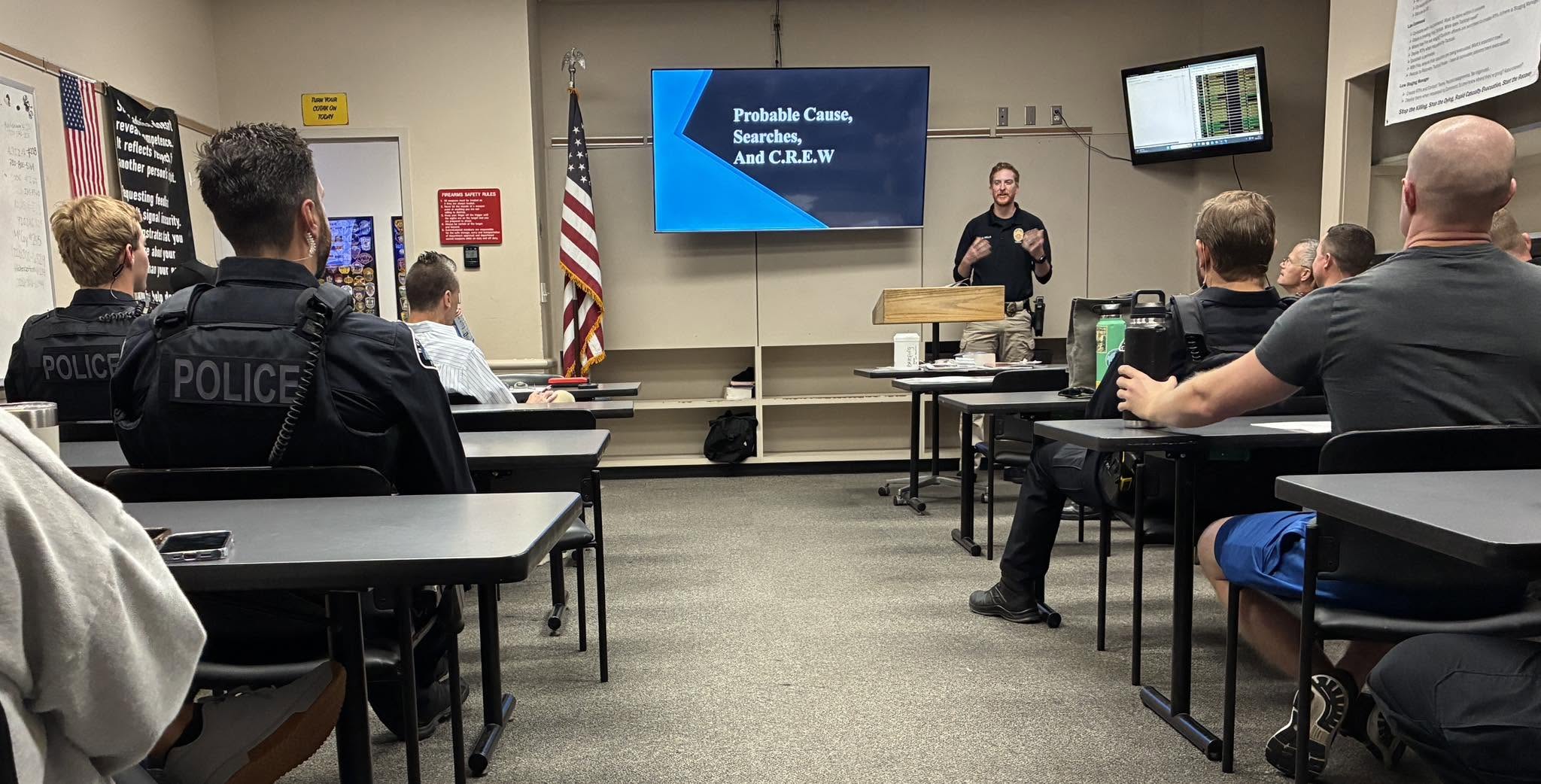
A police training session in a classroom setting, with officers seated at tables and a speaker presenting concepts related to probable cause and searches on a screen.

On my first ride-along two years ago on Watch 2, with recall at 2:00 p.m., we responded to a noise complaint at dusk. Before getting out of the car, the officer looked up the hours the city code allows loud noise. It turned out the contractor was well within the limits. The officer told him a neighbor complained and that he should use his better judgment and finish by the designated hour.

Later that night, several officers on duty drove around looking for a citizen who had wandered away. It turned out we searched the wrong area. What if caregivers of people prone to getting lost wore an AirTag necklace or bracelet? That would help find lost loved ones.

A friendly cat’s been snooping around my neighborhood with an AirTag on its collar. The same idea would work with pets.
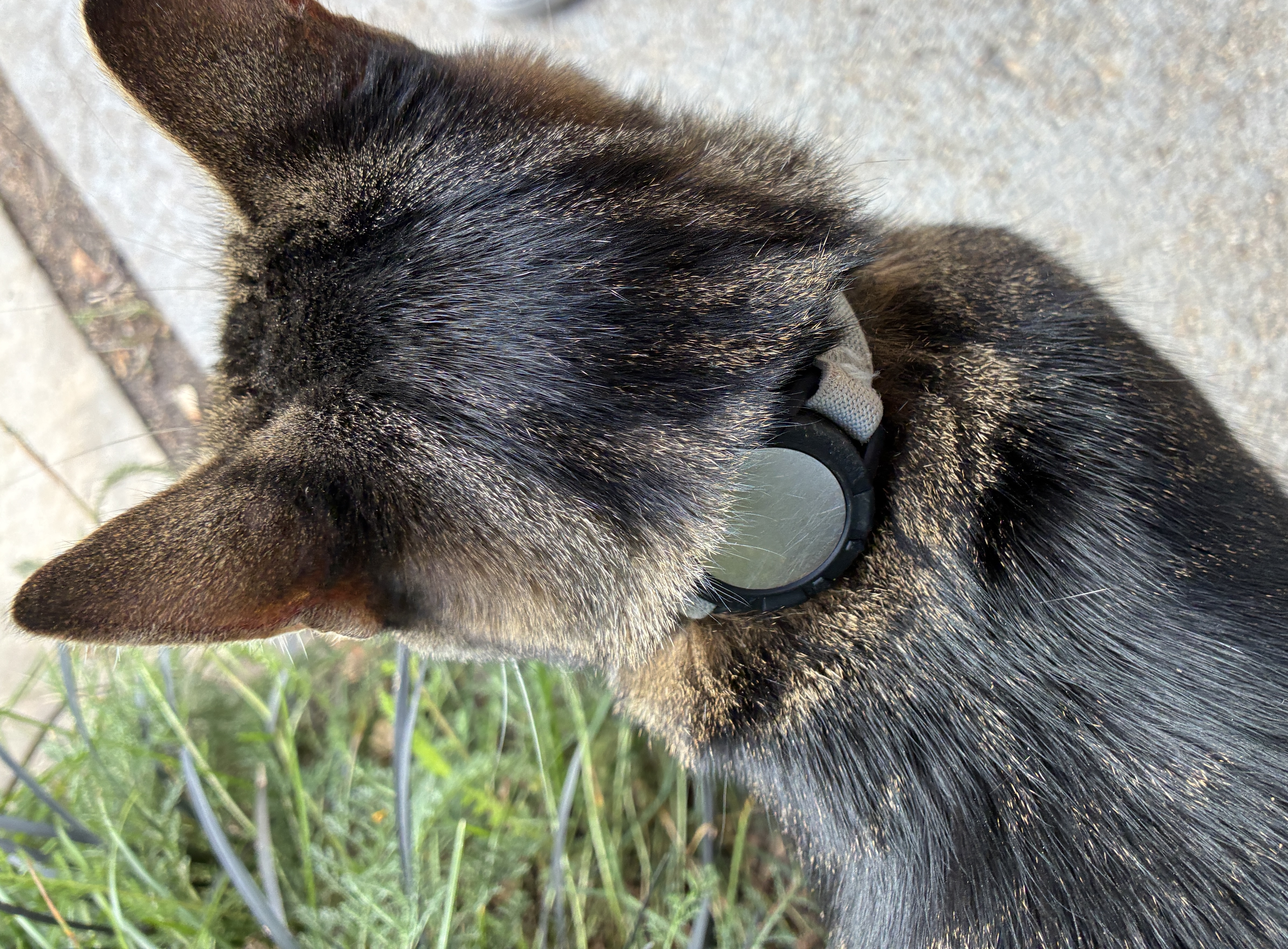
Close-up view of a cat's back and head, showing its ears and a collar with a round tag.

For this year’s ride, I joined Officer Russ Maynard, a 17-year department veteran on Watch 1. Compared to my previous two ride-alongs, not much happened during our shift, which, I suppose, is a good thing.

No dramatic confrontations.

We stopped to check out a report of someone sleeping in a stairwell. The person had already left. Later, we walked along Boulder Creek to investigate a report of four people causing a disturbance. They, too, had departed.

No arrests.

During my first ride-along two years ago, I observed a felony arrest earlier that day. Before we went in to pick up the suspect, the officer explained the level of force he would be using as a precaution. He cuffed the felon and a second responding officer took him to the county jail without incident. We went back to the PD and logged his belongings.

No high-speed chases.

Last year, during my second ride-along, also on Watch 1, after roll call, we got a call and zoomed out of the parking lot with lights flashing to check on a pickup truck that had knocked over a power line on Highway 93. That contact diverted traffic for several hours.

I appreciate the ride-alongs as a way to get to know patrol officers as people, rather than as the stereotypes we carry around, learned from TV shows and movies. Of course, police officers have their own stereotypes about oversight panels and Internal Affairs offices.

“Serpico,” about an Internal Affairs undercover whistleblower, comes to mind.
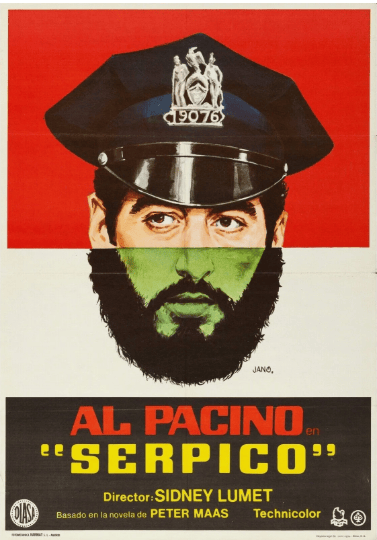
Movie poster for 'Serpico' featuring a split image of a police officer in a hat and a man with a beard. The text includes 'Al Pacino en "Serpico"' and credits for director Sidney Lumet.

A little time together in a cruiser helps both sides see beyond preconceived notions. The other is what citizens can do if they believe an officer crossed the line or deserves a commendation.

The city’s website provides a link to guide them through the complaint and commendation process. The flow chart looks more complicated than it is.

Generally, this is what happens after a citizen fills out the complaint form, or if you would like to commend an officer, contact Chief Redfearn. You can also call the Department at the non-emergency number, 303-441-3333

The Independent Police Monitor (IPM), who works out of the city manager’s office, reviews and classifies each submission. Once the police Professional Standards Unit (PSU) and the IPM have processed a case, BPOP may review it and recommend changes to the findings or disposition.

The Chief of Police retains final supervisory authority over the department’s employees.

This process provides accountability while recognizing the chief’s responsibility for managing the department.

The BPOP ride-alongs have been the most enlightening part of my tenure on the panel. Meetings and reports are no substitute for talking with officers, asking questions, and seeing a little of the world from their perspective.

The most useful lesson I’ve learned is the importance of showing up, listening, and understanding someone else’s job.

I enjoyed my time with Officer Maynard. We didn’t solve any crimes or make the evening news. That’s for Sgt. Hank Voight on “Chicago P.D.” and Capt. Olivia Benson on “Law & Order SVU.”

I already know how I’ll mark the arrival of another autumn, though. I’ll look forward to climbing into a police cruiser, buckling up, and seeing where the day takes me.

Maybe I’ll sign up for Watch 3 beginning at 2100 hours on a Saturday night during CU football season and after a big win over Northwestern, avenging the Buffalo’s 2026 loss in Evanston to the Wildcats.
The #HandsUpDontShoot and #ICantBreathe protestors in Ferguson and NYC need closers

Protesters block highway 36 in Boulder, Colorado (Photo by the Daily Camera)

Protesters block highway 36 in Boulder, Colorado (Photo by the Daily Camera)

Even in white bread Boulder, Colorado protesters and marchers have taken it to the streets in the wake of the cop killings of  Michael Brown and Eric Garner.

The problem?

There’s no end game.

The movement needs closers.

Lot’s of glittering generalities scrawled on the placards – “justice for Mike”, “hands up don’t shoot”, “no killler cops” … reactionary causes like this are heavy on feel good symbolism and light on outcomes. I had high hopes for the Occupy movement, too, but that fizzled.

Already the Brown – Garner furor has waned and CNN is on to the next news cycle about CIA torture and vicious Sony emails.

That’s too bad.

About the only outlet that oppressed people have to get their larger communities to take notice is through civil and criminal disobedience and the willingness to accept the consequences of jail time and injury. The topic moved race relations to the forefront, though, even forcing Walmart to pull a TV ad.

Race riots around the country in 1964 got the nation's attention.

Race riots around the country in 1964 got the nation’s attention.

Back in the 1960s, segregation was a state’s right and legal in the south. The bus boycotts and restaurant sit-ins initially were not that successful but the 1964 riots in Chicago, Harlem and Philadelphia got people’s attention. This was also the first time there was TV news coverage.

What was the end game?

The Civil Rights Act of 1964.

This is the 50th anniversary of that legislation which passed by landslides in both houses of the US Congress and Lyndon Johnson’s trademark legislation carrying the torch for John Kennedy.

Half a century later, the country has come along way in civil rights, but what’s next?

No laws will change societal attitudes. That’s work that each person has to do on their own by looking in the mirror and deciding what kind of person they want to be; ask what values do they want to instill in their children and the children of others; decide if its work losing friends over their new outlooks.

It’s hard work.

You ask anyone and nobody will say they are “racist”.

Their rationales?

“I don’t burn churches and wear white hoods.” I hear people say they are “color blind.”

If a person is truly “color blind” they should be willing to give up personal power to people of color and oppressed people.

The work goes way beyond exchanging pleasantries at church coffees – although that’s a good start for some people.

the notion of cultural competency rears its head from time to time. It wouldn’t surprise me if there aren’t funds for this in the big federal program Obama unveiled the other day that would give money to local police departments to buy body cameras.  The problem is, cultural competency work is generally an “add-on” and not really integrated into the day to day workings. It gets discussed on a reactionary basis.

Quality of law enforcement can be plotted on a bell curve. On one end are bad cops that lie, cheat, steal and kill and on the other end are great cops that save kitties from trees, help a stranded motorist. We just need a whole bunch of okay cops, good cops. In fact, the vast majority are okay and good trying to make a living for themselves and their families. Here’s an example of a cop who caught a woman shoplifting eggs.

What were his choices?

He could embarrass her by a shake down in the store. He could call in back-up; He could see if the store wanted to press charges; or he could pay for the eggs, which he did. I doubt he got any special training to do this, but rather he’s just a nice guy.

I also think that people and police generally want to change their attitudes towards inclusion, but there aren’t any readily accessible day to day tools, other than, maybe through a church or nonprofit, or workplace.

Law enforcement officers catch the brunt of frustration and I think that’s just part of the job. If the protest groups get their acts together, what might be some outcomes for them for them to pursue? This is largely a local issue and here are a few ideas:

  • Work with civil service commissions police unions and citizen police boards to change their police testing and recruitment procedures to include stronger cultural competency indicators. Police departments do pretty good jobs weeding out the real bad apples and tests tend to be standardized and don’t control for race relations.
  • Work with police academies and college law enforcement departments to add additional training and classroom instruction about how to verbally deescalate situations. These two citizen killings escalated from stealing cigars and selling cigarettes to death. That’s a problem. There are companies that provide training about this. Deescalation classes should be a part of criminal justice college / university curricula and not just on the job workshops.
  • Develop new leadership by recruiting members for the city parks board, planning commission, housing committees. Once emerging leaders gain experience they can make runs for the city council or other elected offices.

About all the nationwide peaceful and violent demonstrations have accomplished is ruining the lives of two cops – Daniel Pantaleo and Darren Wilson – who will soon fade into oblivion and sold some newspapers. That’s not a very good return on investment, if you ask me.

The activists from the 1960s and 70s  are tired and there wasn’t much, if any, thought about passing on organizing skills to others. It’s a young people’s world now and there must be at least a few closers out in the fray …