Cheyenne Frontier Days changes, but stays the same. This will be my 65th CFD. Wherever I am, I manage to stop by for at least a day.
The world needs more cowboys.
It’s been several years now since CFD expanded into an extra weekend added onto the “last full week of July.” It was controversial when that happened, CFD became more about profits.
The change amounted to an extra parade, a couple more shows and bull riding and three or four more days of tourists buying boots and hats.
There are huge crowds and kids selling ice cold soft drinks along the parade route.
Two CFD mainstays, the Hitching Post Inn was out of business for many years before it was torched and the Mayflower burned, came back and then went out for good. It’s now a sushi place of all things.

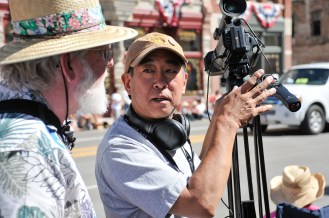
Bob Larue and yours truly filming Rose Garden at the CFD parade in front of Marv’s Pawnshop.
All businesses either make or break their year based on CFD trade. A new sandwich place called the Capitol Cuisine opened last week hoping for a big start.
The night show entertainment is taking over as the big draw these days. CFD numbers are up, not because of the rodeo, but because of the party atmosphere promoted during CFD. The standing room seats are the primo tickets and a party zone for young people who think hamburger comes from the grocery store.
The world needs more cowboys.
Back in the good old days, the popular shows were family acts like Doc and Festus from “Gunsmoke” and the chuck wagon races. They don’t do those anymore either due to liability issues.
Being a Cheyenne native, some people are surprised to learn that my family and I were city people and didn’t get much into the rodeo part of Frontier Days.
Despite that, I figure I’ve been through four, going on five phases in my CFD lifespan, not counting my very early years I chased pieces of candy in the street at the parade. That’s not allowed now.
Who picked up those plastic ducks from the water raceway at the carnival?
1. Parade Pop Sales – When I was in the fifth and sixth grades, one of my golfing pals, Pat Higgins, my sister Lori and cousin Matthew from Salt Lake City sold ice cold pop along the parade routes.
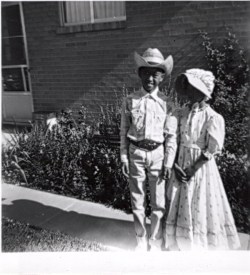
My sister and I getting ready to ride the hay wagon in the CFD parade.
Two months ahead of time was spent hoarding all the cheap off-brand sodas like Shurfine and Cragmont to sell at each of the three parades that wound through downtown Cheyenne. Although my dad worked for Coca Cola, we opted for a higher profit margin. Besides, thirsty parade goers weren’t interested in brands, they just wanted something wet and cold. This was well before bottled water. I think it was before flip tops and we had to open them using a can opener.
The first year, we ran out of pop and wasted at least a half an hour running over to Brannen’s Market on Carey Ave. which is now a Wyoming state government office.
During subsequent years, three red wagons were dispatched and cars with additional supply strategically parked along the parade route. My cousin saved the bag of loose change from his first take as a reminder of his first entrepreneurial project. I wonder if he still has it.
These days, kids have to get a permit and be accompanied by an adult. Plus there is no selling in the street in front of potential customers, only on the sidewalk behind them.
Sheesh – talk about over regulation.
2. Learning Human Nature at an Early Age – The Hitching Post Inn was the most popular CFD party spot. When I was in junior high school my first job was working as a bus boy there during the summers of 1966 to 1968. It gave me an early education about human nature – I hadn’t run into as many jerks and a**holes as I did during those days and nights at the Hitch.
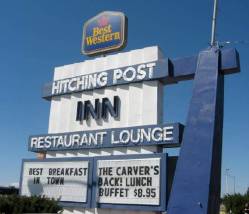
The Hitching Post was one of the CFD hot spots. It was my best job.
My favorite shifts during CFD were 7pm to 3am and 11pm to 7am. There was always plenty of action for a 14 year old kid – running booze and glasses to the smoke filled Coach Rooms for the Son’s of the Pioneers Show, shooting the breeze with fun-seeking cowboys and their girlfriends at the counter in the coffee shop.
I was in Phoenix Books and Music the other day and noticed a record by Jody Miller. She used to play in the Hitching Post lounge. I delivered room service to her. The only other famous person I met was Victor Jory, who sat at the coffee shop counter in a tan safari jacket smoking cigarettes.
Just before sunrise one morning another busboy named Mark Samansky – God rest his soul – and I went into the Coach Rooms. Mark played the drum solo from Iron Butterfly’s “Inna Gadda Da Vida”. I don’t think the boss – Kenny Ahlm – ever figured out who was making all the racket. I kept in touch with Mark until he graduated high school. He was a few years older than me and we lost contact. He, not surprisingly, went into radio broadcasting as a well known DJ. He died a few years ago.
3. High School Parade Rides – I’d ridden in the parade before as an elementary school aged kid. My mom was in a singing group called the Dearies, a group of her her women’s club members. All the members had kids – Murrays, St. Clairs, Nichols, Lummises – and we all hung together during the summer. Many of us still keep in touch through facebook.

In high school, I rode in the CFD parade with Ed Frye in the ambulance.
I can’t remember who had the pull, but all of us kids from the neighborhood rode on the hay wagons during the CFD parade. That was sort of an initiation for kids to get involved with CFD – turns out it was for me since I’m still involved. The mom of one of my high school classmates, Janice Benton, was a volunteer on the CFD Parade Committee and for three summers through high school we rode in the horse drawn field ambulance wagon.
Two girls dressed up as Civil War nurses and two guys moaned in pain with bandaged limbs hanging out of the windows. For my shift, it was Jan, Eddie Frye and Tad Leeper.
We had messy jugs of red colored water and let it run out of the corners of our mouths – pretty graphic for CFD – but the crowd loved it.
We also had this “bed pan” schtick, but I don’t need to go into any of the details about that!
4. Old Enough to Drink in Public – As far as I’m concerned, Frontier Days started to go downhill when the Mayflower Bar on 17th Street went rock and roll. It was nutty back in the late 70s and early 80s. I was living in Gillette at the time and one year, we packed way too many people in a room at the Atlas Motel.

The second Mayflower went out of business the year I made my Kerouac movie. This is the original Mayflower interior.
The police would block off 17th Street between Capitol and Central Avenues and walk down the sidewalk wielding night sticks banging beer cans out of the hands of pseudo-cowboys wearing huge gold and silver fake trophy buckles.
The obligatory circuit was flowing along with the mass humanity from the Mayflower then to the Elks Club then back to the Mayflower where I would bump into Cheyenne friends I hadn’t seen for years.
The Pioneer Hotel was taken over by bikers.
The Cheyenne Club opened on Capitol and was the big cowboy hangout for a few years until it went out. It’s been through several iterations and now empty when the Drunken Skunk went out.
All the CFD gathering points are now out of town at the Cadillac in east Cheyenne. and the Outlaw in south Cheyenne. When the parade ends, downtown turns into a ghost town with tourists and locals heading to the rodeo and the carnival Midway in Frontier Park.

CFD parade watch 50th birthday July 19, 2003 with Judy Gilmore, Susan Keenan, Jill Jensen, Steve Gilmore, Jeff Tish, Bill Keenan.
The Plains Hotel has had an identity crisis over the past few years. One of things I’d wanted yo do is watch the parade from a corner suite there.
In 2003, Bob Jensen, Al Wiederspahn – God rest his soul – and Mick McMurry renovated the Plains into a show piece. It wasn’t ready to open, but for my 50th birthday, I rented the room and invited 100 of my closest friends over for Bloody Mary’s and the parade.
Downtown Cheyenne has been unstable since JC Penney moved out to the mall 40 years ago. The Plains changed hands again. The restaurant is separate from the hotel.
Under the previous management, the Wigwam 2 – an homage to the original Wigwam Bar sort of worked.. It was kind of small but fun.
I don’t know what will be in there this year, but it’s a great place to eatch the parade.
I imagine the bar hopping circuit will be the same, but a much smaller circuit: Albany – Crown – Elks. There is the relatively new Chop House, which, if they wanted to become the focus, open up the parking lot to revelry.

5. Movie Making – I’m now in my fifth CFD life. I’d generally get media credentials when I was in the newspaper business. I remember doing a pretty good story about Indian Relay Races. CFD doesn’t have those any more.
I’ve made a couple short movies in Cheyenne using CFD as a back drop – “On the Trail: Jack Kerouac in Cheyenne” which is about the night Sal Paradise spent in Cheyenne during CFD on his way to Denver; “Rose Garden” which happens at the parade and in Frontier Park. I’m working on a documentary about the wild horse race, but I’m having a little trouble coming up with a story.
I also did work for the CFD Old West Museum and make the CFD Volunteer Crisis Fund annual tribute video.
CFD 2018 beganon Friday. I’ll be over at the media trailer picking up credentials and talking to people I see once a year there.
Incidentally, my CFD handle is “Bud” which is one of my best kept secrets.
The World Needs More Cowboys.

 As a result of that experience he’s become much more aware of his health. One of his neighbors circulated information about a research study at the University of Colorado about the effects of exercise on brain health.
 Silver Sage Village featured residents:
 Collaborative neighborhood process. Future Lincoln Court denizens will have a chance to participate in the design of the community so that it meets their needs. There will be a series of meetings as the project progresses to define them. Some collaborative communities are initiated or driven by a developer. The Lincoln Court Collaborative Community is a combination of both with the developer playing more of a technical role making the community member vision real. This collaboration will result in a well-designed, pedestrian-oriented community that integrates with the adjacent West Edge community, as outlined in the city of Cheyenne Missile Drive Corridor Plan.
 Collaborative common spaces. Common facilities will be designed for daily use, and for special community activities. They are an integral part of the collaborative community, and complementary to the private residences and businesses. The extent to which the private businesses and studio spaces are public will be determined. There will likely be an expectation that community uses and activities will be a part of the private business spaces. Participating in community life is optional – denizens may have as much community as or as little community as they want. Since the buildings are clustered, the Lincoln Court may retain several or many acres of undeveloped shared open space for future expansion.
 Collaborative management. Lincoln Court denizens will manage, to a great extent, the business of the collaborative community, and also perform much of the work required to maintain the property. The cohousing sub-communities participate in the preparation of common meals, and meet regularly to solve problems and develop policies for the community. A master Community Association may be formed to deal with issues concerning common spaces of the entire collaborative community, such as snow removal, open space maintenance, and managing community business relations.
 Collaborative consensus. Leadership roles will evolve and based on how and when community members join Lincoln Court. However, no one person (or persons) has authority over others. As individuals, families, businesses and organizations join the collaboration, each take on one or more roles consistent with their skills, abilities or interests. Lincoln Court will make decisions by consensus or similar forms of consensus decision-making. Although likely will have a policy for majority-rules voting if the group cannot reach consensus (nuclear option).
 Collaborative community economy. The community is not a source of income for its individual members. However, in the Lincoln Court, rental income from businesses, use of performance / exhibition space, studio / co-working spaces would accrue back to the community at-large to decrease homeowner / community owner association fees / reserve funds. It is possible that the master association or a sub-associations could contract with a resident / tenant to perform a specific task for compensation, but more typically the work will be considered that member’s contribution to the shared responsibilities. It is possible that community residents will earn income from rented studio or business location.
 Collaborative higher purpose. The envisioned community “higher purpose” is around arts, culture and fostering creative thinking in the day-to-day community functionality. The site has a great story. The original site was a part of a Homestead Act land grant at the turn of the 20th century. Historic Highway 30, also known as the Lincoln Highway spanned coast to coast in the 1930s. The Lincoln Court was built as a motor hotel which later evolved into the Hitching Post Inn. The Hitching Post was a legendary Cheyenne landmark. There are some great stories associated with the site which are big selling points for the project. Mine, for example? My first job when I was a 12-year-old was at the Hitching Post.
 Views from Behind the Lens