I heard on the radio this morning that Major League Baseball and the players union agreed to play 62-games in the season truncated by the COVID-19 play at home orders.
It’s all about money and I’m wondering why the owners didn’t hire Andrew Yang and figure out how to pay the players a uniform basic income of $1000/month, rather than go through all the brain damage of setting up a season that’s only between teams that are relatively close to one another. That sounds like a local rec center slow pitch softball league.
The on-field rules are probably for the better: No spitting; no high-fives or fist bumps; no more patting players on the butt.
Pitchers won’t be able to lick their fingers. Instead, they’re allowed a damp hanky in their pockets to wipe off the crud from their grubby hands.
That got me thinking that the COVID-19 pandemic is moving me into the seventh phase of my life, based on my baseball card collection.
Since I moved to Colorado in around 1993, I was a born-again fan because the Colorado Rockies expanded to Denver. I was a season ticket holder, but after the All-Star game was played in Coors Field, my passion waned along with the team’s lack of success.
Here it is 20 years later since I paid any attention, but I’d rather watch a Little League game over at the Y than hassle with buying tickets and $10 beers. Not only is access limited to people with disposable income, the game is so much more about the monetary worth of this player or that player.
There aren’t near as many kids playing baseball, compared to soccer, which is a low-cost-of-entry pass time, plus any kid can play the game and learn the basic rules. Baseball is an ambidextrous sport with lots of subtleties to the rules of the game.
My life transitions have pretty much mirrored my baseball card collecting. In baseball card milestones, I’m entering into the seventh phase of my life.
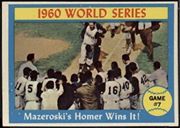
This is the 1961 Topps card with Bill Mazeroski rounding the bases after winning the 1960 World Series with a home run.
Phase 1, the 1960s, Growing up and JFK – I really didn’t get into baseball until the early 1960s. My family got a TV around that time and the first World Series I watched was in 1960 when the Pirates beat the Yankees. My maternal grandfather was a Yankees fan and my dad was a Yankees fan, which would make me a third generation Yankees fan.
Watching Bill Mazeroski hit that home run to win the series in 1960 is still etched in my mind and to this day, I’m not much of a Pirates fan. I have a 1960 Roberto Clemente that was abandoned to me by Pat Higgins since his dislike for the Pirates was even greater than mine!
Also in that trade, I got a 1957 Frank Robinson rookie and a JC Penney golf putter. I can’t remember what I traded.
As for baseball cards, I don’t think I bought a pack until 1962 when my ranging pattern expanded. My grandparents lived a few blocks from a Safeway and the Missile drugstore in Cheyenne. I remember buying packs of Topps cards. In 1961, as my 8th birthday favors. Around that time was when I signed up for Little League and ended up playing for the Red Sox, of all things. In November 1963, my mom’s church circle group held their annual rummage sale in the Presbyterian Church basement.
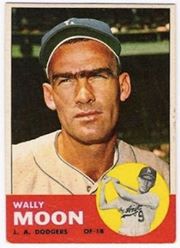
In 1963, I bought a Rawlings Wally Moon baseball glove at my mom’s church rummage sale. This is a 1963 Topps card.
My dad was a pretty good ballplayer. He bought me my first glove, which was from the Ben Franklin store. I used it for a summer but it didn’t have a very good pocket and a ball bounced out, hit me in the eye and KO’d me.
After that, I found a Wally Moon mitt at the rummage sale, and bought it for a quarter, which was my weekly allowance. It was the weekend after President Kennedy was murdered. Besides the glove, I remember many of the women talking about JFK, when one of the women – who was a staunch conservative – came out of the kitchen area and said “It serves him right.”
Being a kid, I was awestruck by the comment, mostly because I didn’t quite know what to think of it. I think the others were caught by surprise, too. By this time, the Beatles were big and Topps put out several years worth of Beatles cards which were sold at the Save More Drug Store. I bought a bunch of those but don’t know where the bulk of them went. I still covet my 45rpm copy of “She Loves You” and “I Want to Hold Your Hand.”
We were baseball-starved in the Rocky Mountain west. The Denver Bears were the AAA affiliate for the Yankees off and on back then. My dad and some guys at his work had tickets to see an exhibition game between the Bears and the Yankees in 1964. They invited me along. Yogi was the manager and Ralph Houk the general manager by then. Seeing Maris and Mantle playing in the outfield is a life highlight.

I lost interest in sports card collecting in the 1970s when I was in high school and college. I ended up voting for Richard Nixon in 1972.
Phase 2, the 1970s, High school, college – When I learned how to drive and was in high school and college, I out grew baseball card collecting and stashed the cards in old Quaker Oats boxes where they remained in the crawl space in my parent’s home in Laramie. Back then, there weren’t plastic storage boxes like there are now.
Luckily, my mother didn’t touch my cards and I eventually retrieved them. The reason cards are worth so much money today is because of moms who tossed out their kids’ collections while they were away.
I became more interested in politics back then and was involved in student government. I’m sorry to say, my first presidential vote in 1972 was for Richard Nixon. I was a Republican for a long time, until I was drummed out of the party for supporting a Democrat, John Vinich for U.S. Senate, in 1988. Wyoming is one of those states where you can change party affiliation at the polls and switch back the same day. Turns out, I probably was a Democrat all along.
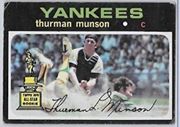
Buzz Thurber was one of the first big time card collectors I knew. He had a complete set of the 1971 Topps cards which were tough to find in good condition.
Phase 3 – 1980s, started working – I got my first job and coincidentally, there was a resurgence in sports card collecting. I don’t know what started it all then, but some tipping point caused mostly guys to dig out their collections – myself included.
There were sports card stores opening and sports card trade shows happening around the country – mostly in the larger towns.
I was in Lander by this time and one of my friends, Buzz Thurber, was a bigger collector than I was. I was impressed that he had a set of the 1971 Topps cards. They have a black border and tough to find with edges not chipped up.
Buzz and I organized a small card show in the meeting room at the Crossroads Restaurant – which it was known back then. I always tell kids to study and get a good job so they can spend money on stuff like baseball cards and not have to ask for permission. I remember one guy who showed off his collection had a binder of HOFers – lots of different, old cards I hadn’t seen before, of course, this is before old cards were found in grandmas’ attics and now priced out of sight.
Back then, I acquired Babe Ruths, Ty Cobb, for around $50.

In 1995 I took my dad to see the replacement Yankees play the replacement Rockies in the first game at Coors Field.
Phase 4 – 1990s, Moved to Colorado – I ended up staying in Boulder when the Rockies came to Denver in 1993. I went to Colorado, for what was originally a temporary stay when I worked for the Northern Arapaho Tribe setting up a “cultural conduit” between the tribe and its former homelands along the front range. The idea was to develop markets for Arapaho artists works.
I remember the first time I drove up to Laramie to visit my parents. My dad asked, “What are those green license plates doing on your car?” I had season tickets to the Rockies from the opening of Coors Field in 1995 until the All Star Game in 1998.
I forgot to mention that I joined a rotisserie baseball league in Lander. I didn’t quite get how to keep the stats since it was before computers and all the data was compiled by hand. My team was called the Yangs. As opposed to yin – yang, there is a Star Trek episode about an alternate world where the Civil War was fought not by the Yanks and Confederates, but the Yangs and the Congs.
In Boulder, I joined a league colloquially known as the Baseball Buttheads with Paul Pearson, Scott Deitler, Glenn Locke, et al. When I joined, it with my Yangs team, the data were figured quasi-manually, but with the explosion of fantasy sports, migrated to an online version. I kept baseball cards of all my players. I was the only team owner with enough guts to draft Colorado Rockies pitchers.

My sports card store in Riverton was called Pine Riders.
Prior to my move to Colorado, my friend, John, and I – we both worked at the Wyoming State Journal started up a sports card store called Pine Riders in Riverton. He was a big sports card collector, too. That was a lot of fun buying and selling cards.
At our grand opening, we had former Yankees pitcher Bud Daley who still lives in Fremont County. I ran into Bud at the Wind River Casino working the slots a few months ago. We also had former Cleveland Indian utility player Woody Held who lived in Dubois. He passed away in 2009.
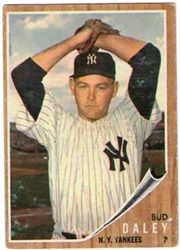
Bud Daley makes his home in Riverton, Wyoming. He pitched the winning game in the 1962 World Series. He was a special guest when Pine Riders opened in Riverton.
It was around this time that the bottom started falling out of the market. The hobby became very weird. Topps had a corner on the hobby which was now being transformed into business. Two other companies, Donruss and Fleer came out with sets. All of a sudden, the market was flooded with cards.
To top it all off, a Walmart opened up in Riverton and if I didn’t know better, Walmart targeted Pine Riders and the office supply store across the street with predatory pricing.
Kids were bringing in cards they bought there for less than our wholesale price. Pine Riders slowly lost that part of the business which was a blessing in disguise since there were Donruss, Score, Topps, Fleer, Bowman, Leaf, Fleer Ultra, Upper Deck, Topps Stadium Club and a bunch of others. The store continued to do okay in the secondary market. I left the business when I moved to Colorado.
The old cards maintained their values, but for new collectors, artificial scarcity was created with unique “chase” cards that were traded and sold like stock. Those cards weren’t for collecting, but rather for making money. I think sports cards mirrored the dot com model. Whoever ended up with a suitcase full of chase cards ended up holding card board.

Roger Maris broke Babe Ruth’s single season home run record in 1961. All the boys in the neighborhood wanted to be Roger.
As for myself, I traded away my bulk cards which were sets spanning 1958 to 1990. I started collecting certain Yankees teams: 1996 the Seinfeld Yankees era with Jeter, Williams, O’Neill; 1977 – 78 with Reggie Jackson; 1961 – 62 with Mantle and Maris; 1953 my birth year, 1932 with Ruth at the end of his career; 1923 first year in Yankee Stadium and first World Series title, 1919 the year of the White Sox scandal NFL and Chicago Bears founder George Halas was on the team. Then lost interest.
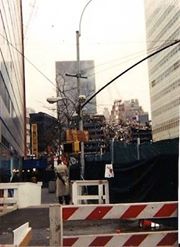
This is Ground Zero in October 2001. Every time I go to New York I go to the same corner and take a picture.
Phase 5 – the 2000s, Terrorism and baseball – September 11, 2001 was a strange day. I was working in Denver at the time. I didn’t have the radio or TV playing that morning. I rode the 204 bus to the RTD station in Downtown Boulder.
No chatter on the bus. There was not one mention of the World Trade Center terrorist attack until we pulled into the Table Mesa Park n Ride. When I got into Denver and on the 15 bus, the town was eerily quiet – no planes were in the sky.
Flash forward.
I’m a very experiential person and felt like I needed to get to New York City. Turned out the Yankees won the American League Pennant, but the World Series was delayed until late October because of the terrorist attacks. I flew from Denver to Boston and made my way to New York on Amtrak for games three and four. I bought game tickets on ebay.
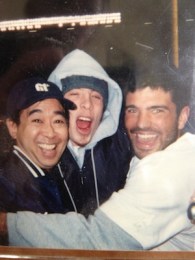
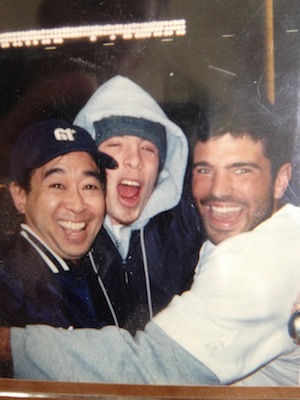
These are the two fans i befriended for game 3 of the 2001 World Series in Yankee Stadium. Jeter hits a walk off homer in the 10th.
This trip, I stayed at the Hotel Pennsylvania which is across from Penn Station. It used to be well kept secret in New York City, but has since been “rediscovered” – at least they raised their rates.
The Yankees dropped the first two to the Arizona Diamondbacks in Phoenix. The security was tight getting into Yankee Stadium. The game was dramatic. President Bush threw out the first pitch.
A flag from the World Trade Center flew over the stadium. Lee Greenwood sang “I’m Proud to be an American”. Clemens pitched well, I think a three hitter and the Yankees win 2 – 1 on a hit by Scott Brosius.
Game four was quite the nail biter that went into the 10th inning. Paul O’Neil gets on base and Tino Martinez smacks one into the stands to tie the game in the bottom of the ninth off BH Kim.

Derek Jeter retires this year. He was one of many Yankees who appeared on Seinfeld.
Kim stays in the game in the 10th and ends up facing Jeter who hits a walk off homer to take a three games to two lead. I sat with a couple New York guys.
Everyone was a Yankees fan that night.
Jeter was dubbed “Mr. November” for his heroics. He’ll likely be the only player to be known as that since I’d be surprised if any more World Series games are played in November.
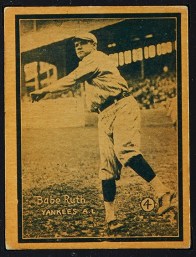
I’ve been filling in my 1919, 1923 Yankees collection. eBay has taken the challenge out of collecting. All a hobbyist needs is money and can buy just about anything.
Phase 6 – 2013, Downsizing – I had some pretty serious health issues in 2013 and came to the realization that it’s time to start sort through my stuff. I’ve been threatening to do this for many years.
I was in the hospital and rehab place for six weeks; physical therapy for four weeks and have been on my own for six weeks.
The acid test will be when I take on the Bolder Boulder 10K foot race on Memorial Day. I joined a facebook baseball card group which compelled me to get out the boxes again. Now that I’m old, it’s time to let other people enjoy what i have and am selling and trading to lighten my load.
I’m moving many cards, autographs, comic books and other ephemera on ebay. I’m converting the stuff that I no longer want into the few odd ball items I need to fill out some of my Yankees collections.
It’s very liberating but very time consuming. I’m still challenged by collecting and enjoy thumbing through my collection – I feel like a kid again!
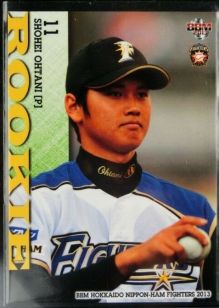
I’m stuck with a couple cards of Shohei Ohtani. So far he’s turned about to be a bust after being hyped up during his rookie season.
Phase 7 – Memorabilia Existentialism. I knew I was getting old, but I didn’t think it would happen this fast. Most years, I buy exactly one pack of baseball cards from the local Target.
I don’t know many of the players these days, since I don’t play fantasy baseball anymore either. But I do collect one or two cards of a hot Yankees player who emerges during the summer.
There was Japanese sensation Shohei Ohtani who debuted in 2018. He was the “next Babe Ruth” because he was as good a pitcher as he was a batter. It turned out that American baseball is a lot more strenuous than the sport in Japan and he was soon injured. Last season, he didn’t play much and used mostly as a pinch hitter.
I haven’t been tempted to chase the “rare cards” created by false scarcity. Before 1980, there was pretty much one card manufacturing company called Topps
After that the market has been flooded by cards by a bunch of card brands. There’s no inherent shortage of cards. Now, “special edition” cards are included, like autographs, or hyped up ones.
Now it’s less about the hobby, and more about investing. Whoever gets stuck holding last year’s fake-rare cards are the big losers.
During my self isolation, I’ve been purging like there’s no tomorrow, which could, in fact be the case. I’ve emptied seven file boxes filled with papers, taken countless books and T-shirts to the thrift stores.
Now I’m inventorying all my “good stuff” for future liquidation.
Since the bulk of my collection was acquired before baseball cards became investments, I don’t worry about resale value as much as I do about enjoyment from the hobby. Over the past few years, I’ve been able to scrounge a 1928 Yankees signed baseball with Babe on the sweet spot, a cut signature of Lou Gehrig, and obscure stuff for my 1960 to 1964 Yankees collection.
I see in some of my facebook collector groups posts by guys who say they are collecting to pay for their kid’s college educations. Fat chance that will happen. It’s an excuse for them to hold on to their pieces of cardboard with pictures of guys wearing funny hats for as long as possible.
My heirs won’t know what’s so interesting about a 1990 Fleer Ultra Frank Thomas, let alone where to sell it. I’ll be getting rid of all my stuff within the next five years, the next 20 years at the latest!




 Views from Behind the Lens