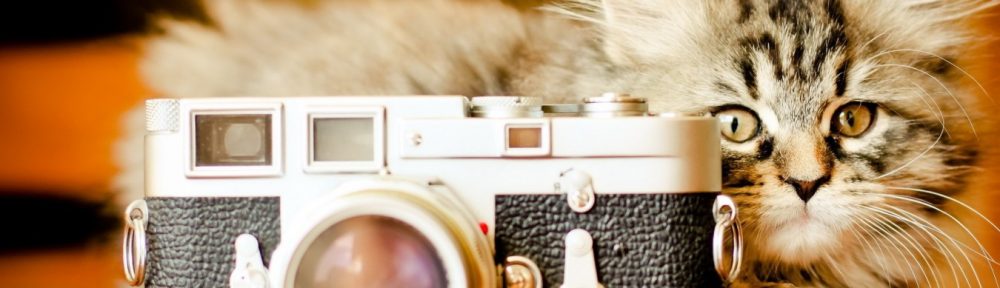

Going to the food store was depressing with not much on the shelves. I switched to shopping on line.
Back in March when there was widespread panic, I quit going to the grocery store, mostly because it was so depressing to see all the customers there grabbing whatever was remaining on the shelves, as if the last can of Campbell’s soup will be their last meal.
There are other jobs I haven’t gotten around to yet. I usually switch out my snow tires around Mother’s Day. That hasn’t happened, since I don’t drive much these days.
I live in a cohousing community. Everyone in the HOA is very collaborative. In the pre-COVID-19 world, if someone is homebound, neighbors step forward and provide a coordinated care giving response.
That would include picking up groceries or medicine from the store, providing prepared meals, and stopping by to say “hello.” My neighborhood is very “retro.”
With COVID-19 self-isolation, those tenets of community have changed with the times. The personal connections are few and far between, but because of fairly strong neighborly relationships, we still get together for meetings and some socializing on web streaming services like ZOOM.
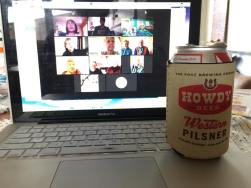
Community members get together for virtual happy hours, but it’s not the same as face-to-face gatherings.
There are some community members who view themselves as more bullet proof than others and are gadding about, much to the dismay of others who are much more vigilant and take the self-isolation mandates issued by the city of Boulder, Boulder County, and state of Colorado much more seriously.
There are exceptions from the mandate. Going to the food store is viewed as “essential.” I’ll be suggesting that all my fellow community members come up with a list of ingredients for their “last meals” and have the more cavalier neighbors go on food and beer runs for however long this pandemic lasts. The Black Death bubonic plague lasted five years.
What’s your “last meal” – you know the one you’d scarf down if you’re on death row and your fateful number finally pops up.
These days, as my personal movements are constrained by the local and statewide COVID-19 “stay at home” mandates, I have accumulated the fixings for my last meals, just in case.
Around the time time I was recovering from my death-defying illness back in 2014, King Soopers started home delivery. Back then a delivery was twenty bucks. At that time, for me, it was worth it. I resurrected my account and have food delivered to the house now, which is handy and also the price dropped to around $6.
Over recent years, I’ve been in and out of some harrowing situations and my last meal is always on my mind.

- Snow and blowing snow; slick and slick in spots from the state line to Laramie.
One weather-related risk I, as well as most anyone who’s lived in Wyoming have experienced, is winter driving. While I no longer live in Wyoming, I spend quite a lot of time on the road traveling around mostly to other towns there, and haven’t had any death-defying driving experiences nor any really close calls other than a couple 360 degree black ice spins and sliding off the highway after winter weather closed the road behind me.
On March 9, 2019, after attending the inaugural Boulder International Film Festival in Fort Collins, I took off for an uneventful Saturday drive through Fort Collins and north toward Wyoming for a community-building workshop presented by my friend and colleague Yana Ludwig at the Solidarity House Cooperative community in Laramie.
Before deciding to drive up to Fort Collins for the film festival, there was snow in southeast Wyoming. I was undecided if I wanted to make the trip, in the first place, but figured if I got on the road fairly early in the morning, there would be plenty of daylight if I had to turn back.
Do Mother and Father Nature plan for weather to drastically change at the Colorado / Wyoming state line?
The the trek suddenly became very eventful at Virginia Dale.
Early-morning sunlight glistened off 30 miles of the black ice encrusting the highway. Blowing and drifting snow buffed the icy road surface to an opalescent sheen from the state line to Laramie.
I didn’t eat anything before I left thinking I would get something along the way. Based on these road conditions, that may not happen. “What if my ‘last meal’ was nothing,” I thought to myself as I passed jack-knifed trailers and cars stuck on the sides of the road. Some nutty driver in a pickup going way too fast was fish-tailing his way up my tail pipe, before he slid off the road behind me.
That in turn, reminded me about a drive I made from Riverton to Laramie in November 2015.
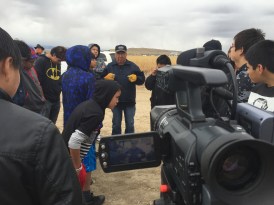
- Iggy John C’Hair explains the traditional Northern Arapaho bison uses to Wind River Reservation students.
I was on the Wind River Indian Reservation documenting a traditional bison ceremony, which was a big success. That movie project stalled, but the content will be used in the documentary I’m working on now.
This was my third trip to the Wind River Indian Reservation in three weeks. It takes a while for the Arapaho to come to consensus, because it’s a very collaborative culture.
Indian time, as it is characterized, which i similar same as Hawaiian time.
It was a successful “hunt” and traditional ceremony. I was anxious to get back on the road, but didn’t think to check the road reports.
When I hit the road the next day, it was a typical November fall weather in 2015 when I was driving back from Riverton. The clime was pleasant with the skies a little overcast and the outside conditions requiring a light jacket.
As is my routine I made a stop in Rawlins for a gas and a pit stop. “You do know I-80 is closed both directions,” the clerk informed me as I paid for my bottle of diet Mountain Dew and bag of Lays potato chips.
What gives?

I-80 was officially closed when I was driving back from Riverton recently. White knuckle driving is an art form in Wyoming.
It’s calm, sunny and warm in Rawlins. The options were to turn around and return to Riverton or backtrack and go way out the way to Casper and Interstate 25, which would likely be worse. I stuck it out in Rawlins.
It was early and I decided to get a room before the truck traffic started to back up.
I didn’t want to give an arm and a leg for a nuisance stay-over and took a room at the Econo-Lodge.
Even as Econo-Lodges go, this one was stark. It’s nestled up against the north side of a bluff where it didn’t get much afternoon sun.
Might as well make the best of it.
I cruised around downtown Rawlins. The streetscape has drastically improved over the years. Before Rawlins created its Downtown Development Authority in 1991, it was a declining business district. The year I drove through, Rawlins was awarded the coveted Great American Main Street Award.

I stopped at this Tex Mex place in downtown Rawlins. I was impressed with the offering of TopoChico agua mineral.
I prefer local joints to the chains and tried a chili relleno at a small Mexican place called Rose’s Lariat. The meal was pretty good especially when I could wash it down with Topo Chico fizzy water out of the bottle, which is my go-to agua mineral when I’m in Mexico, and now available in the United States.
Globalization.
I made my way back to the room, if that’s what you want to call it. The Econo-Lodge was more of an Econo-Fridge. The heater hadn’t been on for quite some time. I flicked it on. The heater parts banged, clicked and finally whirred enough to spit out heated air.
While the room warmed up, I’d always wanted to take a look at the “Frontier Prison.” It was the old state penitentiary that was abandoned in 1981, but now a tourist attraction. As a kid one of the parental threats when I was scolded was, “You don’t want to end up in Rawlins making license plates, do you?” The prison made money from inmates stamping out car tags.
I pulled up to the now historic sandstone block building. By this time, it was snowing again and the attraction was closed, probably because of limited “winter hours.” It was getting late in the afternoon and I headed back to the room for good.
Closed roads are a growth industry in Wyoming.
The Department of Transportation closes the interstate because there are no more parking spaces along the route to accommodate any more trucks, let alone passenger cars. All the cities lining the road sell out motel rooms from Cheyenne, Laramie, Rawlins, Wamsutter, Green River, Rock Springs to Evanston.
Pizza Hut advertises on the plastic room keys. Bored, I decided to order my “go to” Canadian bacon and mushroom thin crust with extra cheese. I’ve been eating that combo since my Hastings College roommate introduced me to it back in 1972 or so. I was able to eat half of it.
Rawlins has pretty good cable. There’s not much to do here on a school night in the dead of a snow storm.
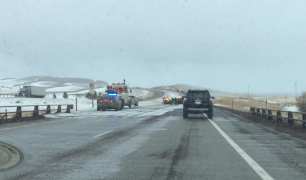
- Roads can be treacherous, even when there isn’t much snow.
I dozed off with the TV on, and at 2am the “REEEEE REEEEE REEEEE!” screeched out on the TV speaker. The pre-recorded road report guy yelled out, “Interstate 80 is now open, but slick and slick in spots with snow and blowing snow.”
I would still wait to get out around 10am when the sun is higher.
After waking up, I gobbled most of the cold pizza and downed a warmed over cup of yesterday’s coffee before getting on the road.
It was a bumper-to-bumper parking lot from Wolcott Junction to Laramie. Traffic was stopped by an accident on the westbound lane. It took three hours to go 90 miles.
Wyoming winter driving takes practice – more like baptism by fire. If you can successfully drive in Wyoming during any small snowstorm, you can drive anywhere.
Riverton, like most other Wyoming communities, is centrally isolated from just about every place else when the weather gets nasty.

- The day I drove from Fort Collins, I stopped at Vern’s Place in LaPorte twice.
There aren’t any places to stop. In the event of road closures, there are lighted barriers like at a railroad crossing that prevent traffic from passing and drivers are required to turn back.
I grew up in Cheyenne and let me tell you, if you haven’t sat out a blizzard in southeast Wyoming, it’s quite the experience.
During certain times of year, it’s so windy, there’s no Final Net hair spray on any store shelf.
Add snow to that.
I always felt lucky about living in Lander and now Boulder, Colorado along the Front Range foothills.
It’s so nice to wake up, look out the window and notice that the snow has fallen into neat little piles on tops of fence posts and not rudely strewn about in seven-foot-high drifts.
I’ve met several people in my travels who have been to Wyoming. Besides having visited Yellowstone Park, the second most frequent comment is, “Oh, yeah, one winter I was stranded in Cheyenne on my way to California.”
Hmmm.
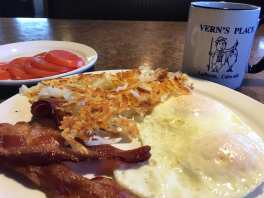
My last breakfast consists of eggs over easy and bacon from anywhere. This trip to Laramie, I ate at Vern’s Place in LaPorte, twice.
Under most circumstances, I’m a calm and collected driver, but when the interstate suddenly disappears in a puff of white, the highway turns into the “Snow Chi Minh Trail.”
Luckily, I didn’t get stranded this time. When that happened back in the days before cell phones and GPS, travel could get problematic. The seasoned drivers keep on plowing ahead since the weather will likely get worse before it gets better.
Back in those days, cassette tapes played music mixes through the stereo that soothed me while my car pounded through invisible snowdrifts and crept around 18-wheeler convoys near Elk Mountain.
White knuckles.
The road was open but barely navigable. Attempting to eat a pizza slice might be too distracting. Espying disgruntled travelers examining their jack-knifed u-Haul trailer and contorted semi-truck silhouettes in the highway median made me realize how out of control these drives can be.

My last lunch would be pork noodles. This bowl was at the 20th Street Cafe in Denver.
I couldn’t imagine being killed by a wild and crazy trucker or freezing to death knowing my last meal was cold pizza and day-old coffee.
My romanticism has me eating bacon, eggs over easy with a pancake for my last breakfast at the Luxury Diner in Cheyenne; Japanese-style pork noodles from the 20th Street Café in Denver as my last lunch; and a good steak from just about anywhere for my last dinner.
I sneaked up on occasional black ice right into Laramie. It was a relief to negotiate slushy roads in town.
By the time my workshop was over around 4pm, the sun had warmed the pavement and dissipated the ice and it was smooth sailing.
I pulled into the parking lot at Vern’s Place in LaPorte for a well-deserved prime rib dinner, hopefully, it won’t be my last.
My COVID-19 King Soopers run next week will includes, bacon and eggs. I always have T-Bone steaks in the freezer, and always a healthy supply of Japanese noodles in the cupboard.
If I catch the COVID-19, I hope my reaction doesn’t include loss of smell and taste.


 Views from Behind the Lens