Last Place Has Benefits in the NFL

Why bad NFL teams sometimes get an easier road back

For all the complaining fans do about NFL scheduling, the league has a system designed to keep all teams thriving. The NFL doesn’t want permanent doormats or untouchable dynasties.

Teams that finish poorly are rewarded with theoretically easier schedules. Last-place teams play other last-place teams in portions of the schedule. 

Better teams get punished with tougher opponents because they face other division winners and higher finishers. Success can make your next season harder before training camp even begins.

Then the NFL doubles down with the draft.

The weaker you are, the higher you pick. The idea is simple: help struggling franchises recover quickly and keep fan bases emotionally invested. Every spring, bad teams are handed fresh hope in the form of rookie quarterbacks, new coaches, and “this changes everything” draft grades from ESPN.

I started following Cleveland when the Browns drafted Shedeur Sanders from CU. He ended the season as QB1 after the team traded Joe Flacco and Dillon Gabriel hurt himself.

The Browns have the formula the NFL system rewards:

  • a new coach,
  • a stack of draft picks,
  • an easier schedule,
  • and Shedeur Sanders, a bargain low-round draft pick from last season, 2025

There’s an energy around teams like that. The Browns franchise stands at the starting line of a rebuild, and in the NFL that can be a dangerous thing.

A few draft picks hit, a young quarterback catches momentum, and suddenly a team everyone laughed at the year before is flexing muscles on national television in December.

Meanwhile my local Denver Broncos took a different path.

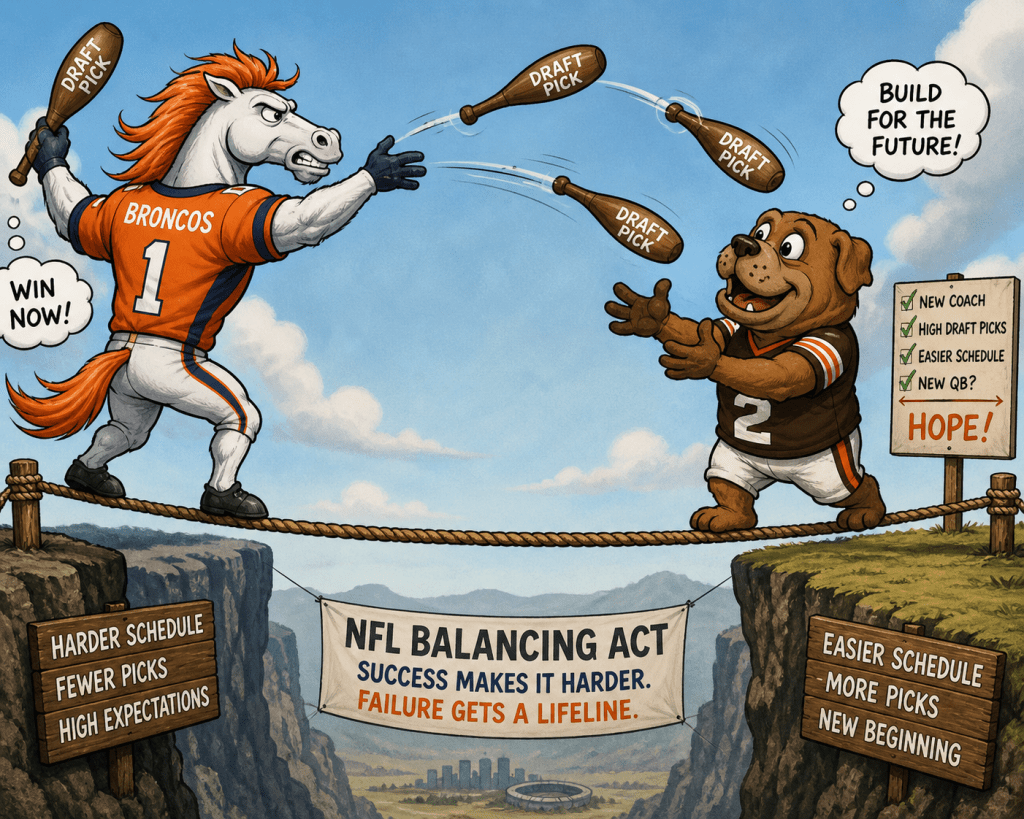
Instead of stockpiling draft picks and rebuilding patiently, Denver pushed its chips into the middle of the table and traded away draft capital for elite wide receiver Jaylen Waddle.

That’s the high-risk, win-now model. It can work brilliantly if the star player transforms the team immediately. But it also means less depth, fewer young players developing behind the scenes, and less margin for error.

So now the Broncos face the harder side of the NFL’s balancing act:

  • tougher schedule,
  • fewer draft resources,
  • higher expectations,
  • and a loaded AFC.

The Browns, meanwhile, get the softer landing the league intentionally provides struggling teams.

That’s why the NFL works so well. The league manufactures hope better than any sport in America. A 5-12team is never supposed to feel dead for long. The league recycles opportunity.

By August, every fan base convinces itself that, “This is the year we turn it around,” and every year, a few of them will be right, because that’s how the parity system is set up.
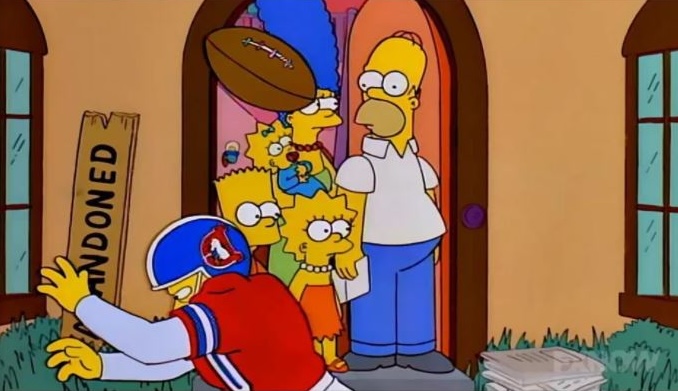
D’oh! Mile High Miracle: Homer Simpson and the Broncos vie for Super Bowl LX

In 1996, Homer Simpson’s boss, Montgomery Burns, gifted him the Denver Broncos NFL football team. The transaction disrupted the space-time continuum and changed Homer’s relationship with hot dogs forever.

Gifted, like a bowling ball with your name already engraved on it, except this Brunswick came with John Elway and a destiny.

Shortly thereafter, the Broncos won Super Bowls XXXII and XXXIII.

Coincidence? The NFL says yes. The Simpsons prophecy industrial complex says absolutely not. Let’s review the facts.

  • 1996: Homer becomes the owner of the Denver Broncos after Burns gets bored.
  • 1997 & 1998: Broncos win back-to-back Super Bowls.
  • 2018: Broncos win Super Bowl L (That’s 50, not Large) behind Peyton Manning.
  • 2022: The Walton-Penner group buys out Homer. He keeps a minority stake, along with Condoleezza Rice.

The Broncos have been playing the long game. There have been ups (Super Bowl 50) and downs (14 starting quarterbacks and five head coaches) since Peyton Manning retired. The Broncos have been fermenting, like bleu cheese in a dark cave.

Now the Roquefort is ready for the charcuterie board.

Enter Super Bowl LX (That’s 60, not extra large)

Super Bowl LX arrives, and suddenly the Denver Broncos are back on the biggest return attraction in football, like the Eagles’ “Hell Freezes Over” comeback tour, which was the first event played at the brand new Invesco Field at Mile High in 1995.

Who owned the team then?

Homer Simpson.

Homer’s Front Office Philosophy

How did the Homer-owned Broncos get this far? He ran the team using three principles:

  1. Always draft the best player with the coolest name (Bo Nix). 
  2. Timeouts are for snacks (30-second timeouts last four minutes).
  3. Rely on advanced vibes (Nine consecutive come-back wins).

Sources say every major decision this season was finalized after Homer asked:

“What’s the name of our kicker, again?”

Curse or Blessing?

For years, fans wondered if Homer’s ownership was a curse. The team wandered. Quarterbacks came and went. Coaches aged visibly on the sideline.

True Simpsons scholars know:

  • The show never predicts things immediately. It lets them marinate.
  • Trump presidency. Smartwatches. Disney owns everything.
  • You think the Broncos were going to peak right away again?

This is television-level foreshadowing.

Homer was a blessing.

Mile High Meets Springfield

As Super Bowl LX approaches, expect the following:

  • Homer mistakes the Lombardi Trophy for a large Hershey kiss and tries to eat it.
  • Bart and Taylor Swift call audibles from the Simpson party suite.
  • Lisa runs the analytics department for Fan Duel
  • Marge reminds everyone to “just have fun out there.”
  • Mr. Burns leans forward in his box seat and whispers, “Excellent.”

Final Prediction

Will the Walton-Penner-Simpson-owned Broncos win Super Bowl LX?

If they do, remember this. It was foretold in 1996 and powered by chaos, nacho cheese, and blind optimism.

D’oh, Broncos!

My first beer at the Stonewall Inn

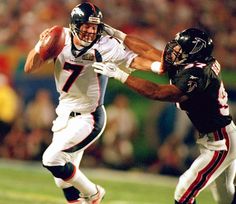
elway xxxiii

Denver Broncos quarterback John Elway in Super Bowl XXXIII

It was 50 years ago on June 29th, 1969 when the inciting incident for what’s now become known as Pride Week happened in New York City.

Thirty years after that, in 1999, I was doing some consulting work for a non-profit in Boulder called Rock the Planet that used mountain climbing as a metaphor for positive youth development. The group sent me on a field trip to attend a climbing wall trade show in New York City. This was well before climbing walls became trendy.

It was the dead of winter. I made arrangements to stay with one of my college classmates who still lives on the Upper Westside between Broadway and Central Park on 72nd. It’s between the 72nd and Broadway Station  and the Dakota.

A couple days before my visit, he called and said he was deathly ill with a cold and made arrangements for me to stay at one of his friend’s short term rentals in Greenwich Village.

img_6488

I arrived and was greeted by Jon who escorted me to the little studio, that he rented to me for a couple hundred bucks for the weekend. It was cozy but cold. By the time the steam heated up the small place, it was time for me to leave.

These days, this apartment would be known as an Air B&B. Back then, it was likely an illegal short-term rental.

I don’t recall anything about the trade show I attended, but it was Super Bowl Sunday and the Broncos were playing. I didn’t know the neighborhood that well, since I normally stay a little further uptown at the Hotel Pennsylvania.

Below my apartment was a bar – or what looked like a bar. There wasn’t a prominent sign. Since neither of the New York teams were playing, I suspected the crowd would be light.

When I walked through the door, the place was rocking – loud music, people dancing. There was a TV behind the bar. I elbowed my way through the crowd, and sat down on an empty stool and ordered a beer. I was the only one sitting at the bar and asked the bartender to put on the game.

Meanwhile a couple guys walked over and sat down and struck up a conversation wondering what I was doing there. We had a couple laughs before they disappeared into the crowd.

Eventually, I noticed that the bar was not only full of mostly men, which wasn’t unusual, but there were men dancing with men and guys making out with guys in the booths.

Not that there’s anything wrong with that.

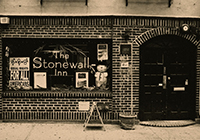
Stonewall1

Turned out, I had stumbled upon the infamous and now famous Stonewall Inn. Back in the summer of 1969, it became the birthplace of the modern gay rights movement.

In those days, police routinely raided gay bars, but on June 28th of that year, nobody cooperated and an insurrection broke out. The following morning thousands joined a protest on Christopher Street.

By the way, the Stonewall was hoppin’ by the time the confetti was flying at the end of Super Bowl XXXIII . I think I was the only one in the house who knew that the Broncos beat the Atlanta Falcons 34 – 19.