COVID-19 preparedness and a throwback to the Cold War

bomb shelter blue prints

This is what our bomb shelter looked like, particularly the separate wall that made for a vestibule.

Being self-isolated during the COVID-19 pandemic is a throwback to my childhood. In the cohousing community we’ve agreed upon how to support one another in the event of illness, lack of food, and when cleaning supplies are short.

The Cohousing Association of the US is sponsoring a series of webchats providing a way for communities to share their “secret sauces” about preventing the spread of COVID-19.

The community common house, and that of the cohousing community across the street would be good large-scale places for others in the neighborhood to shelter in place, if need be. More likely in the event of a bad storm.

As a course of our day-to-day cohousing lives, the community keeps stores of paper towels, toilet paper, and cleaning supplies on hand. When this coronavirus thing blows over, we’ll refine our civil defense protocol.

The mutual support that’s come about today is a lot like how things were back during the Cold War. My family and extended family were tight-knit enough to hunker down together while preparing for the impending nuclear holocaust.

We were the only household in the neighborhood to build a “fallout” shelter. In the 1964 Barry Goldwater favored the use atomic warfare to end the Vietnam war. I’m pretty sure my dad voted for Goldwater, which may be one reason behind our family civil defense project.

Similarly, during the early stages of the COVID-19 pandemic, there was a high degree of international and national tension. but soon friends and foes worked together to slow the viral spread.

As for COVID-19, it’s pretty easy to build consensus around stomping out a bad virus, since there are no people involved, and, for example, no disagreements around having to determine who are the good nazis compared to the bad nazis.

Baby Boomers and older likely remember October 1963 when Russia installed nuclear missiles in Cuba in response, in part to the botched Bay of Pigs invasion to take back Cuba from Fidel Castro. There was a political stand off between President John Kennedy and Russian premier Nikita Khrushchev. Lots happened after that, JFK was assassinated, some conspiracy theorists think that was somehow connected to the Bay of Pigs, and the missiles of October.

While I was growing up, Cheyenne had the highest concentration of nuclear missiles in the country. Francis E. Warren Air Force Base was the command center for the Atlas missile program following World War II. The Department of Defense figured out that a better way to deploy nuclear weapons was to install lighter weight nuclear warheads on rockets. Missile installation was a booming industry in middle-of-nowhere places like southeast Wyoming.

Not that we were any safer, but my parents decided to build a bomb shelter in the basement of our home in the Cole Addition, one of the suburbs on the east side of Cheyenne. Suburban growth was a result of the missile boom.

I imagine the bomb shelter was for peace of mind more than anything.

One of the guys who worked for my dad at the Coke plant was Bill Fisher. He was a veteran of World War II and the Korean War and lived in the basement of a house that was started but not built. Part of the foundation was completed, but there were dirt tunnels where he kept stuff. I was never quite sure what to make of Bill living underground in a series of tunnels.

He was a hermit, maybe that was PTSD-related, but very smart about science. He worked around the plant sorting bottles, helped on the production line, but his main job was working on the vending machine refrigeration systems.

His place was located across the street from the Coke plant. When I went to work with my dad on Saturdays, I goofed around inside the plant, but eventually made my way over to Bill’s.

He subscribed to “Things of Science” which was an educational program launched by the nonprofit news syndicate Science Service in November 1940. The program consisted of a series of kits available by subscription and sent by mail monthly.
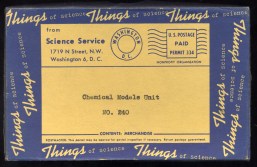
things of science box

My interest in science was reinforced by the Things of Science kits given to me by Bill Fisher.

They were packed in a small blue cardboard box about the size of a portable hard drive with a yellow address label. Included inside was a simple science project. I remember one being a crystal radio set, and another was a small motor run on electromagnetic current – battery not included.

Bill had the little boxes categorized by year and stacked up on a ledge in a niche carved into the dirt wall of his of literal “man cave.”

One Christmas, he bought me a subscription – the cost was $5.00 for the year. He was a quiet guy. Since he had no family, Bill was always invited over to our place for Thanksgiving. On Christmas, we always stopped by to see him and drop off a gift and some food on our way to the grandparents’ for Christmases 2 and 3.

Anyway, Bill had done research about bomb shelters and helped build ours. Bill was also a very meticulous mason. He taught me how to mix mortar, and lay blocks, which are life skills I’ve used on occasion over the years.

Our shelter was located in the northeast corner of the basement at the bottom of the stairs, which made for easy access. There was also a window well that led to the outside. Bill welded together an air shaft from steel pipe that led from inside the shelter and vented to the outside.

There was a set of surplus bunk beds, a pantry where canned goods and water were stored, along with plates and table ware. The fallout shelter temperature was always the same and was a good place to hang out during hot summer days. There wasn’t a place to cook, but there was a Sterno camping stove that could heat up a can of soup in a small space. There was a downstairs bathroom, but in the shelter the toilet was a galvanized steel port-a-potty with a sealed cover.

The threat of nuclear attack was real, but largely theoretical. If Cheyenne was targeted, a missile that hit in Torrington, would be considered, “close enough.” The main reason for the shelter was protection from “fallout,” the residual radioactive dust spewed into the upper atmosphere following a nuclear blast and eventually fall back to earth. The amount and spread of fallout is based on the size of the weapon, the altitude at which it is detonated, and prevailing winds. Since Cheyenne is so windy, locals though any fallout would be blown to Nebraska and Colorado.

In school, we watched short Civil Defense movies and film strips about how to prepare for a nuclear attack, “Do not look at the fireball,” we were warned. There were air raid drills similar to fire drills, except we sheltered in place. One exercise was to dive under our desks and cover our heads with our hands or a pulled over garment.

We also practiced exiting the classroom and going down into the school boiler room that was manned by the custodian, Mr. Costello.

maris topps

I collected cards like this Roger Maris from the backs of a Post cereal boxes. This particular one was a “giveaway” from a LIFE magazine ad.

During the summer time, I liked to go to the grocery store with my mom. Not that I like shopping, I stood in the cereal aisle looking at the backs of all the Post cereal boxes that had panels of baseball cards looking for the ones that had the most New York Yankees players – particularly Mickey Mantle and Roger Maris.

After returning home from the store, one of my jobs was to rotate the bomb shelter canned goods out and replace them with the new stock. The cans were dated using a magic marker. I’m still a food hoarder based on those days. Rather than buying one can of Beeferoni, I get four.

My dad and I spent Saturdays making the rounds at the local war surplus , Goodwill, and Salvation Army stores looking for items that would make living in the bomb shelter with some of the creature comforts, like extra can openers, and cooking utensils. That’s a habit a learned from my dad. I don’t have one tool kit, I have five – one in the car, house, garage, and two in my office – one dedicated to the camera equipment.

One item was a manual air circulator. I don’t think that thing was ever hooked up.

After Khrushchev backed down to JFK and the nuclear weapons were removed from Cuba, tensions decreased, even though there continued to be an escalation in the arms race between the United States and Russia. While the threat of nuclear war was lessened, everyone was more aware and vigilant as a result of preparing for an unforeseen war.

At my cohousing community, early on, there were some who didn’t think the COVID-19 thing was any big deal. They attended the community dinners with hubris. There are others who have self-isolated since the beginning.

Since then the community approved a set of guidelines concerning use of the common house. Most of my neighbors have come around, don’t go out much, and observe social distancing when talking to neighbors. If the governor orders Coloradoans to stay home, our cohousing community has been observing much of how that’s being handled in California. Since we’re all over 60 here and a “vulnerable” demographic, we may get more flexibility. I saw that Safeway now offers “senior hours” from 7am to 9am on Tuesdays and Thursdays.

Today, we’re celebrating one neighbor’s 80th birthday outdoors in the courtyard. Hopefully, the prevailing winds will keep any airborne COVID-19 away from the party. Even if they don’t, I have peace of mind knowing that there is a stash of toilet paper in the common house basement.

I’ll be at the birthday party in spirit.
Boulder Co-living – Nuts and Bolts

ssv coho alan boulder

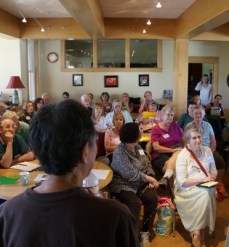
The burning souls organize gatherings for the future residents to get together and talk about the nature of their community.

What are the general steps to building the Boulder Co-living community? There will be people who get involved with various levels of interest ranging from the “Burning soul” advocates to the passively interested who sit back and watch how the project comes together. Nonetheless, there are three basic steps:

Feasibility study

  • Discuss and agree upon community values and perhaps, a higher purpose, which would fill the need to walk their community values talk while participating in service projects;
  • Whether you’re 30 or 80 people, come up with a name and “elevator speech” identifying the community. Referring to yourselves as a “bunch of housemates” doesn’t tell about your community story;
  • Community cohesiveness could be built around a higher purpose of community service that binds a community together.
  • Once you kick the can down the road a few blocks, check your state laws about homeowner association regulations. You will find they set up HOAs that do not mirror co-living very well – lots of centralized power and control, lots of voting.

Develop budgets

  • There likely will be common expenses that relate to community activities, coordinating transportation, common meals, intra-community communication and a fee structure to pay for all or part.
  • Community values and mission are implemented through the budget by teams – overall steering team equivalent to a board of directors, social events, managing building and grounds, proceed and governance, finances and legal matters,
  • The entire community approves by consensus the budget or any action for that matter, and the steering team ratifies the action also by consensus.

Design and Construction

  • If you’re sharing a big house, there will be design issues about designating common spaces and storage. Some design and construction in retrofits may be necessary if you’re in an existing condo community or apartment building is adapted. This may include renovating an existing dwelling unit into a common space with a guest room and common kitchen which was the case at Boulder Creek cohousing in Colorado;
  • Identify resident needs, how the “site” functions – if it is in an existing physical development like a condo association, apartment complex, or households dispersed within a given boundary;
  • Determine what are considered “common spaces” which may not be literally common, but function in common. These may be in private homes for shared meals and meetings, civic spaces, churches, libraries

Cohousing is a vaccine against COVID-19 isolation, loneliness

ssv corona lindy

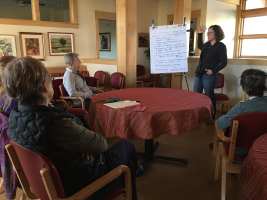
RN Lindy Cook gives a community orientation about the corona virus at an early meeting when the pandemic was still in its infancy.

A version of this story is now published in the fall 2020 edition of Communities No. 188. You download the publication here, courtesy of myself.

*************************************

One thing I’ve learned over the years, there’s nothing like a good old fashioned emergency to bring a community of any size together, from meeting your neighbor for the first time as a result of a power outage during a huge snowstorm to quickly spreading diseases like the coronavirus.

Cohousing communities and their residents are well equipped to deal with crisis situations, such as implementing current COVID-19 / Coronavirus prevention measures without resorting to martial law.

Internationally, nationally, and locally, hyper-vigilance will create political heroes, increase ratings on cable TV talking heads shows, sell more toilet paper – but in the long run, save lives, and bridge social and cultural divides.

We cohousers are predisposed to be hedges against isolation through collaboration, sharing of time and resources, and keeping track of one another. We’re big on meetings and getting together to make decisions about stuff.

Cohousing Association of the U.S. held a national online webchat about what other communities are doing around the country to respond to COVID-19. There is an online series that continues. Recordings will be available for those unable to participate live.

At my place, we have several neighbors self-isolating because of actual illness, having returned from travel or just being cautious. That hasn’t deterred the community from getting together.

ssv corona zoom

A virtual community meeting was held on the zoom.us platform for residents to talk about how to limit outside use of the Common House. All households were represented.

My community has convened a series of Zoom.us online conversations and reached consensus together on a set of common sense guidelines around how to use the community common house during lockdown.

Over the past few weeks, our resident opinions were all over the spectrum from “This is a hoax” to “I’m not worried” to “Put on the haz-mat suits.”

Myself? I’m more of a “Business as usual” guy, as far as my being “freaked out” quotient goes. I’ve been catching up on pandemic-related movies and TV shows. Last night “Outbreak” with Dustin Hoffman and Rene Russo was on Prime Video.

On Netflix, I’m watching a TV series called “Containment” about what happens among frustrated people during a viral outbreak in a quarantine area where there are too many “rats in a cage.” Next are the classic “Andromeda Strain” and “Contagion” with Gwyneth Paltrow. There’s a good one called “Flu” from Korea, but it’s subtitled – I’ll watch that when I can concentrate more.

But in the cohousing community, my behavior is to observe the the most important lowest common denominator, which is hyper-vigilance.

Silver Sage Village COVID-19 guidelines  generally prohibit outsiders from entering the common house, and itinerant use by community members.

During normal times, the building is seldom frequented except for a few people using the laundry, residents checking the mail, getting items from the storage room, the new social distancing criterium isn’t much of an inconvenience. The mailman is asked to wipe the mail boxes.

Most Baby Boomers, including myself, were around during the 1950s and 1960s toward the end of the polio pandemic, and the swine flu that spread in 2009, which coincided with the financial system collapse.

My family provided support when the oral polio vaccines came out. In my grade school one kid recovered from polio and wore a leg brace ala Forrest Gump. He was bullied because he also wore a hearing aid – back then, they were very conspicuous, with earphones wired to a receiver the size of a Band-Aid box.

glass syringe

I remember my grandfather’s insulin syringe as looking similar to this Dr. Frankenstein item.

Jonas Salk developed the first vaccine that was administered by injection. Getting jabbed with what seemed to be a needle the size of a railroad spike was my first shot.I don’t remember being freaked out about it.

Living on top of others is not new to me. One time, my grandfather, who had diabetes stayed with us. My grandmother was unable to care for him at the time since she was running the family business, the Highway Cafe.

I had to give up my bedroom, but went in to see him every morning because I was curious about the insulin shots he administered to himself. He let me poke him with the big syringe. It was a glass barrel connected to a stainless steel contraption. I don’t know how sterile it could be, since it was only wiped off by a cloth and some alcohol.

Anyway, I didn’t have a fear of needles, still don’t.

Back in the 1960s, the vaccine development competition was fierce. In the case of polio, Albert Sabin won the oral vaccine contest. Polio vaccines were risky in that some people who were vaccinated contracted polio, but that risk was outweighed by the number of cases prevented.

I remember a big family social event was gathering at my grandparents house on 8th Street in the Southside of Cheyenne. We walked over to the fire station and stood in line with all the other neighbors to get a sugar cube with pink fluid dropped onto it. Seems like there were boosters necessary, but the most memorable was the first one.

ssv corona spam shelf

During the 2009 swine flu pandemic, there wasn’t a run on food like now during the COVID-19 scare, but there were a billion cases and 500,000 deaths in 2009.

What about the swine flu pandemic from 2009? That was a pretty big deal. Obama had a lot on his plate back then keeping the auto industry and banks stable. He eventually declared swine flu a national emergency. I had to look it up to refresh my memory.

I don’t remember anything about self-isolating, wiping doorknobs with Clorox, social distancing or anything like what’s happening now – but 500,000 people died and a billion were sick around the world. Turned out, saving the world economy was more important than saving people.

There were warnings about the swine flu contagion, but no mass closures of schools or businesses, nor were employees self-isolating in mass numbers.

The coronavirus outbreak could be a lot like the swine flu and the crash of 2009. Getting ahead of the disease and propping up the economy is the best we can hope to minimize disruptions.

Cohousers have the wherewithal to fast track hyper-vigilant responses to the control the COVID-19 virus. The U.S. government getting out in front with an economic stimulus package that includes couple Andrew Yang-esque Uniform Basic Income payments of $1,000 to most people, will be a short-term shot in the arm.

I don’t know about you, but I have plenty of toilet paper in the bathroom cabinet – I’m a hoarder from way back. I’m eating up all my emergency food, though. Next crisis, I’ll stock up on my least favorite snacks.
conrad dobler si cover
I mentioned at the start about meeting my neighbor during a snowstorm. It was when I moved to Laramie for graduate school in 1976 or so and living at my parent’s townhouse.

There was a power outage and I saw my neighbor out on the walk. We were both checking out the situation – snow drifted to the side of the house and no power.

Turned out, he was a University of Wyoming alumnus and a former linebacker for the Pokes.

He and his family lived in Laramie during the off season when he wasn’t on the field playing for the St. Louis football Cardinals – it was none other than Conrad Dobler, pro-football’s “Dirtiest Player.”

Conrad turned out to be a pretty nice guy, and if you do anything over the next few weeks, get to know your neighbors, even if it’s from six feet away. Your lives may one day depend on your friendships.