
I caught a TV soft news segment about the giant balloons being prepared for the Macy’s Thanksgiving Day Parade. The story featured Underdog, the blue-caped canine superhero whose balloon first appeared in the parade in 1965.
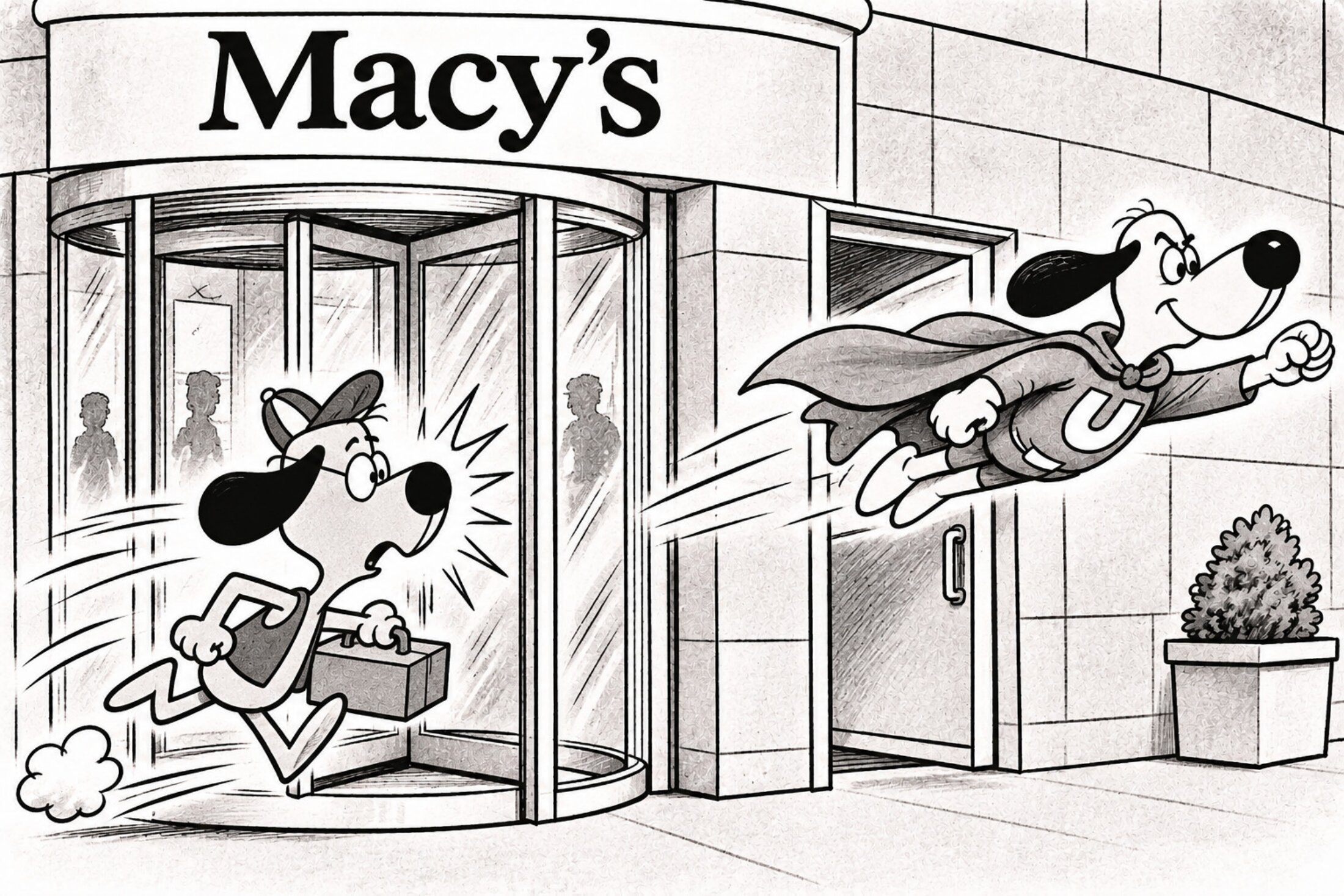
I have to admit, seeing Underdog brought back memories. The superhero, voiced by the late Wally Cox, didn’t need artificial intelligence, a streaming subscription, or a complicated origin story.
“There’s no need to fear. Underdog is here!”
He had a cape, a telephone booth, matched wits with the evil doer Simon Bar Sinister, and a good supply of helium.
Helium?
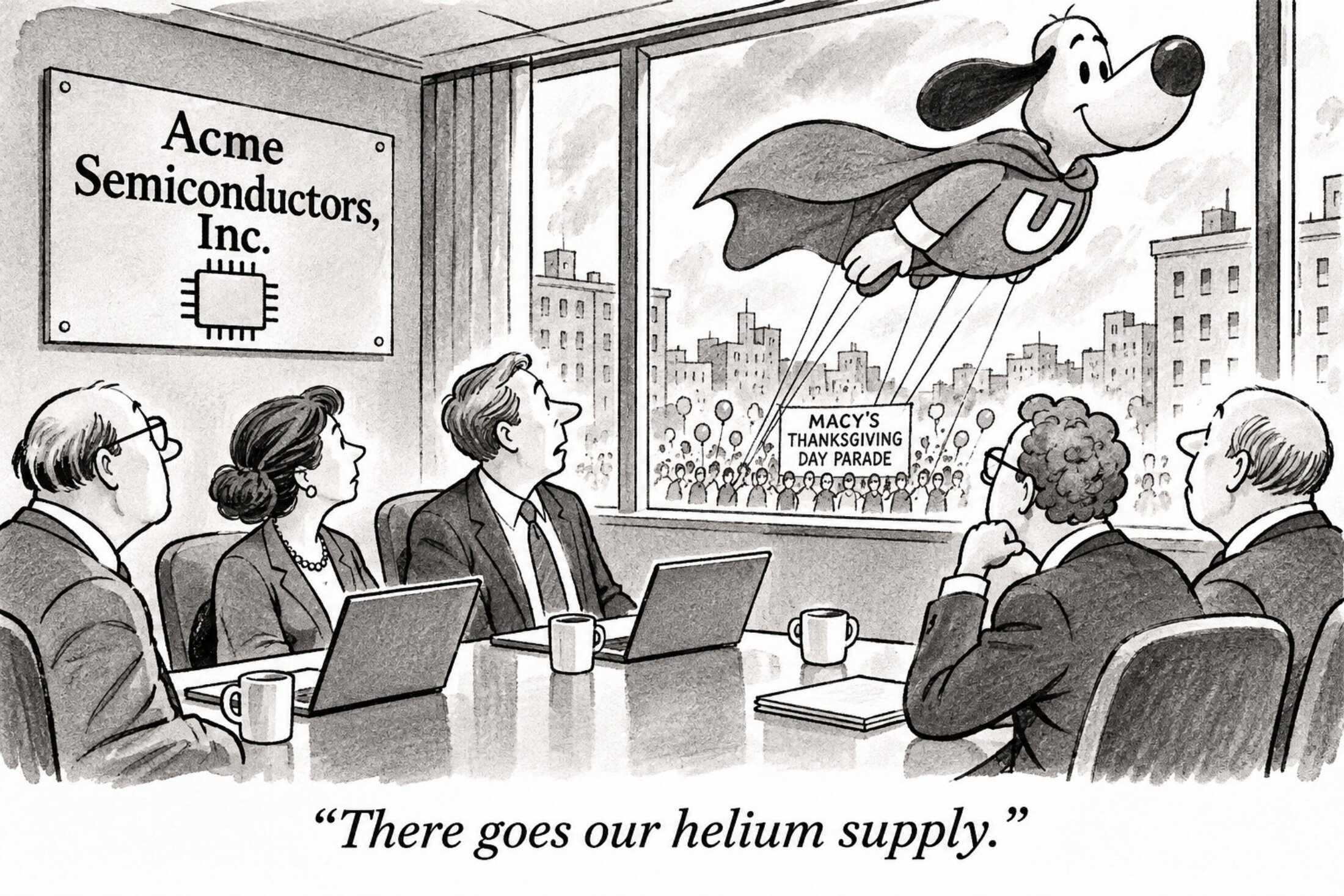
The same lighter-than-air gas that makes Underdog fly has a behind-the-scenes job regulating silicon wafer temperatures as they’re etched and processed. Think of it as the air conditioning system for the world’s most expensive microscopic assembly line.
That got me thinking. Why are we running short of helium?
In October, the U.S. Department of Energy added helium to its Critical Material List, recognizing its importance to semiconductor manufacturing, medical applications, and other essential technologies.
Helium has officially graduated from filling party and parade balloons to a national security concern.
If helium is such a high-demand commodity, why not recycle it?
One reason helium is wasted is that semiconductor manufacturers don’t routinely recover all the gas they use. During some manufacturing processes, helium flows behind silicon wafers to help regulate their temperature. Afterward, some of the gas enters the chamber exhaust, where it mixes with other process gases, including corrosive chemicals.
Recovering and purifying that mixture can be technically difficult and expensive. Engineers have developed ways to capture helium before it gets mixed with the exhaust, but recovery isn’t yet standard across the industry.
Recycling a valuable resource can interfere with profit margins.
The Thanksgiving Day balloons spewing helium into the post-parade air don’t help the cause either.
When the chips are down
According to the U.S. Geological Survey, in 2024, only 18 percent of American helium consumption went toward lifting gas, including balloons and airships.
The rest went toward running equipment and machines. About 15 percent of that total went to controlled atmospheres, fiber optics, and semiconductor manufacturing. Another 17 percent went to MRI machines, and 22 percent went to analytical, engineering, laboratory, scientific, and specialty gases.
Welding, aerospace, leak detection, and deep-sea diving account for much of the remaining consumption.
That’s a lot of important work for a gas most of us associate with floating birthday balloons.
Much of the world’s helium comes from a relatively small number of sources. Qatar produced nearly 40 percent of the world’s helium in 2024. Disruptions to its natural gas infrastructure during the 2026 Middle East conflict have put additional pressure on global supplies and technology supply chains.
Why does Qatar matter when we have helium here at home?
Wyoming is a helium heavyweight. The natural gas fields around LaBarge and Big Piney in southwest Wyoming account for an estimated 20 to 25 percent of the world’s helium supply.
The LaBarge facility alone has an estimated 80 years of production remaining at current rates. A new project near LaBarge, approved by the Bureau of Land Management in December 2025, could add more than 800 million cubic feet of helium production annually when it begins operating, currently expected in 2028.
That’s nothing to sneeze at.
It’s time we paid a little more attention to what the Cowboy State has underground.
Underdog might want to keep his cape handy. Wyoming could help keep him airborne for the next eight decades.
Does Underdog get priority?
Here’s a question for the folks managing our national resources.
When helium supplies get tight, who gets priority?
MRI machines? Scientific laboratories? Semiconductor factories making chips for artificial intelligence? The people responsible for keeping Underdog airborne?
Underdog has some serious competition.
I’m not suggesting we ground my favorite dog who had cosmic vision and spoke in rhyme like a 1960s hip-hop dog. Heaven knows we could use a superhero right about now.
The parade has its own history with wartime shortages. Macy’s suspended the parade during World War II, from 1942 through 1944. Materials that would have gone into the celebration, including rubber for the balloons, went to the war effort.
Underdog could do his patriotic duty and volunteer to walk the parade route instead, although that might disappoint the children and the adults who still remember him from Saturday morning cartoons.
The Creating Helpful Incentives to Produce Semiconductors (CHIPS) Science Act
At first, this story started out as a jokey connection between two seemingly unrelated uses for helium.
After I got to digging, there’s a serious economic policy question here.
In September 2023, the Biden administration announced a funding opportunity for smaller semiconductor supply-chain businesses. The program included manufacturers of chemicals, gases, equipment, and other materials American chip manufacturers need.
The Commerce Department has since reopened and amended that funding opportunity. Its current program accepts proposals for facilities producing semiconductor materials, including gases, with concept plans accepted through 2027.
There’s a principle here.
If taxpayers subsidize the construction of semiconductor factories to protect American economic and national security, shouldn’t those same taxpayers expect the companies to help strengthen the domestic supply of helium?
We don’t have to prohibit imports. We don’t have to pick a fight with Qatar, an important American security partner in the Middle East.
We can reward companies that invest in American suppliers, including those in Wyoming.
Here are my three ideas:
- Domestic purchasing preference: Companies receiving federal semiconductor subsidies should demonstrate that they prioritize American helium when it meets quality, availability, and competitive-price requirements.
- Long-term purchase agreements: Offer tax credits or other incentives to chip manufacturers that sign multiyear contracts with domestic helium producers. This gives producers the confidence to invest in additional extraction and purification capacity.
- Helium recovery requirements: Require federally subsidized semiconductor facilities to evaluate and install helium recovery systems when technically and economically practical.
A helium-filled Underdog parade balloon isnisn’tsponsible for computer chip shortages. The quantities and uses are different.
The connection between the two raises an interesting question about our priorities.
We spend billions encouraging sophisticated technologies that depend on a gas that, when inhaled, makes a grown man’s voice sound like a Munchkin.
This Thanksgiving, when Underdog makes his return to the parade after a 42-year absence, I’ll be cheering for him to stay afloat.
Let’s hope nobody gets the bright idea to substitute hydrogen. An exploding Underdog would be a terrible way to celebrate the parade’s centennial.
Get that dog a fire extinguisher!

