Memorial Day 2014

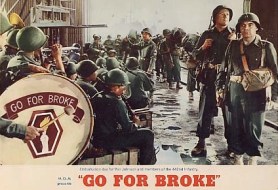
goforbrokeRlc4

My uncles George Sakata, Rich Ohashi and Vince Ichiyasu were members of the 442nd Regimental Combat Team during World War II. My uncle Jake O’Hashi also served in the U.S. Army.

CHEYENNE, WYOMING – Memorial Day is upon us again. When I was a kid growing up here, the Japanese had a big carry-in picnic at Holliday Park – lots of sushi rolls, teriyaki chicken, abalone salad – bento box type food.

I think because this park is closest to the cemetery is why we all met there.

A couple of the guys brought over boxes and boxes of flowers. After the first go-around of food, everyone went over to the Lakeview Cemetery and placed flowers on all the Japanese graves. There wasn’t much reminiscing that happened, but that was just the “inscrutable oriental” way.

The Cheyenne Japanese community used to be fairly large. One of the gathering places was the original City Cafe that was run by Mrs. Shuto and later her son, Tommy.

lakeview japanese head stone

The Japanese grave markers in the Lakeview Cemetery. I grew up in the Cheyenne suburb Cole Addition Japanese Ghetto – Nakano, Kubota, Shiba and O’Hashi. It was also the home for several Greek families – Contos, Hatanales, Talagan, Mears.

Occasionally, my family went over there to watch black and white samurai movies and listen to music. In the back, the old guys were screaming and hollering during their rousing game of hanafuda (flower cards) that also involved slapping the thick cardboard cards on the table.

I didn’t learn how to play. I don’t think the rules were written down anywhere back in those days and I didn’t understand Japanese if someone tried to explain them to me.

Since I happened to be in town, I stopped over and decorated my family’s graves at the cemetery east of Cheyenne on the old Lincoln Highway. I overshot the exit on I-80 and on my loop back on Highway 30, I picked up a hitchhiker named Chris. He’s from Huntington, WV home of Marshall University (“We Are Marshall”).

suspect hynds building

Cheyenne’s finest questioning a guy sitting in front of the Hynds Building during the Cheyenne International Film Festival earlier this week.

He was walking back to the Pioneer Hotel from his job as an irrigator on a farm east of town. it would have been at least a 10 mile walk for him. He was lamenting about the high cost of housing in Cheyenne and that the Pioneer meets the needs of men who have jobs, but can’t afford traditional housing. He’s only been in Cheyenne for a month, but has noticed the discrimination that the Pioneer Hotel residents and homeless people face.

Anyway, he went to the cemetery with me while I decorated the family graves before I dropped him off at the Pioneer. He was looking forward to the extra day off after toiling in the fields. As we passed a convoy of Wyoming Highway Patrol, we both agreed that Memorial Day weekend would be a good time to be on foot and not driving a car.

When the Issei and Nisei generations started passing on, the Memorial Day picnic tradition pretty much stopped.

I was curious about Memorial Day and how it all got started. This is what wikipedia has to say about it:
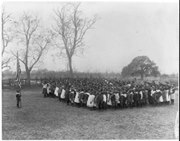
original memorial day

The first Memorial Day was observed in Charleston, SC after the Civil War.

“The first widely publicized observance of a Memorial Day-type observance after the Civil War was in Charleston, South Carolina, on May 1, 1865. During the war, Union soldiers who were prisoners of war had been held at the Charleston Race Course; at least 257 Union prisoners died there and were hastily buried in unmarked graves.

Together with teachers and missionaries, black residents of Charleston organized a May Day ceremony in 1865, which was covered by the New York Tribune and other national papers. The freedmen cleaned up and landscaped the burial ground, building an enclosure and an arch labeled,

“Martyrs of the Race Course.” Nearly ten thousand people, mostly freedmen, gathered on May 1 to commemorate the war dead. Involved were about 3,000 school children newly enrolled in freedmen’s schools, mutual aid societies, Union troops, black ministers, and white northern missionaries. Most brought flowers to lay on the burial field. Today the site is used as Hampton Park. Years later, the celebration would come to be called the “First Decoration Day” in the North.”

I don’t think Memorial Day became “official” until several years later when the politicians took hold of it.

ohashi grave

I haven’t been in town for Memorial Day. I stopped by today and decorated my parent’s and the other family head stones.

There are still a number of Sansei in Cheyenne and the surrounding area, including my sister, some cousins and myself. My uncles and aunts and the Nisei generation don’t have the energy they once had for organizing any big activities like the Memorial Day picnic. Every year, I think about getting in touch with everyone, but I don’t have the energy for it either.

This has nothing to do with honoring fallen soldiers – but from here on out, Memorial Day will be memorable for me since my autoimmune health issues began shortly after I finished the Bolder Boulder 10K foot race in 2013. I’ll let you know how the acupuncture treatments are going.

Bolder Boulder Update

alan bolder boulder 2014

I ended up taking a swig of O2 coming up the final Folsom Hill, I’m still swelled up from the steroids.

After tapering off the steroids for my lung problem, It was an unknown adventure. My neighbor Henry drove my across the sidewalk neighbor, Jim and I to the Bolder Boulder start point. I was unsure how far I could make it since my practice is NOT to train for races. The only training has been occupational therapy walking from place to place.

When I dug my shoes out of the closet last night, I noticed that they didn’t quite fit right. My ankles are still swelled up for some unknown reason and the muscle mass of my feet was also less than it was – nothing a little cinching up won’t fix The last time I trained for a race was for a 5K in Lander many years ago, when I twisted an ankle. Since then, I’ve just taken my lumps during the real thing.

After making it past the first mile, I felt like I’d be able to finish the course. My practice is to film snippets of each of the  bands along the route, which slows down my pace a bit. My mission is to complete the race before the mop-up crew gets out there.

I’m 15 pounds lighter than I have been, but carried my oxygen bottle just in case. I did have to take a few boosted breaths midway up the Folsom Hill on the way into the stadium. Other than that, I felt pretty good. In the past, even last year, around the 5K mark, the interior part of my knee joint would begin to hurt and my thighs would cramp, but not today. I attribute that to eating better and not having so much crud built up in my scrawny muscles.

Northern Arapaho, Jews, Japanese, Passover, Kugel and Me

Passover is happening this week and next and how that relates to the Northern Arapaho Tribe, Jews, Japanese, Kugel and me is a circuitous and non sequitur route.

When I first started traveling to Boulder back during the Rockies’ first baseball season in 1993, I befriended a lot of Jewish people. In fact, the reason I stayed in Colorado was because of baseball, having been Major League Baseball starved for most of my life.

I don't know the attraction, but at the time I was working for the Northern Arapaho Tribe on the Wind River Indian Reservation in west central Wyoming.  This is the Arapaho flag.

I don’t know the attraction, but at the time I was working for the Northern Arapaho Tribe on the Wind River Indian Reservation in west central Wyoming. This is the Arapaho flag.


There was a nonprofit group in Boulder – now defunct – called the Next 500 Years (N500Y) that had as its mission the repatriation of tribal lands. Turned out that was a bit lofty, but creating a “cultural conduit” between the rez and Boulder seemed to be a bit more doable.

At that time, there were a lot of art galleries on the Pearl Street Mall and the idea was to convince the galleries to dedicate some space for Arapaho artists and artisans. The project started to get some legs but the organization went out of business for a variety of reasons, none of which will be mentioned here.

The tribal cultural conduit went away, but I remained. Most if not all of the N500Y crowd moved out of Boulder.

My N500Y Jewish pals took me along to quite a few Jewish events, including Passover seders in my early days in Boulder. Back then, Rabbi Firestone was just starting up her reformed synagogue in her home and in the homes of members.

Some of my new Jewish friends had fallen away from their roots and I was more of a safety valve as they checked out what the reform movement had to offer. That congregation has grown to point that it took over my former Methodist church on 19th Street in North Boulder which was “deconsecrated” and otherwise went out of business a couple years ago.

To refresh your memories from Sunday school / Hebrew school about Passover, here is a very truncated version of the origins of Passover.

The descendents of Joseph (of the “Amazing Technicolor Dream Coat” fame) eventually decided to stick in Egypt. The Hebrews take on the Egyptians, for some reason. That was a hopeless cause.

I think for revenge, the Pharaoh put out a decree to find and kill the first born children of Hebrew moms. Upon learning of this, baby Moses’s sister, Miriam,  hides him in a basket in the shallow the bull rushes. The basket and infant Moses are fished out by the pharaoh’s daughter who brings him up as an Egyptian prince.

Prince Moses gets into trouble – what he does, I can’t remember, but he ends up stealing out of town. He eventually returns after getting the word from God to free his people from Pharaoh Ramses.

Moses makes a demand to the Pharaoh to "Let my people go" - Charlton Heston's Moses and Yul Brenner as the Pharaoh are probably the most widely recognized in American pop culture.

Moses makes a demand to the Pharaoh to “Let my people go” – Charlton Heston’s Moses and Yul Brenner as the Pharaoh are probably the most widely recognized in American pop culture.


Unless he does, Moses tells the pharaoh that there will be a bunch of consequences – 10 to be exact – perpetrated by his God in the forms of polluted water, various kinds of frogs clogging up the waterways, bugs eating the crops among other plagues.

What finally convinces the Pharaoh is, after the 10th quid pro quo, his first born child dies after the Angel of Death passes over, but spares the Hebrew households that have smeared lambs’ blood above their doors – ergo, The Passover.

The bummed-out Pharaoh sends the Hebrews packing. In their haste, they don’t have time to let their bread rise and thus the sympolic use of unleavened matzoh during Passover.

Things don’t get much better, since the Pharaoh and his troops go after them, but get swallowed up after the Red Sea parts. Moses and his people are out wandering around in the middle of nowhere searching for the “Promised Land” having faith that Moses knows where he’s going. There’s more, but you can read the book of Exodus as well as I can.

As for myself, being a gentile, I was accepted at the Jewish ritual events, including Hanukkah (not-so-ritual) and Passover (very ritual), but haven’t really participated much in recent years, although writing all this reminds me about that old joke about Japanese Jews.

These two guys are walking down the street and wonder whether there are any Japanese Jews. They finally decide to put their debate to rest and wander into a Sushi restaurant.

One guy asks the Sushi chef, “Excuse me, but my friend and I are having a debate and wondered if you could help settle it. Do you know of any Japanese Jews?”

Of course in Boulder, there are plenty of Jewish Buddhists.

When I ran the Boulder Asian Film Festival, a documentary called "A Zen Life" screened at the Shambala Center about a Japanese scholar named D.T. Suzuki.

He is credited for bringing Buddhism to the west back in the early part of the 20th century.

Of course in Boulder, there are plenty of Jewish Buddhists. When I ran the Boulder Asian Film Festival, a documentary called “A Zen Life” screened at the Shambala Center about a Japanese scholar named D.T. Suzuki. He is credited for bringing Buddhism to the west back in the early part of the 20th century.


The sushi chef thinks for a moment and says, “I don’t know, let me go back and ask the owner, he’ll know.”

A few minutes later the sushi chef comes back out and says, “Oh, no Japanese Jews, but we have orange jews, tomato jews, grape jews, but no Japanese Jews.”

Pretty bad, but generally gets a laugh.

World War II Exodus

There is another historic link between Japanese and Jews.

My friend Chris Tashima did a short movie that won an Oscar for “Visas and Virtues” about Jews during the World War II diaspora fleeing Germany through Lithuania many heading for Shanghai in China which also was a safe haven. I suspect this is where Jewish women began their interest in Mahjong.

The Japanese Consulate Sempo Sugihara (Chris Tashima), risked bad repercussions for his actions there when he processed hundreds of documents of transit.

The Japanese Consulate Sempo Sugihara (Chris Tashima), risked bad repercussions for his actions there when he processed hundreds of documents of transit.

I’m working on screening “Visas and Virtues” at the Heart Mountain Japanese Internment Camp Interpretive Center by Powell, Wyoming in June.

What next?

My colleague Michael Conti asked if I could help him on a live video stream from the house of a “Boulder Rabbi” next week.

Turns out it's Reb Zalman Schachter, who I've been following around since I moved to Boulder starting with my stint on the Boulder Human Relations Commission.

Turns out it’s Reb Zalman Schachter, who I’ve been following around since I moved to Boulder starting with my stint on the Boulder Human Relations Commission.


He wrote a book called “From Aging to Saging” which is how I first got to know about him. I gave my dad a copy of the book when he retired and was figuring out what he wanted to do.

Reb Zalman can’t make the trip to a conference himself, but will be there via the internet. I am quite honored to set up this remote which will be happening next week.

Where does that leave my story …

Kugel. There's a microwave recipe for sweet noodle kugel I'll whip up today.

Kugel. There’s a microwave recipe for sweet noodle kugel I’ll whip up today.

Sweet Noodle Kugel

Ingredients

  • 1/3 cup white sugar
  • 1 (8 ounce) package egg noodles
  • 2 apples – peeled, cored and finely chopped
  • 1/2 cup sour cream
  • 1/2 cup cottage cheese
  • 3 eggs
  • 1 teaspoon ground cinnamon
  • 1/2 teaspoon salt
  • 1/3 cup raisins
  • 2 tablespoons brown sugar
  • 2 tablespoons chopped walnuts
  • 2 tablespoons butter

Directions

  1. * Fill a large pot with lightly salted water and bring to a rolling boil over high heat. Once the water is boiling, stir in the egg noodles, and return to a boil. Cook the pasta uncovered, stirring occasionally, until the pasta has cooked through, but is still firm to the bite, about 5 minutes. Drain well in a colander set in the sink.
  2. * Grease an 8-inch square microwave-safe glass baking dish. Beat the eggs together in a mixing bowl. Stir in the cooked noodles, white sugar, chopped apples, sour cream, cottage cheese, cinnamon, salt, and raisins; mix until combined. Pour the mixture into the prepared dish.
  3. * Microwave on medium high (70% power) for 7 minutes.
  4. * Combine the brown sugar and chopped walnuts in a bowl, and cut in the butter to form a crumbly topping. Sprinkle the topping over the pudding. Return the pudding to the microwave and cook on medium high (70% power) until the pudding is firm in the center, 7 to 9 minutes.

Shabbat Shalom!