
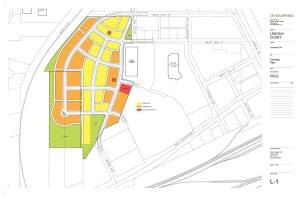
After a couple meetings with the city of Cheyenne planning office, the Lincoln Court mixed use affordable housing project is making some headway. Click on the image to read the latest.
I’m leaving for Nashville in a few hours to participate on a panel at the Tennessee Governor’s Conference on Affordable Housing.
Part of my presentation was about the Lincoln Court mixed use affordable housing project I’m pushing in my hometown of Cheyenne. Based on what I learned at an informational meeting last week about the project, my entire presentation is changed.
We’re getting a little press about the Lincoln Court mixed use affordable housing project. It’s a moving target with lots of things happening in the neighborhood with the likely Hitching Post demolition and the Atlas Motel now up for sale.
Project architect and also my across-the-street neighbor Bryan Bowen and I held a couple informational meetings in Cheyenne last week. The first was attended by stakeholders from the city, realtors and lenders.
The second was attended only by the newspaper reporter Austin and photographer Jacob. That was a little disappointing, but based on the comments we sought on social media, it wasn’t surprising.
Both of them have wondered about the lack of affordable housing in Cheyenne. Having been a newspaper reporter, I know that news gatherers aren’t exactly pulling down the big bucks. Jacob reported that he spends 50 percent of his monthly income on housing in Cheyenne. The generally-accepted housing cost is closer to 30 percent.
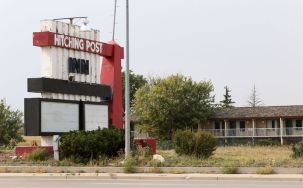
The city shut off the power and water to the Hitching Post Inn signalling a move to demolish the historic hotel.
Based on the intrepid reporters’ observations around Cheyenne, particularly about the, apparently, very active Not In My Back Yard (NIMBY) crowd, they, too are skeptical about whether Lincoln Court would actually happen because of the lack of community support for the idea of affordable housing.
Lincoln Court is the perfect project to satisfy the NIMBYs since it is bounded by Highway 30, Missile Drive and the railroad tracks – who in their right minds would want to live there, and to top it off how about 40 mph winds and 40 below?
This is a huge opportunity to anchor the redevelopment with a collaboration among the city, the Hitching Post Inn and the Atlas Motel to return the West End to the vibrant neighborhood it once was.
While comparing Boulder to Cheyenne is “apples and oranges,” Boulder’s Holiday Neighborhood is a strong corollary to what can happen on Cheyenne’s West End. Holiday is bounded by State Highway 93 (Broadway), US Highway 36 (to Estes Park). The surrounding land uses are industrial (peat moss yard), light industrial (garages, car lots, storage), trailer parks (Ponderosa and Meadows), risky recreation (two shooting ranges and a strip club – now closed).
Holiday ended up with over 333 homes with 40 percent permanently affordable on 27 acres. There are data from an affordable housing purveyer called Artspace that when new residents are introduced to slum and blighted areas, the land uses change and become vibrant.
This is generally identified negatively with the concept of gentrification where affordable housing is replaced with high end housing and kitschy boutiques and Starbucks.
What’s great about a place like the West End of Cheyenne is, there will be no displacement of current residents, but rather new ones will be attracted. No historic buildings will be demolished, but new ones built that keep memories alive through historic place making.
There is a huge housing gap not just in Cheyenne, but many places. On social media we asked for input and comments and heard from mostly skeptics about the meaning of “affordable housing” and whether or not the city government was going to lead or muddle through.
When housing is only reliant on market forces to set prices, developers typically nurture a niche that meets the needs of people who earn a good living, are of lower financial risk and able to purchase larger and more expensive houses.
In the absence of community supporting decent housing for all and no agreed upon definition for “affordable” anyone but those with an ability to buy what the market offers are literally left out in the cold. I think there is a WTE article coming out in the near future about people living in substandard conditions.
I’m not saying the public sector has to set up a bureaucracy to deal with affordable housing. One of the objectives of Lincoln Court is to come up with a way to market-regulate permanent affordability.
I have to say that the project is a bit frustrating since there’s a demonstrated need for lower cost housing in Cheyenne. The Lincoln Court wants to meet the heart-felt need to provide affordable and safe homes where individuals and families can thrive.


 Collaborative neighborhood process. Future Lincoln Court denizens will have a chance to participate in the design of the community so that it meets their needs. There will be a series of meetings as the project progresses to define them. Some collaborative communities are initiated or driven by a developer. The Lincoln Court Collaborative Community is a combination of both with the developer playing more of a technical role making the community member vision real. This collaboration will result in a well-designed, pedestrian-oriented community that integrates with the adjacent West Edge community, as outlined in the city of Cheyenne Missile Drive Corridor Plan.
 Collaborative common spaces. Common facilities will be designed for daily use, and for special community activities. They are an integral part of the collaborative community, and complementary to the private residences and businesses. The extent to which the private businesses and studio spaces are public will be determined. There will likely be an expectation that community uses and activities will be a part of the private business spaces. Participating in community life is optional – denizens may have as much community as or as little community as they want. Since the buildings are clustered, the Lincoln Court may retain several or many acres of undeveloped shared open space for future expansion.
 Collaborative management. Lincoln Court denizens will manage, to a great extent, the business of the collaborative community, and also perform much of the work required to maintain the property. The cohousing sub-communities participate in the preparation of common meals, and meet regularly to solve problems and develop policies for the community. A master Community Association may be formed to deal with issues concerning common spaces of the entire collaborative community, such as snow removal, open space maintenance, and managing community business relations.
 Collaborative consensus. Leadership roles will evolve and based on how and when community members join Lincoln Court. However, no one person (or persons) has authority over others. As individuals, families, businesses and organizations join the collaboration, each take on one or more roles consistent with their skills, abilities or interests. Lincoln Court will make decisions by consensus or similar forms of consensus decision-making. Although likely will have a policy for majority-rules voting if the group cannot reach consensus (nuclear option).
 Collaborative community economy. The community is not a source of income for its individual members. However, in the Lincoln Court, rental income from businesses, use of performance / exhibition space, studio / co-working spaces would accrue back to the community at-large to decrease homeowner / community owner association fees / reserve funds. It is possible that the master association or a sub-associations could contract with a resident / tenant to perform a specific task for compensation, but more typically the work will be considered that member’s contribution to the shared responsibilities. It is possible that community residents will earn income from rented studio or business location.
 Collaborative higher purpose. The envisioned community “higher purpose” is around arts, culture and fostering creative thinking in the day-to-day community functionality. The site has a great story. The original site was a part of a Homestead Act land grant at the turn of the 20th century. Historic Highway 30, also known as the Lincoln Highway spanned coast to coast in the 1930s. The Lincoln Court was built as a motor hotel which later evolved into the Hitching Post Inn. The Hitching Post was a legendary Cheyenne landmark. There are some great stories associated with the site which are big selling points for the project. Mine, for example? My first job when I was a 12-year-old was at the Hitching Post.
 Views from Behind the Lens