Unknown's avatar

About Alan O’Hashi, Whole Brain Thinker

I’ve been involved with community journalism since 1968 when I wrote for my junior school paper, the "Tumbleweed," through high school and college and then wrote for the "Wyoming State Journal." I put aside my newspaper pen and began Boulder Community Media in 2005. There wasn’t much community journalism opportunity, so I resurrected my writing career as a screenwriter. My first short screenplay, “Stardust”, won an award in the 2005 Denver Screenwriting Center contest. I've made a number of movies over the years. Filmmaking is time-consuming, labor and equipment intensive. I recently changed my workflow to first write a book and make a movie based on that content. - Electric Vehicle Anxiety and Advice - This is a memoir travelogue of three trips covering 2,600 EV miles around Wyoming (2022) - Beyond Heart Mountain - Winter Goose Publishers released my memoir in February (2022) - The Zen of Writing with Confidence and Imperfection - This is a book recounting how luck planed into my signing a book deal after a 15-minute pitch meeting. (2020) - True Stories of an Aging Baby Boomer - War stories about living in a cohousing and lessons others can learn when starting their communities (2021) - Beyond Sand Creek - About Arapaho tribal efforts to repatriate land in Colorado (PBS - TBA) - Beyond Heart Mountain - Based on my memoir about my childhood in Cheyenne facing overt and subtle racism toward the Japanese following World War II (PBS - 2021) - New Deal Artist Public Art Legacy - About artists who created work in Wyoming during the Great Depression (PBS - 2018) - Mahjong and the West - SAG indie feature which premiered at the semi-important Woodstock Film Festival (2014) Over the years, I’ve produced directed, filmed and/or edited several short movies, “Running Horses” (Runner Up – Wyoming Short Film Contest), “On the Trail: Jack Kerouac in Cheyenne” (Lowell Celebrates Kerouac Festival, Top 10 Wyoming Short Film Contest), “Gold Digger” (Boulder Asian Film Festival), “Adobo” (Boulder International Film Festival), “A Little Bit of Discipline” (Rosebud Film Series), and two feature length documentaries “Your Neighbor’s Child” (Wyoming PBS and Rocky Mountain PBS), and “Serotonin Rising” (American Film Market, Vail Film Festival). He also directed and produced the award winning stage play “Webster Street Blues” by my childhood friend Warren Kubota. Boulder Community Media is a non-profit production company dedicated to democratzing media in all their forms - large and small screens, printed page and stage by providing sustainable and community-based content. I mostly work with community-based media producers, organizations, and socially-responsible businesses to develop their content via – the written word, electronic and new media, the visual and performing arts in a culturally competent manner – I’m what’s commonly called a niche TV and movie producer. Along with all this is plying my forte’ – fund development through grant writing, sponsorship nurturing and event planning.

Not that there’s anything wrong with that

elway xxxiii

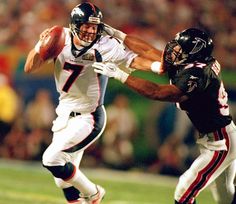
Denver Broncos quarterback John Elway in Super Bowl XXXIII

The Broncos fresh off a win in Super Bowl 50 are looking for a quarterback now that Peyton Manning is hanging up his spurs. His back-up, Brock Osweiler is on to greener prairies in Texas leaving the team’s General Manager, John Elway, in a lurch.

I’m sure Elway can relate to the quarterback replacement dilemma after his retirement following the Super Bowl XXXIII win which brings me to my story.

In 1999, I was doing some consulting work for a non-profit in Boulder called Rock the Planet that used mountain climbing as a metaphor for positive youth development.

The group sent me on a field trip to attend a climbing wall convention in New York City.

It was the dead of winter. I made arrangements to stay with one of my college classmates who still lives on the upper westside between Broadway and Central Park on 72nd.

A couple days before my visit, he called and said he was deathly ill with a cold and made arrangements for me to stay at one of his friend’s short term rentals in Greenwich Village.

I arrived and was greeted by Jon who escorted me to the little studio, that he rented to me for a couple hundred bucks for the weekend. It was cozy but cold. By the time the steam heated up the small place, it was time for me to leave.

I don’t recall anything about the meeting I attended, but it was Super Bowl Sunday and the Broncos were playing. I didn’t know the neighborhood that well, since I normally stay a little further uptown at the Hotel Pennsylvania.

Near my room was a bar – or what looked like a bar. There wasn’t a prominent sign. Since neither of the New York teams were playing, I suspected the crowd would be light.

When I walked through the door, the place was rocking – loud music, people dancing. There was a TV behind the bar. I elbowed my way through the crowd, and sat down on an empty stool and ordered a beer. I asked the bartender to put on the game.

Meanwhile a couple guys walked over and sat down and struck up a conversation wondering what I was doing there. We had a couple laughs before they disappeared into the crowd.

Eventually, I noticed that the bar was not only full of mostly men, which wasn’t unusual, but there were men dancing with men and guys making out with guys in the booths.

Stonewall1

The Stonewall Inn was ground zero for the modern day gay rights movement.

Turned out, I had stumbled upon the infamous and now famous Stonewall Inn.

Back in the summer of 1969, it became the birthplace of the modern gay rights movement. In those days, police routinely raided gay bars, but on June 28th of that year, nobody cooperated and a riot broke out. The following morning thousands joined a protest on Christopher Street.

My college friend is gay and while frat brothers at a small Presbyterian college in the middle of Nebraska, sexual orientation wasn’t of much concern since it was an assumed heterosexual world there. I didn’t learn that my ‘mate was gay until we were well out of school.

Back in the late 1980s when I was living in Lander, Wyoming, I was out drinking with a buddy. After the bars closed we went over to his place. That was the first and only time I had been propositioned by a man. I told him I prefer women. He made it sound like being gay was a choice and tried to talk me into it,  “You might like it,” he said.

I told him I prefer women.

That was that.

I imagined he felt the same as when I was when a woman turned down my proposition. My sexual exploits aren’t anything to write home about. I don’t imagine they are much different that the rest of the people I’ve hung around with over the years.

What may be different, I do have a documentary movie in mind about personal classified ads and online dating. I’m of the age where I’ve had success and failures with both. I’m now getting up the nerve to ask some of the women I’ve met through those means whether they’d be willing to share their experiences  – not necessarily experiences with me, though.

I watched a documentary on HBO about gay online dating which included some bizarre stories.

The Stonewall Inn will probably be a part of this project in someway, but i probably won’t get around to it until the next Super Bowl because I’ll have to make a pilgrimage there.

By the way, the Stonewall was hoppin’ by the time the confetti was flying at the end of Super Bowl XXXIII. I was the only one who cared that the Broncos beat the Atlanta Falcons 34 – 19. I got on the train and went uptown to Sardi’s to celebrate.
Swish and spit

I got a call from my cousin, Leslie.

These days, whenever relatives call, there’s generally some sort of family emergency. This time, Leslie told me our Auntie Elsie died. She was 89 and after a fall breaking her ankle she was moved out of her house and into a rehab center in north Cheyenne.

I stopped in to visit her when I was in town before and noticed she had a banged up face. Cheyenne is a smallish town. Elsie’s roommate is the great aunt of some high school mates of mine. She said Elsie fell out of bed. What I wasn’t told, is that she was now in hospice care because of it.

I was planning another trip to visit her and get a couple bits of family history from her about the time she sprung my grandfather and her brother – my Uncle George – from a holding stall at the Santa Anita Racetrack when Executive Order 9066 was signed by FDR rounding up west coast Japanese – Americans.

Long story short, Japanese who lived in the interior like in Wyoming were viewed as being non-threatening and allowed to stay in their homes and Elsie was able to get them back to Wyoming.

After World War II Elsie chose to move to Boston where she attended dental hygienist school and upon graduation, returned to Cheyenne and worked for Dr. Carson, who ended up being our family dentist.

Back in the 1950s and 1960s going to the dentist was viewed, I think by everyone, as cruel and unusual punishment. Those belt-driven drills that moved the bits at the speed of a hamster spinning his cage were gruesome.

The classic diabolic dentist movie scene is when a Nazi war criminal played by Lawrence Olivier bores into Dustin Hoffman’s front teeth in “Marathon Man”.

I inherited my dad’s bad teeth. I don’t know if kids still get their baby teeth capped, but all my teeth were covered with stainless steel. If there were metal detectors back then, I never would have made it into a sporting event or through the airport.

My aunt the hygienist cleaned my teeth. She always made it fun for kids. This was during the days of cuspidors – those little round sinks with cold water swirling around. I’d get that gritty toothpaste which sort of tasted good squirted out by my aunt pulling the trigger on that high pressure water pistol that shot a straight stream from two feet away.

Then swish and spit.

I always liked the mist that splattered up on my face as the fast moving water sloshed up the ceramic sides of the bowl.

When it was Dr. Carson’s turn, he wasn’t the most personable guy, at least compared to Dr. Cohen, my pediatrician. After a few pleasantries, if I was in for a filling, he pulled out this Dr. Frankenstein contraption. It was a glass, graduated cylinder embraced in a stainless steel housing with a needle the size of a house nail. He would stick it in a bottle of Novocain, pull it out of the robber stopper with a squeak and squirt the air out before jabbing me various places in my mouth.

Elsie would come in and mix up the filling gunk, which consisted of mercury and silver. My mouth was so full of toxins by the time I was out of high school, it would make a tuna fish gag. I gave up my last old school filling when my root canal tooth finally gave way a couple years ago and replaced by a ceramic one. My dentist at the time talked me out of gold, because it would ‘show’.

I shouldn’t have listened.

There’s no wonder dentists are viewed as torturers.

I don’t have to tell anyone who’s experienced those low RPM drills how much more pleasant it is to go to the dentist now and have to submit to those water-cooled hydraulics ones.

When I have dental work done nowadays, I don’t bother with the anesthetic since the needle poke hurts more than the drilling and there’s no biting of the inner cheek because of the weird numbness.

At the end of the session, Auntie Elsie handed me a pencil and a toothbrush and I was on my way.

Dr. Carson’s office was right next to the Bunten Pharmacy on one side and a block away from Save More Drug and Thrifty Drug. While waiting for my ride, I killed time browsing the baseball cards and Beatle cards and waste my money one a pack or two of them.

Elsie was single and in those days, that was unique, but not unusual for my family with three of her brothers never marrying and a brother and sister marrying much later in life.

She lived in south Cheyenne with my grand parents and her brother, Richard. She eventually moved out to her own place. Rich stayed there until both grand parents died and eventually married. More on them later.

Elsie was quite the athlete – playing 2nd base in a competitive softball league and a 175 scratch bowler. When she quit playing, I think I have her glove in my baseball box. My dad gave me my first glove, which I still have. Not a good memory about it though. The neighbor kid, who was much older than any of us threw a ball at me that was catchable.

I was scrawny and my hand and arm weren’t strong enough to keep the ball from flying out of the webbing and into my eye. I think it knocked me out. I ended up going to the emergency room, but I was no worse for the wear.

The glove I used most of my Little League career I bought at a church rummage sale in November 1963. It’s a Rawlings Wally Moon model. It had a broken in pocket and I made many a good play with it. There were a couple fly balls I should have had but flinched when the fence came up on me. Those weren’t major league fences, they were chain link barely waist high with the barbed edges uncovered which aren’t allowed these days.

Elsie taught me how to bowl. Starting out, everyone uses the house balls. The problem was, finding the same or a similar one each time I went to the alley. I didn’t really get the hang of the game, even though my mom and dad were at one time avid bowlers. World War II put an end to that when they were both kicked out of the American Bowling Congress after Pearl Harbor.

Neither of them picked up the sport again after that. Besides, my dad had a bad back which kept him 4F and out of the war. I also inherited his back problems and was introduced to chiropractics and sat out my sophomore year of high school wrestling – a great sport for spindly guys like me.

I think chiropractors had the same macabre reputations as dentists – maybe they still do.

When I started working and had disposable income, Elsie talked me into buying my own ball and shoes. I wasn’t a great bowler because I didn’t spend enough time at it. I did bowl enough to win a bowling trophy while on a team in Lander, Wyoming.

That was a rite of passage.

About that same time “The Big Lebowski” came out. I related to the nerdy Steve Buscemi character, since I didn’t quite fit into the usual bowling crowd.

Bowling has changed. I got rid of my ball in an early purge, which I now regret. There’s no bowling alley in Boulder and the ones in Denver are these disco-like places with flashing lights and loud music.

The worst part is, the score keeping is automatic.

Keeping score with soft lead pencils projected overhead is a lost art form. It was a display of bowling knowledge. I was always lousy at math, but I could score a bowling game. I think I was good at it because it was very visual – marking those x’s and half x’s writing legible numbers. Some people were bad at it. Even if I wasn’t bowling, I liked to keep score.

After Elsie died there was no big to do, I come from a long line of low key die-ers. A few months earlier my cousin Alison called to report her mother – my Auntie Jeannie – had passed away. She had a stroke while sleeping and didn’t wake up. She had a small reception, nothing like some services I’ve attended.

‘Hateful Eight’ on 70mm – retro movie history

70mm hateful 8

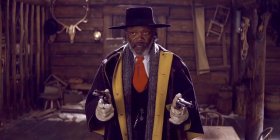
Samuel L. Jackson in a wide interior “Hateful Eight” shot

Quentin Tarentino’s latest movie “Hateful Eight” came out on Christmas Day in 70mm format in 100 theaters around the country. The cineplex digital version comes out on January 8th.

What’s the big deal about 70mm?

It’s not a big deal for any Baby Boomer kid and their parents, particularly if they lived near a big city.

Retro movie history.

I grew up in Cheyenne, Wyoming just north of Denver and watched a variety of 70mm movies during the 1950s – 1960s.

During any given year, there weren’t that many studio movies that came out, which made going to the movies extra special, particularly when there was a lot of hype.

“Hateful Eight” is set in Wyoming during after the Civil War. The other Wyoming connection to the movie is the buffalo coat worn by Kurt Russell was made at a tannery in Thermopolis – Merlin’s Hideaway. This is where last month, I took a buffalo skin from a Northern Arapaho traditional bison ceremony, which is a story for another day.

“Hateful Eight” was shot using old technology analog Ultra Panavision cameras. There were several technologies out back in the 1950s and 1960s – MGM pioneered the wide format in Ben Hur and won an Oscar in cinematography.

70mm how the west was won

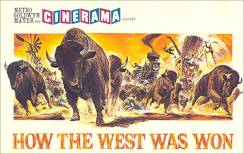
The buffalo stampede scene is spectacular.

My family used to drive down to Denver to watch movies. In 1963, we made a weekend of going to the Cooper Cinerama Theater to watch the epic western “How the West Was Won” packed with stars of the day and three hours long.

The theater had a 105-foot curved screen that was 35 fet tall and had over 800 seats. Everyone went dressed up to go to the movies in those days

“Hateful Eight” is R-rated. All of the original Cinerama movies would be rated G today.

The film was shot in Ultra Panavision. Compared to today’s High Definition 16:9 (1.8:1) aspect ratio, Ultra Panavision is 2.57:1 aspect ratio or nearly double the width of HD.

The cameras have special lenses that correct for the extra wide angle. When shown on the bigger screens, the special projectors also had special lenses for the wider format. There are some spectacular scenes like the buffalo stampede that were great to watch in Cinerama.

There weren’t many Cinerama theaters back in the day, which is why the outdated equipment is so hard to come by and the few remaining were scrounged up to screen “Hateful Eight”.

I wonder if Tarentino saw “How the West Was Won” in a cinerama theater and decided to make an homage to the western epic on the very wide screen.

70mm cheyenne autumn

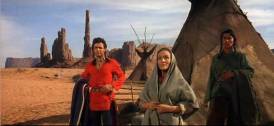
Cheyenne Autumn had the media premiere in Cheyenne

In 1964 “Cheyenne Autumn” had its media premiere in Cheyenne, Wyoming at the Lincoln Theater with Carroll Baker and James Stewart in attendance.

That screening was a 35mm roadshow print. The world premiere was 70mm in London, England at the Warner Theater.

The last 70mm film I saw in a a theater was “Alien” at the Century 21 in Denver near the Cooper. That was when I was stranded on Colorado Blvd with a broken down VW.

70mm sound of music

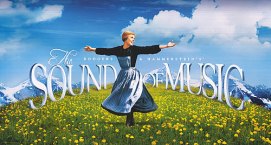
The Sound of Music played 112 weeks at Denver’s Aladdin Theater

My family also took a weekend vacation to Denver in 1965 to see the “Sound of Music” at the Aladdin Theater on East Colfax. That epic was shot in 70mm on Todd – AO cameras. The wide panoramic shots of Julie Andrews singing “… the hills are alive” in the Swiss Alps were spectacular. It wasn’t Cinerama. The Todd-AI tecnology was billed as Cinerama through one hole. Cinerama had three synched projectors.

There’s a scene at the end of the movie when the Von Trapp’s are evading capture in a cemetery. Liesl’s former boyfriend Rolf – now a Hitler Youth hides behind a pillar.

The shot has to be so wide that Captain Von Trapp while approaching Rolf has all this dialogue to say before he gets near enough for a close up – it could have been a cut, but the camera pushing in gives more visual drama.

Ultra Panavision affects screenwriting.

The “Sound of Music” played for 112 weeks at the Aladdin. Back in those days there were very few movies on the road.

70mm paint your wagon

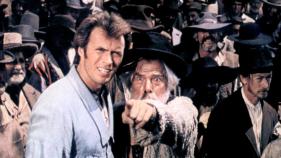
Clint Eastwood and Lee Marvin in Paint Your Wagon

In 1969 we went to the Cooper to see “Paint Your Wagon” – also shot in Ultra Panavision. I remember this great scene when a runaway wagon plummets into a river from the POV of the driver.

It made me whoozy.From what I see in the “Hateful Eight” trailer, there are some great wide shots, but much of the story is shot on a sound stage, which sort of defeats the purpose of Ultra Panavision.

70mm force awakens

Star Wars was shot in 70mm

I’m not much of a Tarentino fan – except for “Pulp Fiction” and I won’t go out of my way to watch “Hateful Eight”  in a Cinerama theater.

If I see any 70mm movie it will be “Star Wars: The Force Awakens” at the Seattle Cinerama. There wasn’t much hype about 70mm in the Star Wars macaroni and cheese ads.