Anti-gun groups should take a page from the anti-abortion playbook


abortion like guns

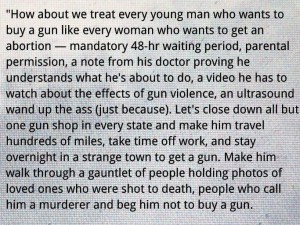
My friend Barbara May posted this meme shortly after the Umqua Community College in Oregon was shot up by a guy with 14 weapons in his apartment. Click on the image for a video about changing the gun culture.

The Orlando Massacre that left 49 dead and 53 wounded reminded me of a conversation some of my classmates and I had at our Hastings College homecoming reunion with Denny Storer, one of our political science professors.

That was in October 2015 – a week after an Oregon community college was shot up by another twisted buy with 14 weapons in his apartment.

Rather than more laws, how can the culture change? There’s an excellent scenario that played out in Manhattan with huge impact. Watch it here.

After our reunion reminiscence about a poli-sci class we took on the road in Washington DC during January 1973, I had an ‘aha’ moment about the nexus between the 2nd and 14th amendments.

The anti-gun crowd should take a page out of the anti-abortion playbook.

The latter is pretty good about dancing around the constitution while the former doesn’t have a clue about how to create cultural restrictions around curbing gun sales.

The above meme is tongue-in-cheek, but tells the practical truth. There are 300,000,000 firearms circulating. I agree that laws won’t help much.

Changing the culture is the most practical and the anti-abortion crowd proves that.

Hastings College operates on a 3-1-3 class schedule that, in 1973, included a one month Interim trip on a long bus ride to Washington DC for a month-long “Legislators and Lobbyist” field trip class.

The advertised highlight of the class and trip to DC was the inauguration of President Nixon. An unadvertised highlight was the death of President Johnson. We stood in line and viewe his casket laying in state under the capitol rotunda.

What’s the upshot of this story?

Less heralded at the time, Denny reminded us about the SCOTUS Roe v. Wade decision handed down on January 22, 1973. The ruling held that women have a right to privacy and protected from unwarranted searches and seizures.
The anti-abortion lobby figured out that passing restrictive laws do stand up to constitutional scrutiny. They work hard to change the culture through grassroots efforts and pass laws that don’t ban abortions, but put roadblocks in the way coupled with strategic public shaming.

The pro-gun lobby says that more laws won’t keep guns out of the hands of anybody, let alone crazy people. I have to agree with that.

All crazy people have access to guns, but not all crazy people have access to mental health services. I don’t know how politicians decide who’s the craziest, though.

After the killing spree in Orlando, I had to quit watching TV because it was all about blood, guts (interviews with wounded people in their hospital beds) and superficial grieving (candles, flowers and facebook posts).

While I’m sure that everyone personally deals with events like this differently, there doesn’t seem to be very many who are interested in creating the social and cultural change necessary to end gun violence.

Compared to anti-abortion groups, the anti-gun groups don’t show the same long-term passion that would include protesting in the rights-of-way of gun stores or on the public sidewalks in front of the Walton family homes; grooming like-minded people to appointed and elected public offices.

I’m thinking that in the final analysis, the only people who get involved in trying to change things are those families and friends directly affected by the death or injury to a friend or loved one. That’s a pretty small number of people and they can’t do it alone.

If 27 school kids murdered in their school, nine South Carolina church goers shot in the back, another nine gunned down in a community college classroom, don’t move legislators into action, I’m not very optimistic that 49 more people killed in a night club will provide much impetus for legislative action.

Here are three ideas to help change the culture without having to take anyone’s guns away since that’s not happening any time soon:

Short Term: Feel the Bern and Get Out The Vote – The biggest thing Bernie Sanders can keep doing is get more of his supporters to keep registering more voters. The disgruntled Bernie supporters – of which I am one – need to get on with life and not support any kind of third party or write in candidate for president. If that’s too difficult, at least vote for Democrats down the ticket.

Medium Term: Limited Martial Law (for lack of another term) – I heard Matt Lauer talking about this on the Today Show this morning. He asked a Homeland Security guy about what it would take to “asterisk” civil rights laws so that anyone like the Orlando terrorist could continue to be watched and monitored even if there is no probable cause determined. I think the only time limited martial law was approved was by the antebellum Congress at the time of Abraham Lincoln.

Long Term: Reapportionment – the US Census will be completed in 2020 and new US congressional districts will be drawn as well as state legislative districts. The SCOTUS ruled in favor of independent redistricting commissions taking gerrymandering out of the political process. This is an opportune time to create competitive state and national districts.

I’m willing to participate in the short and long term ideas i’ve proposed. It will be interesting to see if there’s the political will to limit civil liberties, but I would think Donald Trump would be all over that one.

The black ops probably have the authority to do this, in any event.
Cheyenne East High school class of ’71 obits updated for download

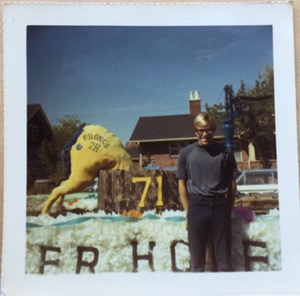
Click on the above image of the EHS homecoming float being guarded by Tony Ross to download a copy of tge Cheyenne East High School class of ’71 obit book.

I’ve been out of high school for 45 years and have managed to keep in touch with a bunch of classmates mostly because of social media.

The mid-decade class reunion for Cheyenne Central, East and St. Mary’s  is scheduled for August 5 – 6 in Downtown Cheyenne.

So far, there has been scant interest, which means the plug may be pulled at some point soon.

The East High class list of obituaries is now downloadable.

A friend of mine is getting ready for his 60th reunion. He said his class eventually quit keeping track of obits. They started going by who showed up.

I was sorting through a box and came across this picture of the  East class of ’71 homecoming float “They Shoot Horses, Don’t They.” We must have played Sheridan. That’s Tony Ross mugging for the camera. The blue pump behind Tony was liberated during a midnight raid to Veedauwoo.

The festivities start Friday night on the Depot Plaza with the Delta Sonics. We’ve partnered with the United Way of Laramie County and encourage you to buy from one of the food trucks they’ve arranged.

You can sign up for it on eventbrite. The cost is $50 which covers the  Southwestern buffet and music on Saturday night at the Historic Plains Hotel.

I, along with a bunch of other ‘mates helped organize the 40th reunion and intended to come, but was called out of town for a funeral in Boston and ended up going to the class of 1972 reunion later that summer, which was a good time.

Speaking of funerals, EHS alumnus, Ralph Zobell, has edited together a list of our EHS classmates who have passed on and converted it to a pdf file for download. It will be periodically updated.

If there’s anything that’s certain, we’ll all end up on the list at some point!

Shall we have a “last classmate standing” pool?

I was an illegal worker in Mexico

francisco lopez barajas

My business partner in Zacatecas Mexico Faustino Lopez Barajas.

I generally only write about things that I’ve experienced personally. I’m becoming more convinced with the recent flood of children crossing the into Texas, that the United States has the most porous border of any nation in the world.

Let me tell you about the time I was shaken down by soldiers with machine guns for being an illegal worker in Mexico. It was a very helpless feeling.

Maybe it’s that poem inscribed on the Statue of Liberty by Emma Lazarus:

tablette-statue-de-la-liberte

Turns out, if you’re from a European country, this quote is more applicable.

Give me your tired, your poor,
Your huddled masses, yearning to breath free,
The wretched refuse of your teeming shore,
Send these, the homeless, tempest tost to me,
I lift my lamp beside the golden door.

Most other countries have largely indigenous populations that have lived there for centuries. The US, on the other hand, conquered the locals fair and square, and that was just over 200 years ago. 

I did business in Mexico for six years or so starting in 1992 when the North American Free Trade Act went into effect. Then US Secretary of Commerce Ron Brown held a bunch of meetings around the country, including one in Denver. I was working for the Northern Arapaho Tribe at the time in economic development and went down to check it out. At that time, the tribe was looking to sell its hay.

hotel sombrerete

Downtown Sombrerete

After all the speeches, there was a round table session with representatives from businesses in Mexico. Most everyone split and left all these business people sitting alone. I stuck around and sat down with a group of guys from a credit union based in a small town called Sombrerete in the state of Zacatecas. It’s located in the north central part of Mexico. We hit it off and they invited me down for a visit.

A friend and colleague of mine flew down to check things out. A couple tribal guys – Fred and Gary – and I started up the 600 acre Arapaho Farms. The Arapaho Tribe was big into sustainable agriculture at the time and was interested in farming practices in Mexico – like using a tree branch hooked up to a mule as a harrow. As it turned out the farming thing in Mexico didn’t work out.

Meanwhile I began consulting for a marketing company based in Boulder which had a manufacturing facility in Alamosa, Colorado. They made and sold hair accessories. The manufacturing costs, even in Alamosa were too high.

francisco mexico city

Francisco at the Mexico City factory.

I mentioned that I had experience in Mexico and when I was down there before, I learned that some of the small towns would be devoid of working age people – mostly men – who went to the US to work – many illegally. I figured out that workers would rather stay in their home towns rather than leave, but there is no work in the middle-of-nowhere Mexico. The immigration policies favored US businesses wanting to create jobs there.

My idea was to recruit home sewers and assemblers in Sombrerete to make the hair accessories, rather than establish on the US – Mexico border, which is the generally accepted maquilla model.

maquila worker

The factory in Zacatecas.

The operation called Luna Llena at its peak employed two shifts of 50 people. We had a bonded warehouse on the border in McAllen, Texas. The first shipment was a disaster, though. How the process works is simple. The idea is to send 10 straps, 10 beads and 10 feathers through customs in Mexico. Then the materials are assembled and the completed 10 pony tail holders are then shipped to the US warehouse.

The finished inventory didn’t match up with the raw materials list. After getting that workflow figured out, everything went smoothly.

One of the best things about Mexico is the time zones are the same as the US. I sometimes flew into Guadalajara or Zacatecas, but mostly flew into Mazatlan in the state of Sinaloa, hung around the beach for a few days then took the bus to Sombrerete. “Papers? We don’t need no stinkin’ papers!” I traveled uneventfully on a passport and a tourist visa for five years.

In 1997 President Clinton and the President of Mexico, Ernesto Zedillo signed an agreement hoping to stem illegal immigration and drugs from flowing to the US.

clinton zedillo

US President Clinton and El Presidente de Mexico Ernesto Zedillo

One of my business partners, Francisco,  was driving us from Sombrerete to Zacatecas in a beat up Toyota pickup with expired California plates. Just outside the town of Fresnillo we were stopped by an armed cadre of soldiers.

We were ordered out of the truck and handed over our papers. I had my US passport and the tourist visa from Mazatlan, which immediately caused problems.

Francisco and I were separated. He was worked over in Spanish and I was worked over in English. A third soldier emptied the truck and tossed my suitcase and repacked it. After an hour we were cleared to go, but not quite. My suitcase was again turned upside down and rechecked for contraband.

I was an illegal in central Mexico on a tourist visa from a coastal state.

They let us go.

I did go through the process to get a visa to work in Mexico. It’s not as big of a deal as it is in the US. I had to get a letter from my partner about the nature of our manufacturing work and took it to the Embassy for Mexico in Denver, pay $125 and I was granted a work visa.

There are plenty of isolationists, including Donald Trump, who want to close the US borders to immigrants – legal or illegal – who at the same time are against moving US jobs off shore.

I’m convinced that the best way to stem immigration from Latin America is for international companies from the US and elsewhere of all sizes to move there and create jobs for locals.

My gig in Sombrerete was good while it lasted.

What happened?

Francisco’s brother, Faustino, was the brains of the operation. He was the only guy among his group who spoke English and had a US visa. On his way to Colorado, he became very ill. Turned out he had cancer.

He moved himself and his extended family to Mexico City for better medical care and eventually died. Francisco moved the factory to Mexico City, which made a sense in a lot of ways and took the business in a different direction and sewed clothing.

I haven’t been back to Sombrerete or Mexico lately. Looking back, it was very isolating being the only English speaker for miles around. Communication was exhausting and I wore out a couple English – Spanish dictionaries.

I hear that Ecuador is now a big haven for expat Americans but I don’t think I’d want to live among them.