‘Hateful Eight’ on 70mm – retro movie history

70mm hateful 8

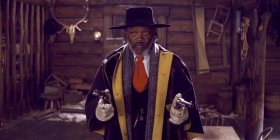
Samuel L. Jackson in a wide interior “Hateful Eight” shot

Quentin Tarentino’s latest movie “Hateful Eight” came out on Christmas Day in 70mm format in 100 theaters around the country. The cineplex digital version comes out on January 8th.

What’s the big deal about 70mm?

It’s not a big deal for any Baby Boomer kid and their parents, particularly if they lived near a big city.

Retro movie history.

I grew up in Cheyenne, Wyoming just north of Denver and watched a variety of 70mm movies during the 1950s – 1960s.

During any given year, there weren’t that many studio movies that came out, which made going to the movies extra special, particularly when there was a lot of hype.

“Hateful Eight” is set in Wyoming during after the Civil War. The other Wyoming connection to the movie is the buffalo coat worn by Kurt Russell was made at a tannery in Thermopolis – Merlin’s Hideaway. This is where last month, I took a buffalo skin from a Northern Arapaho traditional bison ceremony, which is a story for another day.

“Hateful Eight” was shot using old technology analog Ultra Panavision cameras. There were several technologies out back in the 1950s and 1960s – MGM pioneered the wide format in Ben Hur and won an Oscar in cinematography.
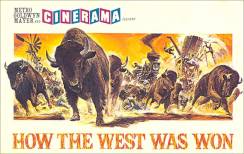
70mm how the west was won

The buffalo stampede scene is spectacular.

My family used to drive down to Denver to watch movies. In 1963, we made a weekend of going to the Cooper Cinerama Theater to watch the epic western “How the West Was Won” packed with stars of the day and three hours long.

The theater had a 105-foot curved screen that was 35 fet tall and had over 800 seats. Everyone went dressed up to go to the movies in those days

“Hateful Eight” is R-rated. All of the original Cinerama movies would be rated G today.

The film was shot in Ultra Panavision. Compared to today’s High Definition 16:9 (1.8:1) aspect ratio, Ultra Panavision is 2.57:1 aspect ratio or nearly double the width of HD.

The cameras have special lenses that correct for the extra wide angle. When shown on the bigger screens, the special projectors also had special lenses for the wider format. There are some spectacular scenes like the buffalo stampede that were great to watch in Cinerama.

There weren’t many Cinerama theaters back in the day, which is why the outdated equipment is so hard to come by and the few remaining were scrounged up to screen “Hateful Eight”.

I wonder if Tarentino saw “How the West Was Won” in a cinerama theater and decided to make an homage to the western epic on the very wide screen.
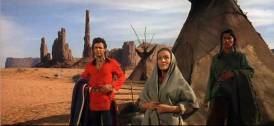
70mm cheyenne autumn

Cheyenne Autumn had the media premiere in Cheyenne

In 1964 “Cheyenne Autumn” had its media premiere in Cheyenne, Wyoming at the Lincoln Theater with Carroll Baker and James Stewart in attendance.

That screening was a 35mm roadshow print. The world premiere was 70mm in London, England at the Warner Theater.

The last 70mm film I saw in a a theater was “Alien” at the Century 21 in Denver near the Cooper. That was when I was stranded on Colorado Blvd with a broken down VW.
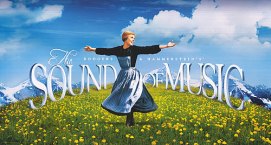
70mm sound of music

The Sound of Music played 112 weeks at Denver’s Aladdin Theater

My family also took a weekend vacation to Denver in 1965 to see the “Sound of Music” at the Aladdin Theater on East Colfax. That epic was shot in 70mm on Todd – AO cameras. The wide panoramic shots of Julie Andrews singing “… the hills are alive” in the Swiss Alps were spectacular. It wasn’t Cinerama. The Todd-AI tecnology was billed as Cinerama through one hole. Cinerama had three synched projectors.

There’s a scene at the end of the movie when the Von Trapp’s are evading capture in a cemetery. Liesl’s former boyfriend Rolf – now a Hitler Youth hides behind a pillar.

The shot has to be so wide that Captain Von Trapp while approaching Rolf has all this dialogue to say before he gets near enough for a close up – it could have been a cut, but the camera pushing in gives more visual drama.

Ultra Panavision affects screenwriting.

The “Sound of Music” played for 112 weeks at the Aladdin. Back in those days there were very few movies on the road.
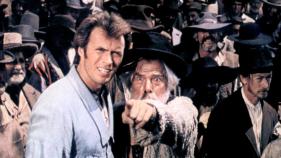
70mm paint your wagon

Clint Eastwood and Lee Marvin in Paint Your Wagon

In 1969 we went to the Cooper to see “Paint Your Wagon” – also shot in Ultra Panavision. I remember this great scene when a runaway wagon plummets into a river from the POV of the driver.

It made me whoozy.From what I see in the “Hateful Eight” trailer, there are some great wide shots, but much of the story is shot on a sound stage, which sort of defeats the purpose of Ultra Panavision.

70mm force awakens

Star Wars was shot in 70mm

I’m not much of a Tarentino fan – except for “Pulp Fiction” and I won’t go out of my way to watch “Hateful Eight”  in a Cinerama theater.

If I see any 70mm movie it will be “Star Wars: The Force Awakens” at the Seattle Cinerama. There wasn’t much hype about 70mm in the Star Wars macaroni and cheese ads.

Last meals – eat drink and be merry!

erik weight of water

Erik Weihenmayer negotiated the Colorado River while not being able to see where he was going.

After stopping in Fort Collins for the Boulder International Film Festival screening of Michael Brown’s “The Weight of Water” documentary at the Lincoln Center, I ventured up to Laramie for a cooperative community workshop led by Yana Ludwig at an intentional community there – Solidarity House Cooperative.

Do Mother and Father Nature plan for weather to drastically change at the Colorado / Wyoming state line?

I got on the road fairly early, but didn’t know how conditions would be. After driving o30 miles over black ice, blowing and drifting snow from the state line to Laramie, I was reminded about “last meals.”

What’s your “last meal” – you know the one you’d eat if you are on death row and your date finally comes up.

It’s not my driving that worries me as much as the bad drivers who think that a big, heavy, 4×4 makes them invincible. There were a few cars that had spun off. The guy behind me towing a top heavy trailer fish-tailed. The driver pulled out of it, which was a sight to see.

I thought about Erik Weihenmayer kayaking the Colorado River rapids through the Grand Canyon.

When I walked into the Coal Creek coffee shop, I was stopped by a patron asking me if I had a Jeep. She and her husband pulling a white tandem-axle trailer ended up in the ditch. “We were only going 35,” she rationalized. The rig was still stuck when I returned later in the afternoon.

While it wasn’t as harrowing a drive as it could have been, it was a reminder that I should have one of my “last meals.” I stopped at Vern’s Place in LaPorte and had their  prime rib. Since being resurrected from death bed in 2014, I eat my last meals as often as possible. I don’t want my actual last meal to be hospital food or cold Pizza Hut at an Econo-Lodge.

__________________________

This story was originally written December 19, 2015.

eggs verns

It’s a toss up for my “last breakfast”. I had eggs over easy, bacon and tomatoes at Vern’s Place. I got on the tomatoes at breakfast thing while in South Africa.

I spend quite a lot of time on the road traveling around mostly to other towns in Wyoming.

I haven’t had any death-defying driving experiences nor any close calls other than a couple 360 degree black ice spins.

I was driving back from Riverton and made a stop in Rawlins for snacks and gas.

The clerk informed me that I-80 east and west were both closed due to snow and blowing snow.

It was calm, sunny and warm in Rawlins, but I was stuck at the Econo-Lodge there for the night. Even as Econo-Lodges go, this one was desolate.

Might as well make the best of it.

IMG_2881

My “last lunch” pork noodles at the 20th Street Cafe in Denver.

I cruised around downtown which has improved over the years. I had a chili relleno at a small Mexican place and went back to the room, if that’s what you want to call it. The Econo-Lodge was more of an Econo-Fridge. The heater hadn’t been on for quite some time.

Closed roads are a growth industry in Wyoming.

The interstate was closed down because there was no more room along the route to accommodate any more trucks, let alone passenger cars.

Pizza Hut advertises on the room keys, bored, I decided to order my “go to” Canadian bacon and mushroom thin crust with extra cheese. I was able to eat half of it. The cable was pretty good in Rawlins – there’s not much to do there in the middle of the week in the dead of an early snow storm.

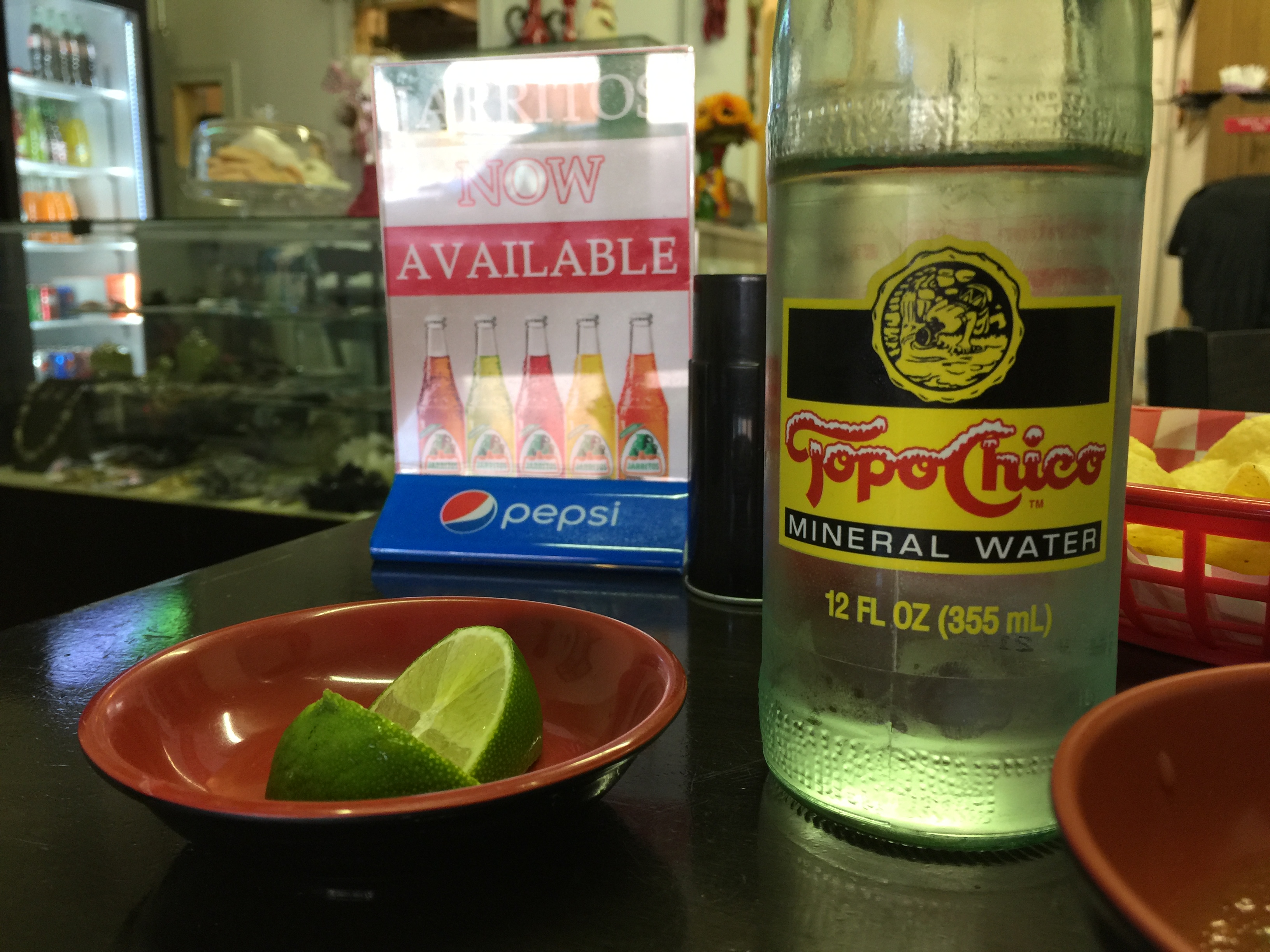
I stopped at this Tex Mex place in downtown Rawlins. I was impressed with the offering of TopoChico agua mineral.

I stopped at this Tex Mex place in downtown Rawlins. I was impressed with the offering of TopoChico agua mineral.

At 2am, the REEEEE REEEEE REEEEE! screeched out on the cable TV. The roads were open. I would still wait to get out around 10am when the sun is higher.

I gobbled the rest of the cold pizza and downed a warmed over cup of yesterday’s coffee before getting on the road.

It was a bumper to bumper parking lot from Wolcott Junction to Laramie. Traffic was stopped by an accident on the westbound lane. It took three hours to go 90 miles.

I-80 was officially closed when I was driving back from Riverton recently. White knuckle driving is an art form in Wyoming.

I-80 was officially closed when I was driving back from Riverton recently. White knuckle driving is an art form in Wyoming.

Wyoming winter driving takes some getting used to. If you can successfully drive in Wyoming during even a small snowstorm, you can drive anywhere.

Riverton, like most other Wyoming communities, is centrally isolated from just about every place else when the weather gets nasty.

I grew up in Cheyenne and let me tell you, if you’ve never experienced a blizzard in southeast Wyoming, it’s quite the experience. During certain times of year, it’s so windy, there’s no Final Net on any story shelf.

I always felt lucky about living in Lander and now Boulder along the front range foothills.

It’s so nice to wake up, look out the window and notice that the snow has fallen into neat little piles on tops of fence posts and not rudely strewn about in seven-foot- high drifts.

I’ve met several people in my travels who have been to Wyoming. Besides having visited Yellowstone Park, the second most frequent comment is, “Oh, yeah, one winter during the War, my train was stranded in Cheyenne at the depot while going to California.”

Midway was probably a fonder memory than Wyoming.

Icky John C'Hair explains the traditional Northern Arapaho bison uses to Wind River Reservation students.

Iggy John C’Hair explains the traditional Northern Arapaho bison uses to Wind River Reservation students.

I was in Riverton to document a traditional Northern Arapaho bison ceremony. This was my third trip to the Wind River Indian Reservation in three weeks.

It was a successful hunt and ceremony, which is the subject of another post. I was anxious to get back on the road but didn’t check the road reports.

Hmmm.

Under most circumstances, I’m a calm and collected driver, but when the interstate suddenly disappears in a puff of white, it’s quite a different story.

Luckily, I didn’t get stuck on the interstate and it closed behind me. I’ve been stuck back in the days before cell phones and GPS.

Back in those days, it was cassette tapes and Glenn Miller and Frank Sinatra tunes soothing me while my car pounded through invisible snow drifts and crept around several 18-wheeler convoys near Elk Mountain.

White knuckles.

Disgruntled travelers examining their jack-knifed u-Haul trailer and contorted semi-truck silhouettes in the media strip made me realize how out of control these drives can be.

I can’t imagine being killed by a wild and crazy trucker or freezing to death knowing my last meal was cold pizza and day-old coffee.

My romanticism has me eating bacon, eggs over easy with a pancake for my last breakfast at the Red Willow in the Wind River Casino; pork noodles from the 20th Street Cafe as my last lunch; and steak and lobster from Svilar’s in Hudson, Wyoming.

I better get with eating, drinking and being merry.

Book a screening – ‘Aging Gratefully: The Power of Community’

Boulder Senior Cohousing Communities

BOULDER, CO – SEPTEMBER 2: Lindy Cook and Alan O’Hashi pull weeds from the garden of the community with other residents. The active adult cohousing community for those 55 or older is setup like a usual condo community with every person having their own place, but the sense of community is what is unique. (Photo By Brent Lewis/The Denver Post)

I recently completed a new documentary about aging together. What happens when 25 senior citizens – the subjects of “Aging Gratefully: The Power of Community” (TRT 51min) – decide to form a cohousing community?

You can keep up with the latest on the facebook page. The 16min preview version is available to give an idea as to the content.

I live in a cohousing community called Silver Sage Village in North Boulder, Colorado. The film provides insights from six of my neighbors about their experiences and perspectives about growing old together. Everyone here is over 50 years of age.

How did the movie come into being?

Cohousing is a collaborative living arrangement. Residents own their own homes, live private lives but share in the ownership and upkeep of common spaces such the garden and common house.

It’s a challenging way to live, but living together more intentionally is a hedge against being alone and isolated through the twilight years of life.

In May, my next door neighbor’s Henry and Jean Kroll were facing the prospects of dementia which was later confirmed as Alzheimer’s Disease. After seven years, Jean had to move into a long term nursing care institution. Soon thereafter, my up stairs neighbor Gere Young was moved by her family into an assisted living facility.

Meanwhile, another resident moved and sold her place to a women with a debilitating health issue.

Times are changing at Silver Sage Village.

There there’s my story, which I’ve written extensively about in these pages.  I faced a huge lifestyle change when I landed in the hospital two years ago on December 16h. I had a rare lung disease, couldn’t walk, was on a respirator. On top of that I developed a septic ulcer that was repaired. I made it home six weeks later.

Having to regain my strength and flexibility, I joined a yoga studio. I didn’t know much about yoga but one of my teachers gave a darma talk about the importance of community and how we are members of many communities that help us navigate through life.

That was the nexus of the movie – where community meets individual choice and the balance that must be struck between the two.

I put out a casting call and was surprised that I heard from so many men, but I wanted to focus on my neighbors who have or have had life changes while at Silver Sage Village. Dan Knifong has Parkinson’s, Jean has Alzheiemers, Jim’s wife Brownie is currently in rehab with an unknown nervous condition, any myself. Two others have mostly been in support roles.

The National Cohousing Conference happened in Durham, NC and I decided to attend at the last minute. I am new to the CoHo USA board and wanted to meet my colleagues, and see if there would be any interesting people there to interview.

I ended up talking with a gerontologist named Anne Glass from the University of North Carolina at Wilmington and architect Chuck Durrett who is credited with bringing cohousing to the United States.

I wanted to find out about their theoretical ideas and see how they match up with real world experiences and perceptions of current senior cohousers.

IMG_2398

The interviews were conducted by a colleague of mine Mary Ann Williamson. I wanted to keep arms-length from my neighbors hoping to get more frank information from them.

Through my reflections, I recount my continuing recovery and weave those experiences with the perspectives of neighbors with Parkinson’s Disease, Alzheimer’s Disease and those who find themselves in supportive neighborly care giving roles.

henry jean bday

Henry and Jean Kroll celebrate Henry’s birthday at a recent Silver Sage Village community event.

 Many thanks to my friends and colleagues Michael Conti and Chris Barrera who filmed the opening scene at the Little Yoga Studio.

Silver Sage Village residents:
– Lindy Cook (nurse)
– John Huyler (facilitator)

– Henry and Jean Kroll (retired PBS staff)
– Dan Knifong (retired professor)
– Jim Leach (Silver Sage Village developer)
– Alan O’Hashi (filmmaker)
Margaret Porter (retired federal government)

Also Appearing:
– Anne Glass phD (University of North Carolina Wilmington)
– Chuck Durrett AIA (The Cohousing Company)
– Larissa Ortiz (teacher The Little Yoga Studio)

Since showing the first cut to my neighbors on December 16th – the second anniversary of being hauled by ambulance to the hospital – “Aging Gratefully” has received a bit of buzz. I have a May 2016 screening in Salt Lake City; a screening in the San Francisco bay area in the spring and invited to show it in Glasgow, Scotland.

Now I have to finish the thing!