We need your ‘like’ of our ‘Plein Air in Thin Air’ trailer!

Click on this image and watch the two minute trailer. Click the ❤️ . You’ll be asked to log in with your facebook or set up an account.

I’m working on a documentary to be shot in Wyoming during August and we’re trying to win the Wyoming Short Film Contest. The theme is “WY am I Here?”

Please watch the trailer and give us a “like!” You’ll be asked to log in with your facebook account if you’re not already a vimeo user.

The Wyoming Film Office gives away $25,000 to the winner that goes toward a Wyoming production. We’ll be making the movie in Grand Teton National Park this August.

The top-10 are decided by popularity contest with no regard to production value. The winner is picked by a panel of judges based on the dogs selected by the production team friends and family – it’s click bait from the Wyoming Film Office. Everyone is having a problem with this, but it cuts down on those who sit at their computers and hit play, over and over.

The main voting criteria has to do with promotion of Wyoming. What a great way to commemorate the 100th anniversary of the US National Park Service than from the top of the Grand?

Please watch the trailer and give us a “like!” You may have to log in with your facebook if you’re not already a vimeo user.

“WY Am I Here”? What if a 62-year-old grandfather of six decides to climb the spectacular Grand Teton and make never-before drawn pastel views of the expansive landscape?

Laramie artist Joe Arnold has been mountaineering for 50 years. He and his son, Jason, are planning an expedition to Grand Teton National Park for an ascent of the Grand Teton (13,776′) North Ridge route (rated 5.8).

It will be a five-day bonding experience for two generations of climbers with an unusual but creative mission at the summit.

Art 321 in Casper was the location for the CLICK! conference. Watch the Plein Air in Thin Air trailer and ‘like ‘

How did I come across this project?
I went to the Wyoming Arts Council CLICK! conference in Casper a couple weeks ago.

I ran into Joe Arnold. We were each presenting about our art works at the conference.

A couple years ago, Joe won a Wyoming Arts Council fellowship. I did a tribute video about his project which was a trek to Patagonia.

We got to talking. I was looking for a movie to make for the film office contest. I thought about my two works-in-progress, but wasn’t inspired.

Joe has a trailer finished, making it the perfect project.

Take a look and click on the heart in the upper right hand corner of the video player. We want to get into the top-10 of the beauty pageant.

Here’s the rest of the team:

  • Director and Director of Photography: Eric Randall
  • Production Assistants: Jacob Chmielowiec and Tim Hall
  • Music By: Dave Beegle davebeegle.com
  • Produced by: Alan O’Hashi and wyocomedia.com
  • Associate Producer: Jason Arnold
  • Executive Producer: Joe Arnold joearnold.org
‘Hateful Eight’ on 70mm – retro movie history

70mm hateful 8

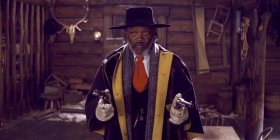
Samuel L. Jackson in a wide interior “Hateful Eight” shot

Quentin Tarentino’s latest movie “Hateful Eight” came out on Christmas Day in 70mm format in 100 theaters around the country. The cineplex digital version comes out on January 8th.

What’s the big deal about 70mm?

It’s not a big deal for any Baby Boomer kid and their parents, particularly if they lived near a big city.

Retro movie history.

I grew up in Cheyenne, Wyoming just north of Denver and watched a variety of 70mm movies during the 1950s – 1960s.

During any given year, there weren’t that many studio movies that came out, which made going to the movies extra special, particularly when there was a lot of hype.

“Hateful Eight” is set in Wyoming during after the Civil War. The other Wyoming connection to the movie is the buffalo coat worn by Kurt Russell was made at a tannery in Thermopolis – Merlin’s Hideaway. This is where last month, I took a buffalo skin from a Northern Arapaho traditional bison ceremony, which is a story for another day.

“Hateful Eight” was shot using old technology analog Ultra Panavision cameras. There were several technologies out back in the 1950s and 1960s – MGM pioneered the wide format in Ben Hur and won an Oscar in cinematography.

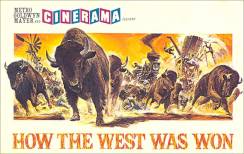
70mm how the west was won

The buffalo stampede scene is spectacular.

My family used to drive down to Denver to watch movies. In 1963, we made a weekend of going to the Cooper Cinerama Theater to watch the epic western “How the West Was Won” packed with stars of the day and three hours long.

The theater had a 105-foot curved screen that was 35 fet tall and had over 800 seats. Everyone went dressed up to go to the movies in those days

“Hateful Eight” is R-rated. All of the original Cinerama movies would be rated G today.

The film was shot in Ultra Panavision. Compared to today’s High Definition 16:9 (1.8:1) aspect ratio, Ultra Panavision is 2.57:1 aspect ratio or nearly double the width of HD.

The cameras have special lenses that correct for the extra wide angle. When shown on the bigger screens, the special projectors also had special lenses for the wider format. There are some spectacular scenes like the buffalo stampede that were great to watch in Cinerama.

There weren’t many Cinerama theaters back in the day, which is why the outdated equipment is so hard to come by and the few remaining were scrounged up to screen “Hateful Eight”.

I wonder if Tarentino saw “How the West Was Won” in a cinerama theater and decided to make an homage to the western epic on the very wide screen.

70mm cheyenne autumn

Cheyenne Autumn had the media premiere in Cheyenne

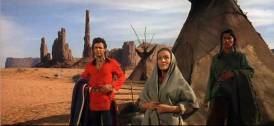
In 1964 “Cheyenne Autumn” had its media premiere in Cheyenne, Wyoming at the Lincoln Theater with Carroll Baker and James Stewart in attendance.

That screening was a 35mm roadshow print. The world premiere was 70mm in London, England at the Warner Theater.

The last 70mm film I saw in a a theater was “Alien” at the Century 21 in Denver near the Cooper. That was when I was stranded on Colorado Blvd with a broken down VW.

70mm sound of music

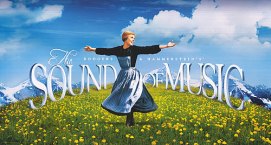
The Sound of Music played 112 weeks at Denver’s Aladdin Theater

My family also took a weekend vacation to Denver in 1965 to see the “Sound of Music” at the Aladdin Theater on East Colfax. That epic was shot in 70mm on Todd – AO cameras. The wide panoramic shots of Julie Andrews singing “… the hills are alive” in the Swiss Alps were spectacular. It wasn’t Cinerama. The Todd-AI tecnology was billed as Cinerama through one hole. Cinerama had three synched projectors.

There’s a scene at the end of the movie when the Von Trapp’s are evading capture in a cemetery. Liesl’s former boyfriend Rolf – now a Hitler Youth hides behind a pillar.

The shot has to be so wide that Captain Von Trapp while approaching Rolf has all this dialogue to say before he gets near enough for a close up – it could have been a cut, but the camera pushing in gives more visual drama.

Ultra Panavision affects screenwriting.

The “Sound of Music” played for 112 weeks at the Aladdin. Back in those days there were very few movies on the road.

70mm paint your wagon

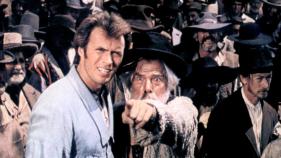
Clint Eastwood and Lee Marvin in Paint Your Wagon

In 1969 we went to the Cooper to see “Paint Your Wagon” – also shot in Ultra Panavision. I remember this great scene when a runaway wagon plummets into a river from the POV of the driver.

It made me whoozy.From what I see in the “Hateful Eight” trailer, there are some great wide shots, but much of the story is shot on a sound stage, which sort of defeats the purpose of Ultra Panavision.

70mm force awakens

Star Wars was shot in 70mm

I’m not much of a Tarentino fan – except for “Pulp Fiction” and I won’t go out of my way to watch “Hateful Eight”  in a Cinerama theater.

If I see any 70mm movie it will be “Star Wars: The Force Awakens” at the Seattle Cinerama. There wasn’t much hype about 70mm in the Star Wars macaroni and cheese ads.

Lassoed fish – an ‘Art of the Hunt’ tale

I produced a series of videos for the upcoming Art of the Hunt display that opens at the Wyoming State Museum in Cheyenne on July 18th.

The exhibit, spearheaded by the Wyoming Arts Council, the University of Wyoming and the Wyoming State Museum, features folkloric stories told through the unique art forms of hunting and fishing, including leather working, bow making, fly tying and taxidermy.

You don’t have to be a rugged outdoors man or woman to have stories.

I’m a city kid who grew up in the suburbs of Cheyenne. One Christmas Santa brought these short fishing rods and rudimentary reels. We could hardly wait until spring to get our lines wet.

My Uncle Rich gave me this fly box for Christmas one year. He was an avid fisherman around Wyoming.

My Uncle Rich gave me this fly box for Christmas one year. He was an avid fisherman around Wyoming.

As a family activity in the 1960s my parents would take my sister and I to Country Club Lake. On the way we stopped by the tackle store and picked up a box of worms for bait. My dad showed us how to bait the hooks and explained the purpose of bobbers.

My mom’s job was to untangle the fish line snags. I remember hooking my first fish, it was a six-inch perch. We caught several small ones that day.

I wasn’t allowed to clean the fish, because I wasn’t yet able to use sharp knives. That evening, my mom breaded the fish and we had them for dinner that night.

When I was a bit older, I don’t remember the exact birthday, but my grandfather gave me one of his manual spinning reels – the kind with a bail.

This was a big step up from the push bottom job I had been using. He also explained to me about using artificial lures. He said it was more challenging because it became a battle of wits catching a fish with lures.

He gave me a box of various flat fish and spoons. I didn’t use the flat fish since I learned they were mostly for fish that didn’t live in Southeast Wyoming, but always have kept those hand-me-downs in my tackle box.

When I was living in Lander, one spring, my fishing pal Perry and I went out up to the Big Wind River just outside of Thermopolis. The water was running high and muddy. We wore hip waders. Perry had a few strikes, I was using a muddler minnow thinking that the brown trout would hit, but became a bit discouraged. Perry suggested that I try something that no fish would like. I opened my fly box and there was the green flatfish.

I clipped it on the end of the leader and cast, then reeled in the line. Tugged and reeled, tugged and reeled. Hopelessly snagged on some plants.  I waded out to untangle the line. Much to my surprise, in addition to the wad of greenery, was a 10 inch trout entangled in the weeds and being strangled by my fish line.

“You lassoed a fish!” Perry hollered.

It wasn’t good, the line was stuck under the fish’s gills and cut him up. I ended up taking the fish out of mercy, but I didn’t think I had taken him fairly.

I still have my grandfather’s flat fish, but I haven’t had it out since. I have an antelope hunting story I’ll jot down when the Art of the Hunt exhibit gets into full swing. Join the facebook page and share your hunting and fishing stories and photos: https://www.facebook.com/artofthehuntwyoming