
The Alphabet of Exclusion: The bureaucratic lexicon included “acronyms” to save time. In the history of American xenophobia, acronyms save face. Three-letter shorthand compresses the jagged edges of state power into something smooth, portable, and easy to swallow.
Today, we see ICE (Immigration and Customs Enforcement) and DHS (Department of Homeland Security) dominating the headlines.
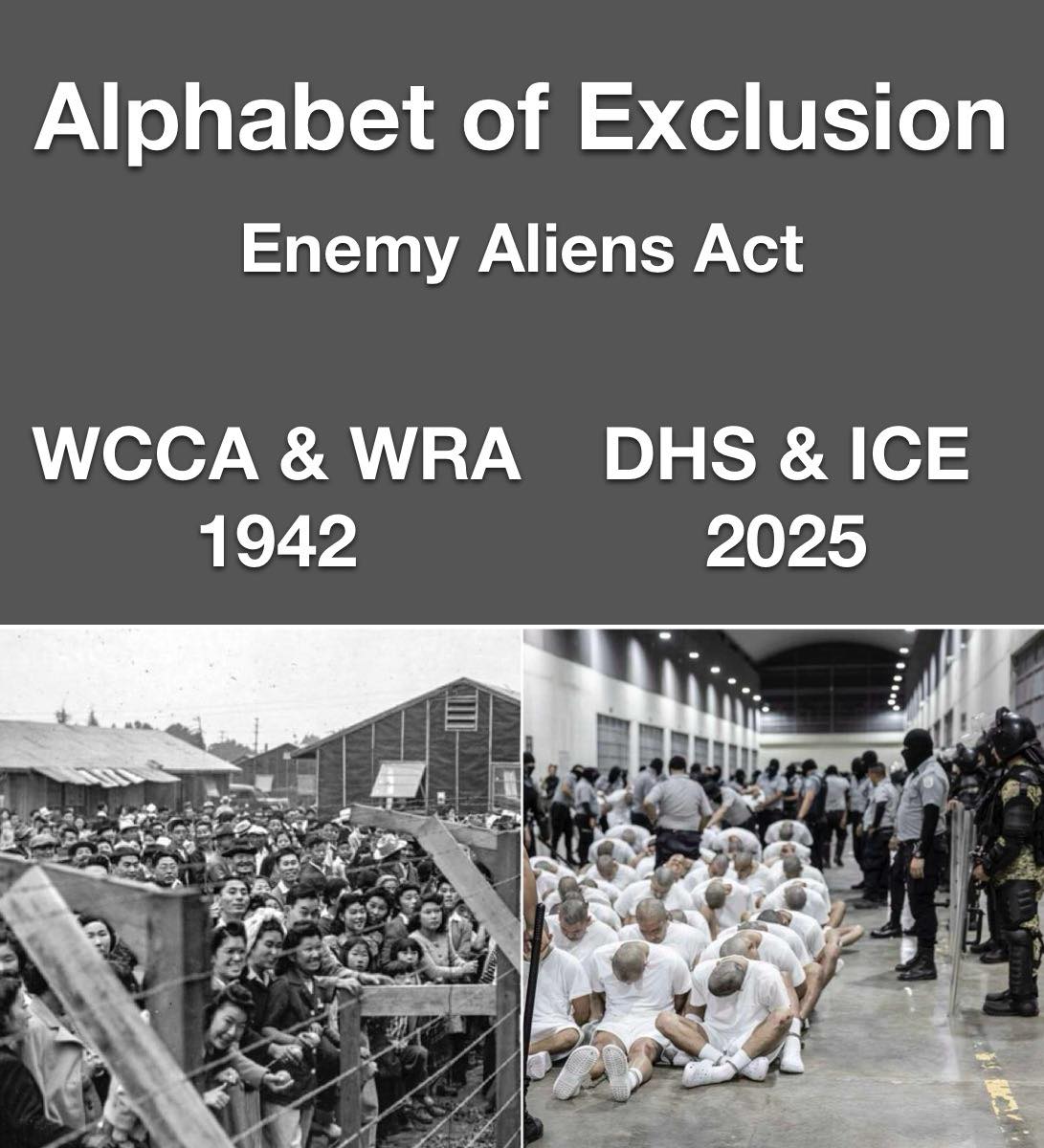
These acronyms are the latest entries in a century-long glossary of exclusion.
Our Long Memory of Othering: Linguistic distancing is an ingrained feature of American domestic and foreign policy.
The names change, but the grammar of “the outsider” remains consistent.
• The Precedent – The Chinese Exclusion Act (1882): Before the era of modern acronyms, this was the first significant law that restricted immigration based on a specific race.
The Act codified the idea that certain people wouldn’t assimilate, establishing a legal basis for the federal government to exclude anyone deemed a threat to the nation’s homogeneity.
• The Prototype – EO (Executive Order) 9066 (1942): Eighty-four years ago, on February 19, 1942, the ink dried on EO 9066. With a stroke of a pen, FDR (Franklin Delano Roosevelt) authorized a military action and birthed a new “alphabet soup” of exclusion.
The WCCA (Wartime Civil Control Administration) and the WRA (War Relocation Authority) were established as wartime agencies for prison management.
By World War II, the language had become clinical. EO 9066 did not mention Japanese people or any specific ethnic group.
Instead, it authorized the Secretary of War to define “military areas” from which “any or all persons” could be excluded, a neutral phrase that allowed the WCCA and the WRA (War Relocation Authority) to operate with stoic efficiency.
By the time the public learned to say these new initials, 125,000 Japanese Americans had been rounded up from the West Coast, and filed away under the euphemistic labels of “evacuees” in “relocation centers.”
• The Modern Pivot – 9/11 and the Muslim Ban: The 21st-century xenophobia found its shorthand in the wake of 9/11. We saw the DHS implement NSEERS (National Security Entry-Exit Registration System), which targeted men from predominantly Muslim countries.
Later, the “Muslim Ban” (EO 13769) echoed the 1942 rationale and used the national security blanket to cover the profiling of a specific faith.
• The Present – ICE and the DHS Deportation Machine: Currently, the conversation centers on ICE and the DHS’s overly aggressive deportation tactics.
A three-letter enforcement agency reduced the complexity of migration and the history of Latin American labor by stripping away human dignity.
History suggests that when we stop using names and start using initials, take actions, and hold beliefs we’d rather not hold to account.
The WRA and WCCA have been abolished, replaced by DHS and ICE.
The letters changed, and digital databases replaced the paper files.
The underlying belief that certain populations must be registered, monitored, and managed for the safety of the collective “us” remains the durable dark side of the American grand experiment.
 Views from Behind the Lens