Unknown's avatar

About Alan O’Hashi, Whole Brain Thinker

I’ve been involved with community journalism since 1968 when I wrote for my junior school paper, the "Tumbleweed," through high school and college and then wrote for the "Wyoming State Journal." I put aside my newspaper pen and began Boulder Community Media in 2005. There wasn’t much community journalism opportunity, so I resurrected my writing career as a screenwriter. My first short screenplay, “Stardust”, won an award in the 2005 Denver Screenwriting Center contest. I've made a number of movies over the years. Filmmaking is time-consuming, labor and equipment intensive. I recently changed my workflow to first write a book and make a movie based on that content. - Electric Vehicle Anxiety and Advice - This is a memoir travelogue of three trips covering 2,600 EV miles around Wyoming (2022) - Beyond Heart Mountain - Winter Goose Publishers released my memoir in February (2022) - The Zen of Writing with Confidence and Imperfection - This is a book recounting how luck planed into my signing a book deal after a 15-minute pitch meeting. (2020) - True Stories of an Aging Baby Boomer - War stories about living in a cohousing and lessons others can learn when starting their communities (2021) - Beyond Sand Creek - About Arapaho tribal efforts to repatriate land in Colorado (PBS - TBA) - Beyond Heart Mountain - Based on my memoir about my childhood in Cheyenne facing overt and subtle racism toward the Japanese following World War II (PBS - 2021) - New Deal Artist Public Art Legacy - About artists who created work in Wyoming during the Great Depression (PBS - 2018) - Mahjong and the West - SAG indie feature which premiered at the semi-important Woodstock Film Festival (2014) Over the years, I’ve produced directed, filmed and/or edited several short movies, “Running Horses” (Runner Up – Wyoming Short Film Contest), “On the Trail: Jack Kerouac in Cheyenne” (Lowell Celebrates Kerouac Festival, Top 10 Wyoming Short Film Contest), “Gold Digger” (Boulder Asian Film Festival), “Adobo” (Boulder International Film Festival), “A Little Bit of Discipline” (Rosebud Film Series), and two feature length documentaries “Your Neighbor’s Child” (Wyoming PBS and Rocky Mountain PBS), and “Serotonin Rising” (American Film Market, Vail Film Festival). He also directed and produced the award winning stage play “Webster Street Blues” by my childhood friend Warren Kubota. Boulder Community Media is a non-profit production company dedicated to democratzing media in all their forms - large and small screens, printed page and stage by providing sustainable and community-based content. I mostly work with community-based media producers, organizations, and socially-responsible businesses to develop their content via – the written word, electronic and new media, the visual and performing arts in a culturally competent manner – I’m what’s commonly called a niche TV and movie producer. Along with all this is plying my forte’ – fund development through grant writing, sponsorship nurturing and event planning.

1. Where were you?

ground zero 2001

The Yankees hosted the Arizona Diamondbacks for games 3 to 5 in the 2001 World Series that was delayed because of the attacks on September 11th, a little more than a month earlier. I went to two of the games and visited “ground zero” in October 2001.

It was an unusually hot day in September. I must have been in a hurry because I didn’t bother to turn on the Today Show or the Morning Edition on Colorado Public Radio while getting ready for my commute to work in Denver.

This particular morning I took the Regional Transportation District (RTD) route 205 bus from the stop near my Boulder condo to the RTD Walnut Street station in downtown Boulder.

The bus stop was next to the convenience store where I stopped most days for a cup of coffee.

“Looks like it’s going to be a good one out there,” I don’t think the dark-skinned clerk understood a word I said about the great weather predicted for the day. He grinned and handed over my change. I clunked a couple cents into the plastic leave-a-penny take-a-penny tray on the counter and cut through the gas pumps to the bus stand.

From the downtown Boulder bus station, few passengers waited to catch the B Express bus to Denver. There’s no free parking. I was okay with transferring from a local bus downtown so as to get the seat of my choice, which was one with extra legroom toward the middle of the cabin a couple rows ahead of where a wheel chair would be parked – similar to the exit row seats on an airplane.

By the time we reached the last Boulder stop at the Table Mesa Park ‘n Ride, the seats were filled with commuters rattling their morning papers, cramming for college classes at the Auraria campus, reading books, listening to music on iPods, catching up on sleep.

This was well before laptops internet hot spots and smartphones. I was one of the few who had a cell phone. It was the size of a small box of Velveeta cheese. I didn’t think to call anyone.

“Did you hear what happened in New York,” the guy sitting to me asked. “No, I hadn’t heard anything.”

“An airplane crashed into one of the Twin Towers,” he said. “No, I hadn’t heard. What kind of plane?” The guy shrugged.

Other passengers murmured about the news and I overheard, “It was a small plane, like a Cessna.” Hmmm, small plane, nothing to see here, folks, and soon we all returned to being immersed in ourselves.

The bus pulled up to a stall in Market Street Station. We disembarked and made our ways up the stairs and escalators to the 16th Street Mall.

My connection on 17th Street was for the eastbound RTD 20 bus that dropped me off near my work in a converted single-family home in an older neighborhood.

I walked up the steps and creaked open the wrought iron screen door before winding my way up the stair case towards my office.

“You can go home if you want,” my boss greeted me at the top of the stairs. “Two planes hit the World Trade Center. There isn’t much more information but all the air traffic is grounded.”

“There was talk on the bus about a plane hitting one of the towers,” I said.

My colleagues had all gone. I had the longest commute to and from Boulder and the last to hear.

I walked back to the bus station and noticed the eerily quiet streets – no car engines, no airplane noise, not many people out and about. When I stood waiting for the light at Broadway and the 16th Street Mall, I glanced up at the Denver World Trade Center that I later learned was a similar target as its namesake in Lower Manhattan.

The bus back to Boulder was a-buzz with rumor, but I didn’t engage.

Braceros, Traqueros: Don’t Ask, Don’t Tell

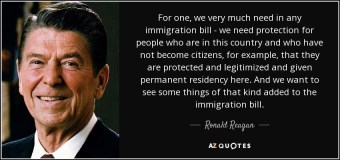
reagan quote immigration

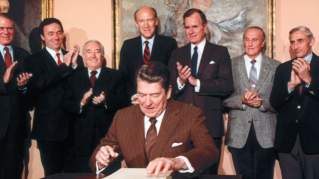
Ronald Reagan signed immigration reform into law in 1986 that was sponsored by former Wyoming US Senator Alan Simpson. The law gave amnesty to 3 million undocumented people.

For the past 150 years, the US government, railroads and agricultural industries welcomed immigrant workers from Mexico. How did they end up coming to the United States in the first place?

Rather than keep immigrants seeking asylum detained, why not give them all temporary visas and put them to work. That’s why they trudged hundreds, if not thousands of miles to America.

I heard there are upwards to 50,000 asylum seekers currently being held around the country awaiting court hearings.

They’re fleeing danger in their homelands, need local sponsors and something to do once they are granted asylum. Anyone who thinks they are going to take their jobs, that’s just hyperbolic race-bait ranting.

What work needs to be done? Here are a couple ideas:

  • Rebuild crumbling roads and bridges
  • Building affordable housing

For the record, I’m not in favor of cutting illegal immigrants any slack. I was an illegal alien and kicked out of Mexico in 1991 for working in Zacatecas on a tourist visa from Jalisco.

My business partner and I were stopped by the federal police, held at machine gun point in the middle of nowhere between a small town of Sombrerete and Fresnillo.

One soldier questioned me in English, my partner in Spanish hoping we would give conflicting stories.

They tossed our pick up truck, groped through my luggage, put everything back and searched again. I think they were looking for drugs. Around this time, the United States and Mexico agreed to stifle cocaine and marijuana traffic. Zacatecas is just south of Colorado.

Luckily for me, they let us go.

I was caught using a Mazatlan tourist visa, but actually working in Zacatecas. I ended up getting my paperwork together and made formal application, along with $97.00 USD and obtained the equivalent of a green card.

A year or so ago, I listened to a presentation by Lu Rocha at a workshop organized by my grad school Center on Domestic Violence at CU-Denver.

She gave a history of the Latino/a/x/ labor force in the United States that dates back to the construction of the transcontinental railroad in the 1800s and propping up the war efforts between 1942 until it’s repeal in 1964.

Immigration issues have been in the news lately. There’s talk of expanding the number of immigrant detention centers in Texas reminiscent of the three war relocation camps set up during World War II to detain and intern Japanese mostly from the West Coast.

daca sign

POTUS 45 repealed DACA put in place by President Obama in 2012 as a stop-gap measure to protect kids of undocumented residents.

The Reagan administration signed the Immigration Reform and Control Act in 1986 which heightened border security but also granted amnesty to 3 million undocumented immigrants. This was a bi-partisan effort led in the US Senate by Wyoming’s Al Simpson.

Red and Blue presidents and congresses failed to act on immigration reform until Obama in his lame duck term issued the Deferred Action on Childhood Arrives (DACA) executive order which cut some slack to kids brought to the US by their undocumented parents. It was a compassionate Band Aid.

POTUS 45 used his bully pulpit, but failed to overturn DACA. Congress continues to be at a standstill, more so now because the House flipped Democratic in 2018.

Immigration reform is a wedge issue for Republicans. They are against immigrants, generally, because of they supposed are “taking of American jobs.” Are all Republicans cleaning toilets, picking beans, or loading dishwashers over at Denny’s in fear of losing their jobs?

At the same time, American business is reliant on immigrant laborers who perform low-end work that regular Americans won’t do which is a throwback to the transcontinental railroad construction and World War II worker shortage.

traqueros

The Transcontinental Railroad was completed by laborers from Mexico.

Traqueros In 1881 Governor Luis Terrazas of Chihuahua drove a silver spike completing a rail line linking Mexico and United States which allowed immigrants transport to the United States and coincided with the West’s construction of the transcontinental railroad.

Mexicans were the dominant immigrant labor laying track in the late 19th and early 20th centuries. Despite low wages compared to their native born coworkers and discrimination, immigrant Mexican laborers became permanent residents, not by law but by fact. By the time of the Great Depression, workers moved to the cities in search of other low-skill work.

Bracero Program

The US Department of Labor and the Immigration and Naturalization Service collaborated on the Bracero Program at the start of World War II. Braceros were allowed in to the US to provide help on farms during wartime.

Braceros The bracero program (Spanish for manual laborer) began in 1942 and operated as a joint program of the State Department, the Department of Labor, and the Immigration and Naturalization Services (INS), as it was known then, in the Department of Justice.

Laborers from Mexico were promised better living conditions in camps, including housing, meals and toilet facilities. They eventually were paid a minimum wage of 30 cents / hour. The pact also stated that braceros supposedly would not be subjected to discrimination and exclusion from “white-only” areas.

During World War II, the bracero program intention was to fill the labor gap, particularly in agriculture. The program lasted 22 years and offered employment contracts to 5 million braceros in 24 U.S. states—becoming the largest foreign worker program in U.S. history.

The bracero program caused problems on both sides of the border with labor shortages in the northern states in Mexico and resulted in illegal immigrants who remained in the United States. Millions of Mexican Americans attribute their roots to their fathers and grandfathers who crossed the border as braceros.

DACA MASS WALKOUTDACA Circle back to DACA kids. They are the modern day traquero/a/x and bracero/a/x. They are people who arrived in the United States under the radar as children.

Like the braceros and traqueros, while they should have returned to Mexico, those families have remained – while looking over their shoulders – without documentation and became productive members of their communities.

The DACA kids ended up with high school and college educations, contribute to society in professional jobs, have families of their own with kids in local school systems. They pay taxes and volunteer in their communities.

DACA kids aren’t Manson women who ran underground and assumed new identities.

When the Bracero Program was ended in 1964, the positive outcomes were better working conditions for farm workers thanks to advocacy by activists including Cesar Chavez and Delores Huerta. There were no immigration laws that turned traqueros back to Mexico.

DACA was a short term fix when Obama acted because Congress didn’t. The immigration issue has come full circle from 1986.

Whether Congress and POTUS 45 get their acts together on immigration reform will be a defining moment for the Republicans like it was for Republicans and Ronald Reagan.

Until then let’s figure out how to engage asylum seekers in useful ways while they awaiting their hearings.

simpson reagan signing“We have consistently supported a legalization program which is both generous to the alien and fair to the countless thousands of people throughout the world who seek legally to come to America. The legalization provisions in this act will go far to improve the lives of a class of individuals who now must hide in the shadows, without access to many of the benefits of a free and open society. Very soon many of these men and women will be able to step into the sunlight and, ultimately, if they choose, they may become Americans.” Ronald Reagan on November 6, 1986 upon signing the Immigration Control and Reform Act.


When you can prove ‘obstruction’ get back to me, will ya?

fox news muellerI watched the Fox News analysis after Special Counsel Robert Mueller was grilled on Capitol Hill, “Nothing to see here, let’s move on to the work of the ‘people,'” and the MSNBC after words, “Throw him out, Throw him out!”
I didn’t watch much of it, but the snip-its I caught, both the Reds and Blues were trying to put words in Bob’s mouth, but he wasn’t biting.
Some Reds and Blues used their five minutes to grandstand for good sound bites that would resonate back home.
His “performance” was panned because Mueller hadn’t memorized the full 487 page report.
If the Blues want to kick POTUS out of office, they need way more than Mueller’s report.
If lying about blow jobs is a “high crime and a misdemeanor,” ‘then “not exonerated” hits that low bar.
If POTUS quits or gets kicked out, it will be because of actual crimes and misdemeanors, not political ones.
In 1973, U.S. Senate Republicans finally came around when Nixon’s actions made it “perfectly clear” he committed felonies.
The nation’s founders had a bad taste in their mouths after colonists were pushed around by their totalitarian British over lords. They wrote the Constitution to give the criminally accused the benefit of the doubt – innocent until proven guilty.
The government has to meet a very high threshold to throw someone in the slammer.
msnbc muellerWhen the Republican-controlled House impeached Clinton, he came back with a vengeance and eked out his re-election in 1996.
He won by a 49.2 percent popular vote plurality over Bob Dole.
If it wasn’t for third party candidate Ross Perot, who garnered 8.4 percent of the vote, Clinton may not have prevailed.
Turning the table, U.S. House Democrats have the votes to make a political statement, but not to fulfill their ultimate goal.
Let the voters kick him out.