Unknown's avatar

About Alan O’Hashi, Whole Brain Thinker

I’ve been involved with community journalism since 1968 when I wrote for my junior school paper, the "Tumbleweed," through high school and college and then wrote for the "Wyoming State Journal." I put aside my newspaper pen and began Boulder Community Media in 2005. There wasn’t much community journalism opportunity, so I resurrected my writing career as a screenwriter. My first short screenplay, “Stardust”, won an award in the 2005 Denver Screenwriting Center contest. I've made a number of movies over the years. Filmmaking is time-consuming, labor and equipment intensive. I recently changed my workflow to first write a book and make a movie based on that content. - Electric Vehicle Anxiety and Advice - This is a memoir travelogue of three trips covering 2,600 EV miles around Wyoming (2022) - Beyond Heart Mountain - Winter Goose Publishers released my memoir in February (2022) - The Zen of Writing with Confidence and Imperfection - This is a book recounting how luck planed into my signing a book deal after a 15-minute pitch meeting. (2020) - True Stories of an Aging Baby Boomer - War stories about living in a cohousing and lessons others can learn when starting their communities (2021) - Beyond Sand Creek - About Arapaho tribal efforts to repatriate land in Colorado (PBS - TBA) - Beyond Heart Mountain - Based on my memoir about my childhood in Cheyenne facing overt and subtle racism toward the Japanese following World War II (PBS - 2021) - New Deal Artist Public Art Legacy - About artists who created work in Wyoming during the Great Depression (PBS - 2018) - Mahjong and the West - SAG indie feature which premiered at the semi-important Woodstock Film Festival (2014) Over the years, I’ve produced directed, filmed and/or edited several short movies, “Running Horses” (Runner Up – Wyoming Short Film Contest), “On the Trail: Jack Kerouac in Cheyenne” (Lowell Celebrates Kerouac Festival, Top 10 Wyoming Short Film Contest), “Gold Digger” (Boulder Asian Film Festival), “Adobo” (Boulder International Film Festival), “A Little Bit of Discipline” (Rosebud Film Series), and two feature length documentaries “Your Neighbor’s Child” (Wyoming PBS and Rocky Mountain PBS), and “Serotonin Rising” (American Film Market, Vail Film Festival). He also directed and produced the award winning stage play “Webster Street Blues” by my childhood friend Warren Kubota. Boulder Community Media is a non-profit production company dedicated to democratzing media in all their forms - large and small screens, printed page and stage by providing sustainable and community-based content. I mostly work with community-based media producers, organizations, and socially-responsible businesses to develop their content via – the written word, electronic and new media, the visual and performing arts in a culturally competent manner – I’m what’s commonly called a niche TV and movie producer. Along with all this is plying my forte’ – fund development through grant writing, sponsorship nurturing and event planning.

Part III – Diverse Personalities: Let’s get personal with cultural competency

glinda dorothy oz

Click on the image of Dorothy and Glinda and watch the clip about how Dorothy always had the way to get back home.

Remember the climax of the “Wizard of Oz” when Dorothy gets herself back to Kansas?

Good Witch of the North Glinda lets Dorothy in on the secret that she’s always had the way to return home.

What do Dorothy and the interactive Dealing with Diverse Personalities retreat have in common?

Previously, I wrote about risk factors and how they may contribute to conflicts among diverse personalities and how protective factors can buffer against risks.

One strong protective factor is cultural competency.

We all are capable to become more culturally competent by evaluating ourselves and learning, sometimes through hard knocks, that we inherently have the ability to be more accepting of others  and their personalities and to better understand our own personality quirks which may cause difficulties for

Like Dorothy having to decide which Yellow Brick Road fork to take, evading flying monkeys, liquidating the Wicked Witch of the West, it takes work for each of us to realize that we possess the inherent abilities to understand ourselves and others. Sometimes we need a little help from our own Lion, Tin Man and Scarecrow.

What is cultural competency and why is it different from learning about diversity?

—If you do a google search, there are many iterations and definitions. For my purposes, cultural competency is a developmental process that evolves over an extended period of time. At any given moment, depending on past histories and experiences, individuals, groups and communities possess various levels of cultural awareness, knowledge and skills necessary to deal with other people – all of us are different.

It’s a very personal journey and at the Dealing with Diverse Personalities retreat, we’ll start the voyage by remembering our histories, developmental influences and how those experiences affect how we perceive and understand others.

Diversity, on the other hand, is descriptive of various groups. Learning aspects of diversity is daunting since there are so many ethnicities, nationalities, religions, languages, that the list is nearly endless. It’s not practical to try and learn them all.

On top of those is the endless list of personality types – extroverts / introverts; over achievers / passive; yes people / no people.

Because of our limited knowledge of diverse characteristics, judgements lead to unintentional stereotyping. Stereotyping is making decisions based on inaccurate or incomplete information.

Cultural competence is self-guided work that will begin or continue at the Dealing with Diverse Personalities retreat. Participants will realize that it is possible to shed behaviors, recognize privilege, understand the need to make personal sacrifices for the good of the whole. The process can be difficult, you may lose friends, but make better ones, and it takes time.

We appeal to all learning styles – auditory, visual and hands-on. Roll up your sleeves and join us. If you’re already on the journey, want to start a new voyage, are interested in helping your organization or community avoid conflicts among diverse personalities which may include yourself, then sign up for the Dealing with Diverse Personalities retreat September 30 – October 2nd.

“There’s no place like home.”

Part II – Diverse personalities: Risk vs Protective Factors

conflict resolution

Find out more about the Dealing with Diverse Personalities retreat September 30 – October 2

I’m facilitating a retreat later this fall about dealing with diverse personalities in Arcosanti, AZ. I’ve been asked by a few people about what the “strength-based” approach I’ll be using is about.

Risk and protective factors are a little jargony and wonky, but important concepts when dealing with disruptive and violent behavior in an organization, community – any group, really.

I formerly worked in the positive youth development and domestic violence prevention fields. Parts of my jobs involved training in strength-based cultural competency, which is how the retreat will be presented.

First I’ll talk a little bit about the differences between the two approaches in the context of disruptive behavior.
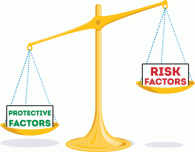
srisk protective cales

Protective factors are buffers against risks that contribute to disruptive behavior and violence.

Risk Factors are numerous. They increase a person’s possibility of committing disruptive or violent acts. It is possible to be disruptive or commit violent acts with or without any of the risk factors listed below – the list of possible risk factors is nearly endless. However, the more risk factors a person is exposed, the possibility of committing disruptive or violent acts increases. Here’s a list of possible risk factors:

Personal risk factors

  • History of tantrums or angry outbursts
  • Resorts to name calling or cursing
  • Bullying others
  • History of being bullied
  • A pattern of violent threats when angry
  • Use and abuse of alcohol or drugs
  • Mood swings
  • Blames others for personal problems
  • Desire for power and control
  • Recent experience of humiliation, loss, or rejection
  • Poor peer relations, is on the fringe of the community

Community risk factors

  • Community disorganization
  • Lack of community norms that set boundaries on behavior
  • Destruction of property within the community

The response to dealing with risk factors is known as secondary prevention (How do we prevent a person from being disruptive a second time) which features “victim blaming.” That’s a consequence of the law enforcement containment approach.

It’s prevalent in schools (administrative confrontation, send a note home to parents, sessions with counselors, expulsion).

In conventional systems of discipline, offenders from school bullies to domestic violence perpetrators are managed or contained by several agencies, groups or individuals and are very labor and time intensive systems.

This “out of sight, out of mind” method, finger-points and isolates, but does not solve the ultimate problem, which may be deeper and enabled by community risk factors.

All of us have had the top-down, more authoritarian model pounded into us from the age of five.

Those habits are hard to shake.

What can we do to prevent disruptive behavior or violence from happening at all?

Protective factors provide primary prevention and buffers the risks which may be associated with disruptive or violent behavior. Protective factors haven’t been studied as extensively as risk factors because they are difficult to measure.

Protective factors are not the opposite of risk factors, but rather shield a person from the effects of risk factors.

In the context of community, it takes a village to create an atmosphere and culture that nurtures protective factors in positive directions rather than negative ones.

The strength-based protective factor approach is one that is more easily implemented.

Why?

Rather than trying to ameliorate, in a reactionary way, individual risks which may or may not cause a particular disruptive behavior a few protective factors can be developed that that buffer against many risk factors.

  • Community establishes boundaries, expectations and norms that emphasizes the whole and not the individual.
  • Community establishes “restorative justice” consequences
  • Community participates in activities that support its “higher purpose.”

What’s “restorative justice”?

In the outside world criminal justice system, it brings together victims, other stakeholders, the affected community to transform. Most community settings don’t have punishments in the strict sense and “enforcing” on disruptive or violent people is difficult, if not impossible. You can’t expel them, make them stay after school, lock them up, or whatever.

In the context of community, there likely is a looming or approved decision that takes from the whole to benefit a few that creates angst. I’ll call the process finding “transformational solutions” (which is a bit wonky).

Any consequence leveled in a community likely involves many disruptive event contributors who must take ownership of their roles as opposed to blaming others. Since disruptions are dynamic and different there are many role combination and curcumstances possible.

  • Target (who likely is directly involved)
  • Incident inciter (who may or may not be directly involved in the disruption)
  • Retaliator(s) (community member(s) who feel harmed by the inciting incident)
  • Bystanders (members who may have witnessed the disruptive behavior)
  • Intervener (bystander who actively tries to calm down the disruption)

The retreat will address how all community members can dig into their pasts and begin to unpack previously learned behaviors and how to better respond to distuptions as we find ourselves in various roles.

What is “higher purpose”?

My cohousing neighbor uses the analogy about community culture, “What if we were all accountants?”All being accountants is a common characteristic, but not a higher purpose. If all the accountants as a community decided to provide money management for senior citizens or help low income people fill out their income tax returns, that would be a higher purpose.

No matter what age, participation in “religion” or organized higher purpose is the most effective protective factor that buffers against risks. Another is having a strong alky who is not a family member.

lack of boundaries memeAs for myself, the reason I’m committed to this process is I’ve recently been involved with a huge conflict within my cohousing community that’s been festering going on three years with no end in sight.

Dealing with diverse personalities is the “elephant in the room” that gets shoved in the closet, only to emerge later in another room.

The retreat leads participants through a process that enables each to know themselves better and how they can better understand others through getting to know them better.

The retreat and three sessions will be very interactive, hands-on and also be quite entertaining with a big dance performance at Arcosanti and plenty of time to network, meet new people and get to know existing acquaintances better.

NEXT – “PART III – DIVERSE PERSONALITIES: CULTURAL COMPETENCY”

My next story will address how cultural competency as a protective factor works hand in glove with developing other protective factors in community as primary prevention against disruptive behavior and escalating violence.

 

I’m standing with Bernie

bernie hillary

I’m standing with Bernie. He endorsed Hillary today.

This just was delivered to my In-Box from Bernie who endorsed Hillary.

I know there are a bunch of my fellow Bernie supporters who are disappointed in this, but there really was no other alternative for him. He says he wants to keep his movement growing.

I also thought Occupy would have some staying power, which didn’t.

As much as I would like to see him stay active on a national basis, I’m pretty sure Bernietheism will slowly whither on the vine. I just don’t have the energy nor the spare time I once had to save the world. 

It would have been impossible for him to get any traction as a progressive candidate. Jill Stein and the Green Party are jaded and I imagine the ardent Berniephiles will go that way.

Some Bernie supporters will join Jeb Bush who won’t support Trump or Hillary and stay home on election day. I thought about Gary Johnson, but he’s a liberal Republican masquerading as a Libertarian and would likely try to junk Obamacare. I think when the debates roll around, he’ll poll high enough to at least get into one national debate. While Trump and Hillary end up bashing each other on the stage, Johnson will pose himself as undamaged goods.

If Johnson catches on and can grab 20 percent of the vote, he could send the election either way considering ClinTrump are neck and neck within the statistical margin of error. Neither of them wants to peak too soon?

Credible third party candidates have turned elections. 
wallace buttonGeorge Wallace in 1968 – After all the violence at the Democratic National Convention, the far left forgot to vote and Richard Nixon won a close one. Back then, though, there was no voting process oversight and there’s no telling what other chicanery was perpetrated back then.
perot mup 1992Ross Perot in 1992 – Ross Perot was a fairly reasonable and very rich oil guy who funded his campaign with his own money. Turned out he and George H.W. Bush were the same candidate and after the reversing his “Read my lips, no new taxes pledge” Perot pushed the election to Clinton. Had Perot’s running mate John Stockdale been a little more articulate, Perot may have competed much better. Gore cleaned his clock in the VEEP debate.
nader 2000Ralph Nader in 2000 – I don’t think Nader was an intentional spoiler since he only won around 3% of the vote (compare that to the 20 percent garnered by Perot and the 14 percent by Wallace). Nonetheless, he took enough support from Al Gore to make it a close race. Gore won a greater percentage of the popular vote since he carried the urban strongholds, but unable to win the more important electoral college vote. Bush won the sparse Red states.
 
In a purple state like Colorado, my vote does matter. I’m a rational voter and didn’t think I’d have to select the lesser of two evils until Hillary’s arrogant and dishonest actions were revealed by FBI Director Comey.
Unlike my ultra-conservative friends who think she should be doing hard time, I see her as more of a political criminal. There are lots of those, including George Bush, et al.  (No Weapons of Mass Destruction); Ronald Reagan (Iran-Contra); Richard Nixon (Watergate, he was an actual criminal); LBJ and JFK had dirty noses. I didn’t add Bill Clinton to that list since he was impeached over lying about blow jobs and in my book, only a political high crime / misdemeanor. If he followed Monica Lewinski’s advice on foreign policy – now that would be grounds for impeachment.
The only clean guys were George H.W. Bush who had a good flip flop on a needed tax increase and Jimmy Carter who had a helicopter go bad sneaking around Iran finding hostages and they both lasted one term.
What about me?
I’m standing with Bernie on this one … here’s likely the last note I will receive from Bernie this election cycle. It will be interesting if he turns his list over to Hillary.
bernie logo

My last email from Bernie. Usually, he asks for money. Not this time.

Alan – I am writing you today to express my deep pride in the movement – the political revolution – you and I have created together over the last 15 months. When we began this historic campaign, we were considered fringe players by the political, economic and media establishment. Well, we proved them wrong.

 We showed that the American people support a bold, progressive agenda that takes on the billionaire class, that fights for racial, social, economic and environmental justice and that seeks to create a government that works for all of us and not just the big campaign donors.
 
We mobilized over 13 million voters across the country. We won 23 Democratic primary and caucus contests. We had literally hundreds of thousands of volunteers across the country. And we showed – in a way that can change politics in America forever – that you can run a competitive national grassroots campaign without begging millionaires and billionaires for campaign contributions.
 
Most importantly, we elevated the critical issues facing our country – issues the establishment has pushed under the rug for too long. We focused attention on the grotesque level of income and wealth inequality in this country and the importance of breaking up the large banks who brought our economy to the brink of collapse. We exposed our horrendous trade policies, our broken criminal justice system, and our people’s lack of access to affordable health care and higher education. We fought aggressively to address the crisis of climate change, the need for real comprehensive immigration reform, the importance of developing a foreign policy that values diplomacy over war, and so much more.
 
We have shown throughout this election that these are issues that are important to voters and that progressive solutions energize people in the fight for real change. What we have accomplished so far is historic – but our work is far from over.
 
This movement of ours – this political revolution – must continue. We cannot let all of the momentum we have achieved in the fight to transform America be lost. We will never stop fighting for what is right.
 
It is true that in terms of winning the Democratic nomination, we did come up short. But this election was never about me or any candidate. It was about the powerful coming together of millions of people to take their country back from the billionaire class. That was the strength of our campaign and it will be the strength of our movement going forward in the months and years ahead.
 
In the coming weeks, I will be announcing the creation of successor organizations to carry on the struggle that we have been a part of these past 15 months. I hope you will continue to be involved in fighting to transform America. Our goal will be to advance the progressive agenda that we believe in and to elect like-minded candidates at the federal, state and local levels who are committed to accomplishing our goals.
 
In terms of the presidential election this November, there is no doubt that the election of Donald Trump as president would be a devastating blow to all that we are fighting for. His openly bigoted and pro-billionaire campaign could precipitate the same decades-long rightward shift in American politics that happened after the election of Ronald Reagan in 1980. That rightward shift after Reagan’s election infected not just politics as a whole but led to the ascendancy of the corporatist wing of the Democratic Party – an era from which we are still recovering.
 
I cannot in good conscience let that happen.
 
To have all of the work we have done in elevating our progressive ideals be dashed away by a complete Republican takeover of Washington – a takeover headed by a candidate that demonizes Latinos, Muslims, women, African Americans, veterans, and others – would be unthinkable.
 
Today, I endorsed Hillary Clinton to be our next president. I know that some of you will be disappointed with that decision. But I believe that, at this moment, our country, our values, and our common vision for a transformed America, are best served by the defeat of Donald Trump and the election of Hillary Clinton.
 
You should know that in the weeks since the last primary, both campaigns have worked together in good faith to bridge some of the policy issues that divided us during the election. Did we come to agreement on everything? Of course not. But we made important steps forward.
 
Hillary Clinton released a debt free college plan that we developed together which now includes free tuition at public colleges and universities for working families. This was a major part of our campaign’s agenda and a proposal that, if enacted into law, would revolutionize higher education in this country.
 
Secretary Clinton has also publicly committed to massive investments in health care for communities across this country that will increase primary care, including mental health care, dental care, and low-cost prescription drug access for an additional 25 million people. Importantly, she has also endorsed the enactment of a so-called public option to allow everyone in this country to participate in a public insurance program. This idea was killed by the insurance industry during consideration of President Obama’s health care program.
 
During the Democratic platform proceedings in St. Louis and Orlando, we were victorious in including amendments to make it a clear priority of the Democratic Party to fight for a $15 an hour federal minimum wage, expand Social Security, abolish the death penalty, put a price on carbon, establish a path toward the legalization of marijuana, enact major criminal justice reforms, pass comprehensive immigration reform, end for-profit prisons and detention facilities, break up too-big-to-fail banks and create a 21st century Glass-Steagall Act, close loopholes that allow big companies to avoid taxes by stashing their cash in offshore tax havens and use that revenue to rebuild America, approve the most expansive agenda ever for protecting Native American rights and so much more.
 
All of these progressive policies were at the heart of our campaign. The truth is our movement is responsible for the most progressive Democratic platform in the history of our country. All of that is the direct result of the work that our members of the platform committee did in the meetings and that you have been doing over the last 15 months.
 
But none of these initiatives will happen if we do not elect a Democratic president in November. None! In fact, we will go backward. We must elect the Democratic nominee in November and progressive Democrats up and down the ballot so that we ensure that these policy commitments can advance.
 
It is extremely important that we keep our movement together, that we hold public officials accountable and that we elect progressive candidates to office at the federal, state, and local level who will stand with us.
 
As part of that effort, we still have a tremendous amount of work left to do in the Democratic Rules Committee that will be meeting in the coming weeks. We have to enact the kinds of reforms to the Democratic Party and to the electoral process that will provide us the tools to elect progressive candidates, to allow new voices and new energy into the Party, and to break up the excessive power that the economic and political elites in the Party currently have. As with our fights on the platform committee, that will only be possible if we stand together.
 
You should know that I intend to be actively campaigning throughout this election season to elect candidates who will stand by our agenda. I hope to see many of you at events from coast to coast.
 
In conclusion, I again want to express my pride in what we have accomplished together over the last year. But so much more must be done to make our vision a reality. Now more than ever our country needs our movement – our political revolution. As you have throughout this historic campaign, I ask for your ongoing support as we continue through the fall and beyond.
 
On a personal note, I cannot say with words how appreciative Jane and I are of the kindness, dedication and love we experienced from so many people across the country. We are deeply touched by it and will never, ever forget it.
 
Please let me know that you will stand with me to defeat Donald Trump, and to elect candidates who will stand by our agenda as part of the future of our political revolution. Add your name now.
 
Forever committed, forever fighting, forever forward,
Bernie Sanders