I was an illegal worker in Mexico

francisco lopez barajas

My business partner in Zacatecas Mexico Faustino Lopez Barajas.

I generally only write about things that I’ve experienced personally. I’m becoming more convinced with the recent flood of children crossing the into Texas, that the United States has the most porous border of any nation in the world.

Let me tell you about the time I was shaken down by soldiers with machine guns for being an illegal worker in Mexico. It was a very helpless feeling.

Maybe it’s that poem inscribed on the Statue of Liberty by Emma Lazarus:

tablette-statue-de-la-liberte

Turns out, if you’re from a European country, this quote is more applicable.

Give me your tired, your poor,
Your huddled masses, yearning to breath free,
The wretched refuse of your teeming shore,
Send these, the homeless, tempest tost to me,
I lift my lamp beside the golden door.

Most other countries have largely indigenous populations that have lived there for centuries. The US, on the other hand, conquered the locals fair and square, and that was just over 200 years ago. 

I did business in Mexico for six years or so starting in 1992 when the North American Free Trade Act went into effect. Then US Secretary of Commerce Ron Brown held a bunch of meetings around the country, including one in Denver. I was working for the Northern Arapaho Tribe at the time in economic development and went down to check it out. At that time, the tribe was looking to sell its hay.

hotel sombrerete

Downtown Sombrerete

After all the speeches, there was a round table session with representatives from businesses in Mexico. Most everyone split and left all these business people sitting alone. I stuck around and sat down with a group of guys from a credit union based in a small town called Sombrerete in the state of Zacatecas. It’s located in the north central part of Mexico. We hit it off and they invited me down for a visit.

A friend and colleague of mine flew down to check things out. A couple tribal guys – Fred and Gary – and I started up the 600 acre Arapaho Farms. The Arapaho Tribe was big into sustainable agriculture at the time and was interested in farming practices in Mexico – like using a tree branch hooked up to a mule as a harrow. As it turned out the farming thing in Mexico didn’t work out.

Meanwhile I began consulting for a marketing company based in Boulder which had a manufacturing facility in Alamosa, Colorado. They made and sold hair accessories. The manufacturing costs, even in Alamosa were too high.

francisco mexico city

Francisco at the Mexico City factory.

I mentioned that I had experience in Mexico and when I was down there before, I learned that some of the small towns would be devoid of working age people – mostly men – who went to the US to work – many illegally. I figured out that workers would rather stay in their home towns rather than leave, but there is no work in the middle-of-nowhere Mexico. The immigration policies favored US businesses wanting to create jobs there.

My idea was to recruit home sewers and assemblers in Sombrerete to make the hair accessories, rather than establish on the US – Mexico border, which is the generally accepted maquilla model.

maquila worker

The factory in Zacatecas.

The operation called Luna Llena at its peak employed two shifts of 50 people. We had a bonded warehouse on the border in McAllen, Texas. The first shipment was a disaster, though. How the process works is simple. The idea is to send 10 straps, 10 beads and 10 feathers through customs in Mexico. Then the materials are assembled and the completed 10 pony tail holders are then shipped to the US warehouse.

The finished inventory didn’t match up with the raw materials list. After getting that workflow figured out, everything went smoothly.

One of the best things about Mexico is the time zones are the same as the US. I sometimes flew into Guadalajara or Zacatecas, but mostly flew into Mazatlan in the state of Sinaloa, hung around the beach for a few days then took the bus to Sombrerete. “Papers? We don’t need no stinkin’ papers!” I traveled uneventfully on a passport and a tourist visa for five years.

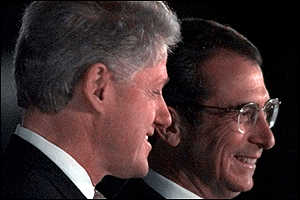
In 1997 President Clinton and the President of Mexico, Ernesto Zedillo signed an agreement hoping to stem illegal immigration and drugs from flowing to the US.
clinton zedillo

US President Clinton and El Presidente de Mexico Ernesto Zedillo

One of my business partners, Francisco,  was driving us from Sombrerete to Zacatecas in a beat up Toyota pickup with expired California plates. Just outside the town of Fresnillo we were stopped by an armed cadre of soldiers.

We were ordered out of the truck and handed over our papers. I had my US passport and the tourist visa from Mazatlan, which immediately caused problems.

Francisco and I were separated. He was worked over in Spanish and I was worked over in English. A third soldier emptied the truck and tossed my suitcase and repacked it. After an hour we were cleared to go, but not quite. My suitcase was again turned upside down and rechecked for contraband.

I was an illegal in central Mexico on a tourist visa from a coastal state.

They let us go.

I did go through the process to get a visa to work in Mexico. It’s not as big of a deal as it is in the US. I had to get a letter from my partner about the nature of our manufacturing work and took it to the Embassy for Mexico in Denver, pay $125 and I was granted a work visa.

There are plenty of isolationists, including Donald Trump, who want to close the US borders to immigrants – legal or illegal – who at the same time are against moving US jobs off shore.

I’m convinced that the best way to stem immigration from Latin America is for international companies from the US and elsewhere of all sizes to move there and create jobs for locals.

My gig in Sombrerete was good while it lasted.

What happened?

Francisco’s brother, Faustino, was the brains of the operation. He was the only guy among his group who spoke English and had a US visa. On his way to Colorado, he became very ill. Turned out he had cancer.

He moved himself and his extended family to Mexico City for better medical care and eventually died. Francisco moved the factory to Mexico City, which made a sense in a lot of ways and took the business in a different direction and sewed clothing.

I haven’t been back to Sombrerete or Mexico lately. Looking back, it was very isolating being the only English speaker for miles around. Communication was exhausting and I wore out a couple English – Spanish dictionaries.

I hear that Ecuador is now a big haven for expat Americans but I don’t think I’d want to live among them.
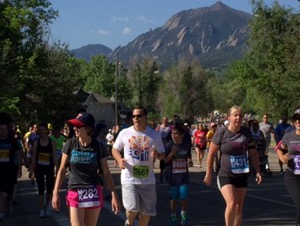
On the trail of Bolder Boulder Skechers: Memorial Day 2016

Obligatory Bolder Boulder shot on Folsom Hill.

I don’t know why I do the Bolder Boulder 10K. Maybe it’s the familiarity – the Blues Brothers crooning  right out of the blocks; the girating belly dancers on the Folsom Hill and off key Elvis at the 7-Eleven; the Slip ‘n Slide – now there are two.

I used to buy a shirt every year but got rid of all of them except the 2002 race shirt. That was the race that remembered 9/11. That takes the guess work out of my annual wardrobe decision making.

I started covering the race in 2006 when I was with the public access TV station and have been going out on the course getting shots of pretty much anything but the race, including all the bands that entertain the runners along the way.

Mugging with Elvis at the 7-Eleven

It takes me around three hours to finish. I stop about 20 times and spend a few minutes with all the bands and live entertainment along the route. I get out too late to sample any of the bacon giveaway – the other power bar – around the 9K neighborhood. I did notice that the Colorado Pork Producers are now a sponsor and taken over the concession.

When I was recovering from my illness in 2014, I had to take a swig of oxygen staggering into the stadium just before the orange shirts – the mop up crew – threw me off the course. My strength and stamina are way better, except the rock climbing on Saturday took its toll. That’s another story.

This year, I took a step on the wild side and made a Bolder Boulder impulse buy.

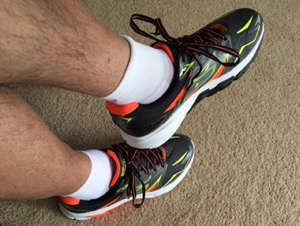
I was bound and determined to find a pair of new sneakers – Skechers. Last year, I was sitting at the lunch table with elite runner Meb Keflezighi. In 2015 Skechers was named as the big sponsor of the Bolder Boulder and Meb swears by Skechers. That’s been his shoe sponsor since 2011.

He couldn’t stop raving about Skechers – sort of like when after winning Super Bowl 50, Peyton Manning said that he was going to relax and down a few Buds in reference to his Louisiana business interests.

Vintage Skechers

Not that I’m any kind of shoe aficionado, but I remember Skechers as pastel pink women’s walking shoes with the rounded bottoms. Now footwear for elite athletes?

If there’s anyone who’s the casual runner, it’s me. I bought a pair of Asics in 2002 and wear them once a year for the Bolder Boulder. Needless to say, my shoes are still in good shape.

Last year – 2015 – Skechers had a big trade booth on the Pearl Street Mall. The Flatiron Running Store was the local sponsor and was giving out T-shirts. I picked up a shirt and some literature about Skechers, but hadn’t made up my mind about the shoes.

Fast forward to 2016, this year I visited the Skecher trade booth and tried on a pair  of the 8 1/2 GoRun Strada shoes, but walked away. When I came back, they, of course, were sold, but I tried on every other shoe in my size, but none were quite right, even at $76. (Actually, any of them would have worked, but they were red. I don’t wear anything red because it reminds me of my high school rivals Cheyenne Central).

My $30 Skechers are little too colorful for my liking, but I won’t wear them until next year.

Not to be deterred, I went down to the Flatiron Running Store in the Table Mesa shopping center and much to my surprise, most of their Skechers were on the deeply-discounted sale table.

After searching around, I uncovered one pair, sticker price $130 marked down to $50 and marked down again to $30.

Retail is for suckers.

I got them home and as the Skechers shoe salesman on the Mall explained, the soles are made out of foam. They are light weight and felt good on my feet. As a general rule, it probably doesn’t make much sense to wear brand new shoes on a 10K run, but they were very soft and comfortable.

Afterwards, no bruised up runner’s toe or achy arches. For this kind of foot abuse, I normally need strong support, but not with these Skechers.

I sound like Meb.

Since I only wear them six miles per year, the foam should last me for a while. This model probably is not for hard core runners which may be why all these shoes were on the “buy these before we send them to “Aftica” sale table.

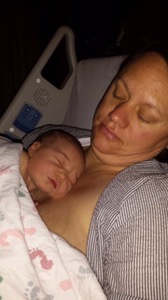
Ellen and infant Evelyn on Memoaial Day

One of my friends was due to have a baby around this weekend. In the pool, I had May 30th and sure enough baby Evelyn was born on Memorial Day.

Bragging rights.

I played the game of Risk in a past life. The custom of the group bestowed on the winner the imperial honor of folding up the board, sorting out the pieces and putting the game away.

Imperial bragging rights.

Baby Skechers rooted out of a pile at Nordstrom’s Rack.

In this vein, as the winner of the birth date guessing game, I felt obliged to get a present. I opted for a Memorial Day – Bolder Boulder themed gift of a pair of baby Skechers, which cost $30 – the same price as the pair I bought for the race. I’m pretty sure if Nike or Adidas sponsored the race, my baby shoes would have been way pricier!

After getting to Folsom Field, I happened to see two folks who were the last two finishers being escorted by the orange shirts past the finish line. Turns out the runners in their 70s were Don and Barb Worden from Rock Springs, Wyoming.

They said this is likely their last Bolder Boulder.

Maybe they have the right idea to end their running careers on a high note as the final finishers in 2016.

‘When I’m 64’ birthday book project for 2016 – 2017

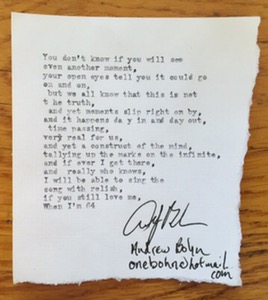
A poem that inspired my book project.

Today is the final day of last year’s birthday activities.

A few months ago, a sidewalk poet in Fort Collins typed up a few lines for me that inspired the “When I’m 64” book project that begins tomorrow.

My 63rd year starts uneventfully tomorrow, May 2nd, with well-wishers on facebook and that will be the extent of it, but a yearlong celebration is stacking up to be action-packed. A smattering of events include:

  • a screening of “Aging Gratefully: The Power of Community” at the cohousing conference in Salt Lake May 19th
  • finishing up two documentaries – “New Deal Art in Wyoming” and “Art of the Hunt”
  • starting some new projects – in August “Plein Air in Thin Air” with a trek up the Grand Teton, teaching Arapaho kids movie production, Prince project in Wyoming
  • going fly fishing

When I turned 60 back in 2013, I had big plans to kick off a productive and action-packed decade.

Instead, it was a big mortality wake up call. I barely made it through 2013 with a big reevaluation of life which is why I continue my tradition of celebrating for the year.

The cohousing community had a talking circle tonight about transitions over the past few months.

Most of the conversation was rather dark about health issues and mortality.

I tried having those conversations a couple years ago with my neighbors which largely fell on deaf ears. Funny how people believe their own observations. It will be interesting to see if their perceptions will match up with reality.

As many of you know by now, May 2013 started out uneventfully – the Bolder Boulder; then the top of the Cyclone roller coaster; then a shingles attack; then too much work – “Mahjong and the West, Governor’s Arts Awards, a wedding; then a week stint in the hospital and then another six weeks in the hospital – that time on my death bed.

I snapped out of it and now every day I wake up, I’m grateful. I’ve been culling through my stuff which includes  a bunch of newspaper columns and other muses.

I’m compiling all that into a memoir woven through my health recovery experiences over the past couple years.

I took a couple writing classes to scrape off the rust, but turns out there are a lot of authors with worse cases of writer’s block than me.

The class exercises were helpful for structure and topics. Though, hearing about and helping others slog through their writing struggles was the most worthwhile. I thought I was stuck, until I met with my workshop-mates who are really stuck – scared to start.

I may run some parts of the book for you to check out. I still have a few things on my 2013 list to complete including weightlessness, skipping stones, climbing a tree and writing a book.