Swedish Death Cleaning II: The Violin Case

Have you ever learned a skill, forgot it, then relearned it?

When letting go brings something back.

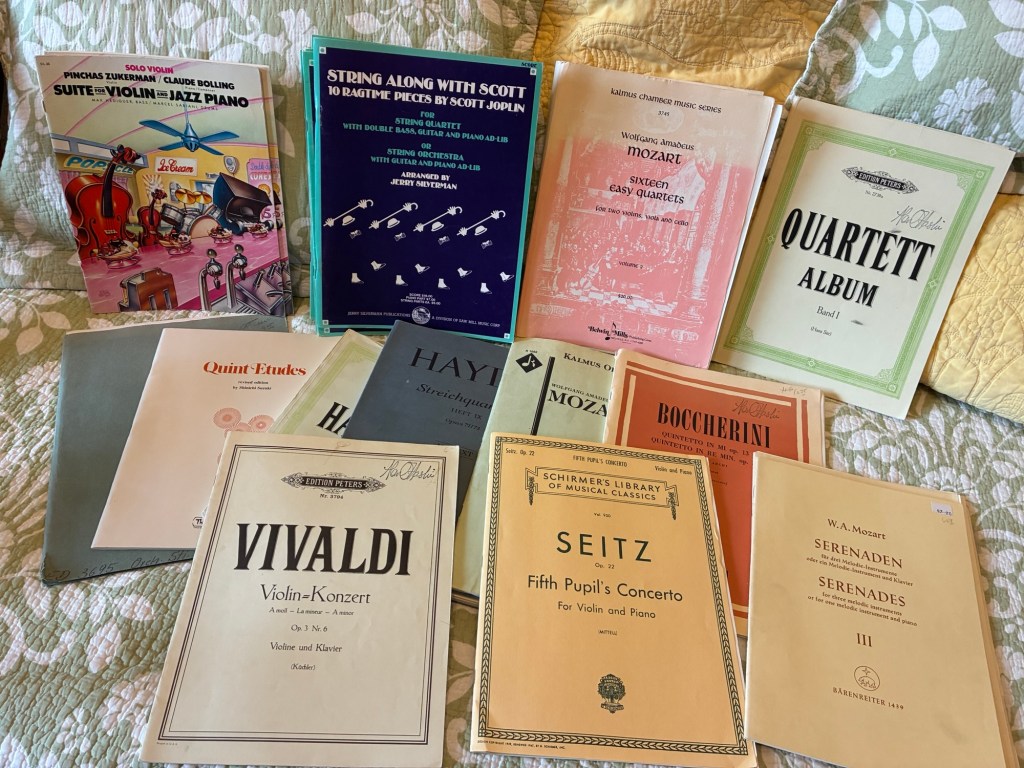
I was sorting through another box for my ongoing Swedish death cleaning project when I came across a stack of old violin chamber music.

Duets. Quartets. Quintets. Pages with penciled notes and dogears from another life.

I figured it was simple enough. Sell the music and two of my three violins. I’d keep the one my grandfather passed down to me, which he bought from a Sears catalog in the 1900s.

That box carried me back to Lander, Wyoming.

Years ago, when I worked at the newspaper there, I wrote a feature story about Becky, the local Suzuki violin teacher.

One Saturday morning my photographer friend Tom stopped by unexpectedly and told me I needed to see a violin he’d found at a garage sale.

We drove back across town. The violin looked worn but had character. The owner said it had once belonged to local fiddler Quentin Roberts. That mattered to me.

It had history.

Provenance.

A life before mine.

I bought it for something like twenty-five bucks.

After that, I contacted Becky and asked if she took adults. She mostly taught the parents of her younger students and people like me who woke up one day and realized they wanted to learn something difficult before it was too late.

So I learned.

Long story short, I got pretty decent.

Not concert hall decent. But good enough to play in a small local orchestra and enjoy myself.

Becky played viola and a second violinist, Lisa, played for tips at a local bar. The patrons there were more accustomed to Dylan than Mozart.

I started collecting music just because I wanted to try playing it someday.

Then life happened and I moved to Colorado.

I relocated to Boulder imagining there would be amateur groups everywhere. There were plenty of musicians, but even the “beginners” had conservatory backgrounds and college performance experience.

My violin disappeared into its case where it has sat for thirty years.

When the woman stopped over to pick up the sheet music, we talked. I asked her why she wanted it.

Turns out she and her husband were in the exact same predicament I was.

Former players. Rusty musicians. People who once loved playing but drifted away from it over time.

Except they had taken the next step. They had found a few other “hackers” like us to play together for fun.

Then came the best part.

She lives two blocks away.

I had been preparing myself emotionally to part with the music and the violins, thinking Swedish death cleaning meant dismantling old identities.

Instead, the process handed one back to me.

Now I’m thinking about restringing the fiddle.

Maybe the point of Swedish death cleaning is figuring out which possessions are still attached to joy, memory, possibility, and will find new homes when the time is right.

Who would have thought that lightening the load could also put something back into my hands?

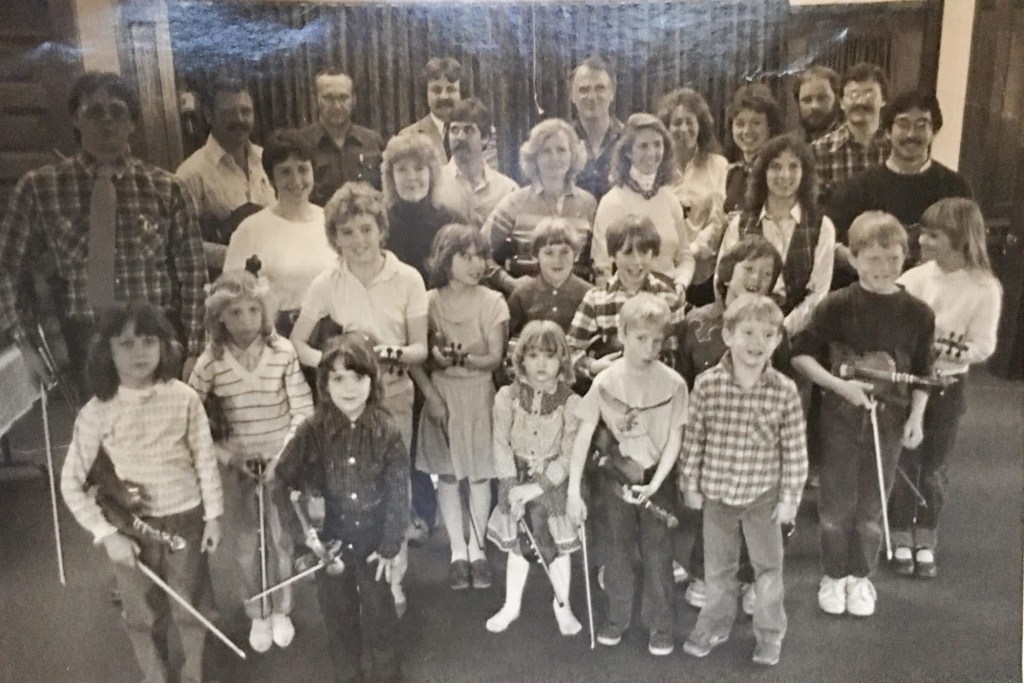
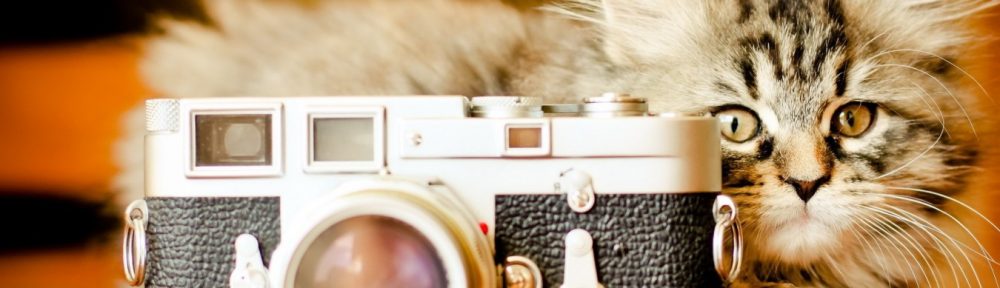
The image at the bottom was taken at a fiddling workshop led by one of my high school classmates Bob Mathews.

Swedish Death Cleaning for Pack Rats

Have you heard about Swedish Death Cleaning?

Where sentimental value meets Facebook Marketplace.

There’s a television show called the “Gentle Art of Swedish Death Cleaning” where three cheerful Swedes descend upon cluttered American homes like minimalist Viking spirits.

They smile politely while staring at your collection of commemorative beer steins and ask questions that cut straight to the soul.

“Will anyone want this after you die?”

“Why do you own 17 extension cords?”

The premise is simple and terrifying. Swedish death cleaning (döstädning) is the practice of gradually getting rid of your stuff before someone else has to do it for you.

I don’t want my grieving friends and relatives to stand in my garage holding a box labeled “miscellaneous cables” and wonder if I was building a radio station or hiding evidence.

I’ve been Swedish death cleaning for years without realizing it had a name. I thought I was slowly becoming the old guy muttering, “Why do I still own this?”

The Marshall Fire accelerated the process for me. Watching entire neighborhoods go up in a puff of smoke changed my relationship with possessions in a hurry.

I started thinning out decades of sports memorabilia, political collectibles, souvenirs, and enough paper ephemera to start my own presidential library or baseball museum.

At first, it was hard.

I had convinced myself that every object contained meaning. I took pictures of everything significant. I got rid of the item and kept the memory.

“This ticket stub is history.”

“This bumper sticker might be valuable someday.”

“This faded Rockies pennant represents an era.”

If I wanted a replacement, I could buy another.

Eventually, I realized my heirs are not going to lovingly curate my life’s treasures. They’re going to rent a dumpster.

Now I’m down to the nuisance phase of death cleaning. The weird objects. The things that survive every purge because they’re too sentimental to toss.

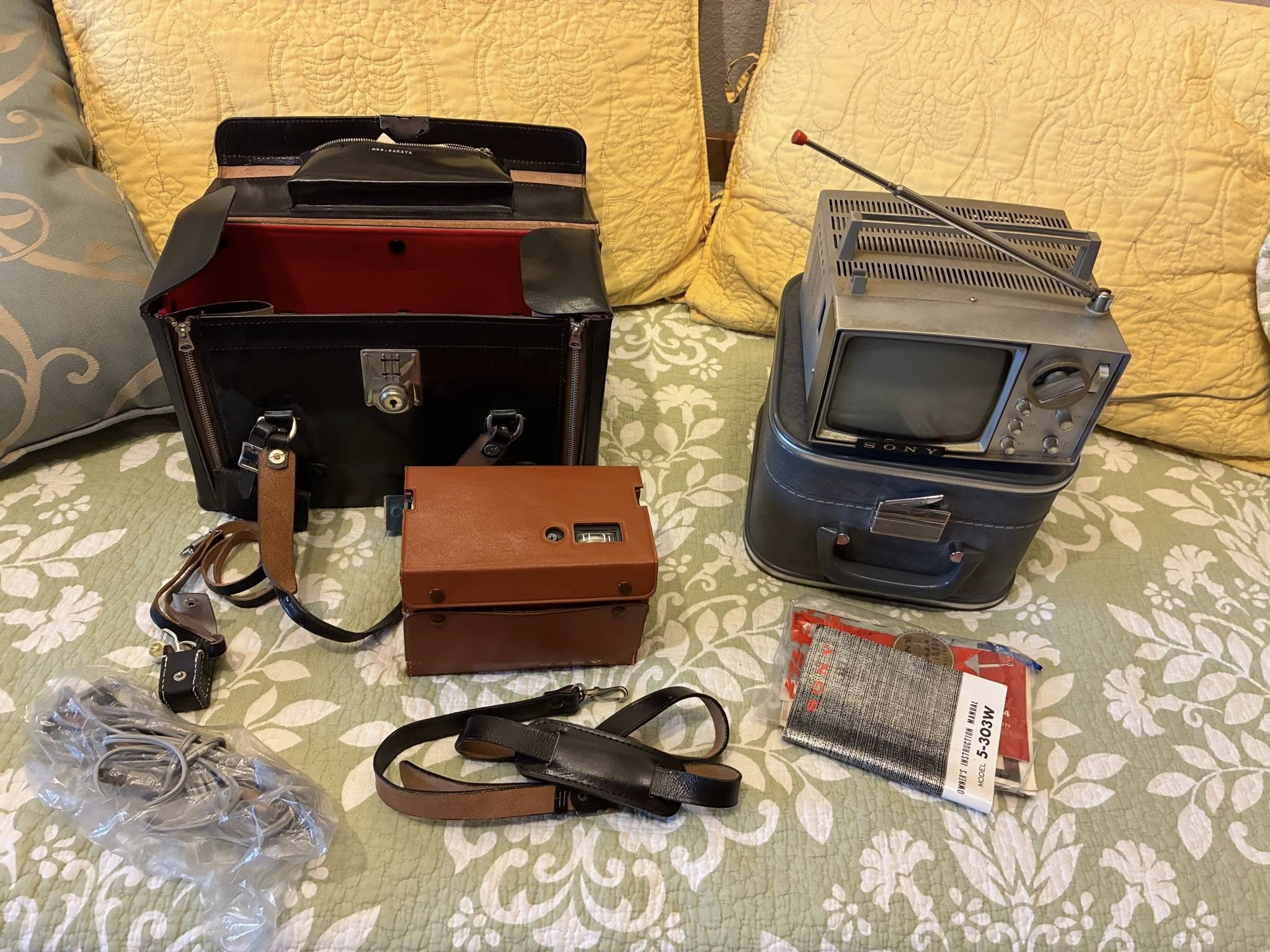
Which brings me to the Sony micro television.

This tiny set came from my grandmother’s estate over forty years ago. She had hauled it all the way from Japan sometime in the 1960s, back when electronics from Japan felt futuristic and exotic.

The little monitor looked like something NASA might issue astronauts to watch Walter Cronkite on the moon.

I’ve carried that little TV through apartments, condos, moves, closets, shelves, storage bins, and several rounds of “I really should get rid of this.” It became less of a possession and more of a hostage situation.

The TV held me hostage.

I dug out the box and posted it on Facebook Marketplace.

Immediately, two kinds of people appeared.

The first guy messaged me within minutes.

“I can come right now.”

That’s slightly alarming. Nobody has ever urgently needed anything good from Facebook Marketplace. Usually, it’s either haunted, illegal, or both.

Then another user chimed in helpfully to explain that old electronics are worthless.

Thank you, internet stranger. That was comforting.

But the first guy arrived today, and it turns out he’s part of a group called the Colorado CRT Connection. These people rescue old cathode ray tube televisions and monitors.

They restore them, tinker with them, keep retro gaming systems alive, and host meetups that benefit the Children’s Hospital.

Who knew there was an underground network of people lovingly preserving obsolete television technology?

This guy looked at my grandmother’s tiny Sony TV the way an art dealer might inspect a lost Picasso.

“The guys are going to be so jealous.” He knew exactly what he bought.

He appreciated its history.

He was genuinely excited.

This object I’d been schlepping around for decades wasn’t junk anymore. It had found its next chapter.

That’s the beauty of Swedish death cleaning. It’s about getting rid of things and releasing them back into the wild while they still mean something to somebody.

All our treasures eventually become mysteries to the next generation.

“Why did Grandpa keep this?”

“What is this thing?”

“Can we throw this away?”

Every once in a while, the right person shows up. The object finds its tribe again.

My grandmother is smiling that her quirky little television, carried across the Pacific Ocean 60 years ago, is still sparking curiosity instead of gathering dust in my basement.

I still have a box of cables I’ll take to Goodwill soon, 2028 at the latest.

What would the Swedes think?

‘On the day i die’ by John Pavlovitz

Birthday gathering at the Manor Care nursing home. This post by John Pavlovitz was on my facebook feed . I’m sharing his observations. Last week, my neighbor organized a group to visit his wife now in hospice with Alzheimer’s . That gathering reminded me of my mortality and the importance of staying connected with friends and family.

On the die I day a lot will happen.

A lot will change.

The world will be busy.

On the day I die, all the important appointments I made will be left unattended.

The many plans I had yet to complete will remain forever undone.

The calendar that ruled so many of my days will now be irrelevant to me.

All the material things I so chased and guarded and treasured will be left in the hands of others to care for or to discard.

The words of my critics which so burdened me will cease to sting or capture anymore. They will be unable to touch me.

The arguments I believed I’d won here will not serve me or bring me any satisfaction or solace.

All my noisy incoming notifications and texts and calls will go unanswered. Their great urgency will be quieted.

My many nagging regrets will all be resigned to the past, where they should have always been anyway.

Every superficial worry about my body that I ever labored over; about my waistline or hairline or frown lines, will fade away.

My carefully crafted image, the one I worked so hard to shape for others here, will be left to them to complete anyway.

The sterling reputation I once struggled so greatly to maintain will be of little concern for me anymore.

All the small and large anxieties that stole sleep from me each night will be rendered powerless.

The deep and towering mysteries about life and death that so consumed my mind will finally be clarified in a way that they could never be before while I lived.

These things will certainly all be true on the day that I die.

Yet for as much as will happen on that day, one more thing that will happen.

On the day I die, the few people who really know and truly love me will grieve deeply.

They will feel a void.

They will feel cheated.

They will not feel ready.

They will feel as though a part of them has died as well.

And on that day, more than anything in the world they will want more time with me.

I know this from those I love and grieve over.
And so knowing this, while I am still alive I’ll try to remember that my time with them is finite and fleeting and so very precious—and I’ll do my best not to waste a second of it.

I’ll try not to squander a priceless moment worrying about all the other things that will happen on the day I die, because many of those things are either not my concern or beyond my control.

Friends, those other things have an insidious way of keeping you from living even as you live; vying for your attention, competing for your affections.

They rob you of the joy of this unrepeatable, uncontainable, ever-evaporating Now with those who love you and want only to share it with you.

Don’t miss the chance to dance with them while you can.

It’s easy to waste so much daylight in the days before you die.

Don’t let your life be stolen every day by all that you’ve been led to believe matters, because on the day you die, the fact is that much of it simply won’t.

Yes, you and I will die one day.

But before that day comes: let us live.