
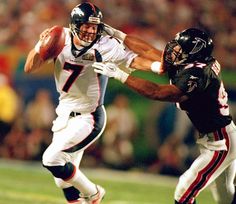
Denver Broncos quarterback John Elway in Super Bowl XXXIII
There doesn’t seem the be much hoopla around Super Bowl LI. It could be because the Broncos aren’t playing this year, but all the news channels have better stuff to cover these days.
My cohousing community will likely have a Super Bowl party in the common house. I’m not much of a Patriots fan, but Tom Brady has bridged the comings and goings of lots of players and he is part of a winning formula – six Super Bowl appearances and four rings? A fifth will be amazing.
As for the Falcons, I’ll be silently hoping they win. When they handled the Broncos during the regular season, it was clear Atlanta had a pretty good team and have played well the entire season.
The Falcons played in one other big game – Super Bowl XXXIII against John Elway and Broncos, which brings me to my story.
In 1999, I was doing some consulting work for a non-profit in Boulder called Rock the Planet that used mountain climbing as a metaphor for positive youth development. The group sent me on a field trip to attend a climbing wall convention in New York City.
It was the dead of winter. I made arrangements to stay with one of my college classmates who still lives on the Upper Westside between Broadway and Central Park on 72nd. It’s between the 72nd and Broadway Station and the Dakota.
A couple days before my visit, he called and said he was deathly ill with a cold and made arrangements for me to stay at one of his friend’s short term rentals in Greenwich Village.

The view of Christopher from my apartment on Super Bowl Sunday 1999.
I arrived and was greeted by Jon who escorted me to the little studio, that he rented to me for a couple hundred bucks for the weekend. It was cozy but cold. By the time the steam heated up the small place, it was time for me to leave.
I don’t recall anything about the meeting I attended, but it was Super Bowl Sunday and the Broncos were playing. I didn’t know the neighborhood that well, since I normally stay a little further uptown at the Hotel Pennsylvania.
Below my apartment was a bar – or what looked like a bar. There wasn’t a prominent sign. Since neither of the New York teams were playing, I suspected the crowd would be light.
When I walked through the door, the place was rocking – loud music, people dancing. There was a TV behind the bar. I elbowed my way through the crowd, and sat down on an empty stool and ordered a beer. I asked the bartender to put on the game.
Meanwhile a couple guys walked over and sat down and struck up a conversation wondering what I was doing there. We had a couple laughs before they disappeared into the crowd.
Eventually, I noticed that the bar was not only full of mostly men, which wasn’t unusual, but there were men dancing with men and guys making out with guys in the booths.
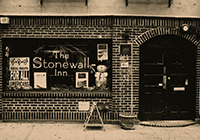
The Stonewall Inn was ground zero for the modern day gay rights movement.
Turned out, I had stumbled upon the infamous and now famous Stonewall Inn. Back in the summer of 1969, it became the birthplace of the modern gay rights movement.
In those days, police routinely raided gay bars, but on June 28th of that year, nobody cooperated and a riot broke out. The following morning thousands joined a protest on Christopher Street.
In 1973 when on a college class trip to Washington DC for Nixon’s inauguration, a group of us were led by a classmate from another Nebraska school into a bar in Georgetown. That was my first gay bar experience as a doe-eyed kid from Wyoming at school in Nebraska. It was also the only time I was in a crowd dispersed by tear gas – there were countless demonstrations protesting the secret bombings of Cambodia.

Lots happened during Nixon’s inauguration. Roe v. Wade was decided, LBJ died, I was tear gassed and went into a gay bar.
Back in the late 1980s when I was living in Lander, Wyoming, I was out drinking with a buddy. After the bars closed we went over to his place. That was the first and only time I had been propositioned by a man. I told him I prefer women. He made it sound like being gay was a choice and tried to talk me into it, “You might like it,” he said.
I told him I prefer women.
That was that.
Not hearing from any of my neighbors, I’ll put out the invite for the Super Bowl gathering and figure out a few gluten-free, vegetarian, no dairy snacks to serve up.
Red or white?
By the way, the Stonewall was hoppin’ by the time the confetti was flying at the end of Super Bowl XXXIII. I was the only one in the housoe who cared that the Broncos beat the Atlanta Falcons 34 – 19. I got on the train and went uptown to Sardi’s to celebrate.


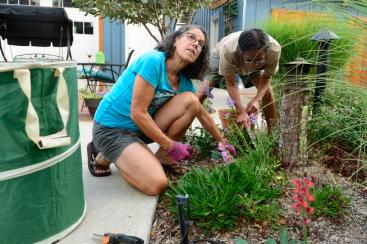
 Collaborative neighborhood process. Future Lincoln Court denizens will have a chance to participate in the design of the community so that it meets their needs. There will be a series of meetings as the project progresses to define them. Some collaborative communities are initiated or driven by a developer. The Lincoln Court Collaborative Community is a combination of both with the developer playing more of a technical role making the community member vision real. This collaboration will result in a well-designed, pedestrian-oriented community that integrates with the adjacent West Edge community, as outlined in the city of Cheyenne Missile Drive Corridor Plan.

 Collaborative common spaces. Common facilities will be designed for daily use, and for special community activities. They are an integral part of the collaborative community, and complementary to the private residences and businesses. The extent to which the private businesses and studio spaces are public will be determined. There will likely be an expectation that community uses and activities will be a part of the private business spaces. Participating in community life is optional – denizens may have as much community as or as little community as they want. Since the buildings are clustered, the Lincoln Court may retain several or many acres of undeveloped shared open space for future expansion.
 Collaborative management. Lincoln Court denizens will manage, to a great extent, the business of the collaborative community, and also perform much of the work required to maintain the property. The cohousing sub-communities participate in the preparation of common meals, and meet regularly to solve problems and develop policies for the community. A master Community Association may be formed to deal with issues concerning common spaces of the entire collaborative community, such as snow removal, open space maintenance, and managing community business relations.
 Collaborative consensus. Leadership roles will evolve and based on how and when community members join Lincoln Court. However, no one person (or persons) has authority over others. As individuals, families, businesses and organizations join the collaboration, each take on one or more roles consistent with their skills, abilities or interests. Lincoln Court will make decisions by consensus or similar forms of consensus decision-making. Although likely will have a policy for majority-rules voting if the group cannot reach consensus (nuclear option).
 Collaborative community economy. The community is not a source of income for its individual members. However, in the Lincoln Court, rental income from businesses, use of performance / exhibition space, studio / co-working spaces would accrue back to the community at-large to decrease homeowner / community owner association fees / reserve funds. It is possible that the master association or a sub-associations could contract with a resident / tenant to perform a specific task for compensation, but more typically the work will be considered that member’s contribution to the shared responsibilities. It is possible that community residents will earn income from rented studio or business location.
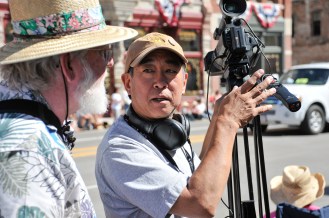 Collaborative higher purpose. The envisioned community “higher purpose” is around arts, culture and fostering creative thinking in the day-to-day community functionality. The site has a great story. The original site was a part of a Homestead Act land grant at the turn of the 20th century. Historic Highway 30, also known as the Lincoln Highway spanned coast to coast in the 1930s. The Lincoln Court was built as a motor hotel which later evolved into the Hitching Post Inn. The Hitching Post was a legendary Cheyenne landmark. There are some great stories associated with the site which are big selling points for the project. Mine, for example? My first job when I was a 12-year-old was at the Hitching Post.

