The cohousing ‘Secret Sauce,’ affordability, inclusion and a new ‘American Way’

american-way

Superman’s “Truth, justice, and the American Way” is based on bigger is better than smaller; winning is better than losing; richer is better than poorer. What if that was refocused through a multicultural lens?

Cohousing Nation, by definition, lives a “New American Way” that balances the good of the community over that of the individual; accepts all people as different and all welcomed and valued; power and strength of a few are replaced by consensus and shared decision making among all.

As such, I’m convinced that cohousing communities – as well as other intentional communities like housing cooperatives – have the potential to bridge cultural divides that continue to plague our country today.

The average cohouser has at least some social justice blood running through their veins. I think change will have a better chance of happening by efforts by cohousers.

What if cohousers, turned out to be gatekeepers who work together and become allies with marginalized groups, rather than marginalized groups trying to break through the glass ceiling, with few allies there with a hammer.

Inclusion of diverse people will bring about more affordable housing organically as the dominant culture becomes more inclusive based on what I call, “c🕉munification” (cOMunification) that focuses on cultural and societal power and privilege dynamics and how only personal change can balance those out.

Remember the old 1950s TV show, The Adventures of Superman? The narrator told my friends and me to model Superman’s can-do behavior because, “he fights a never ending battle for truth, justice, and the American Way.”

Superman’s “American Way” is based on rugged individualism; cultural divides narrowed by assimilation; and quests for power and control.

There isn’t anything inherently wrong with the “Old American Way,” I think it needs to evolve along with society and one way that can happen is through a collaborative approach that results in truth, justice and a “New American Way.”

I continue to believe that racism, as we know it today, began in 1526 when the first people from Africa were enslaved to work at a short-lived settlement in South Carolina.

Public awareness of differences among people, particularly since 1964, enflamed simmering racist attitudes that continue to exist today.

I think people want to change and do what’s right, but based on the audiences I’ve met over the years, most people don’t know how to go about it. Personal change doesn’t happen over night and like anything else that requires better skills, it takes practice, and letting go of personal privilege isn’t exactly something people are too crazy about.

lincoln emancipation

It’s been just 154 years since Lincoln signed the emancipation proclamation.

The current political climate didn’t create racism, it makes it socially acceptable to reveal previously hidden beliefs that oppression of the weak was what, historically, made America great.

Considering America has a 339-year history enslaving people (1526 to 1865) that’s more than double the 155-year history, at least on paper, since President Abraham Lincoln’s emancipation proclamation (1865 to 2020).

There has been social change, but reinventing the American Way won’t happen over night

secret sauce

Cohousing secret sauce can undo the Old American Way.

A part of that reinvention is cohousing, which is a market-based solution. Cohousing brings individuals together to form communities.

Housing is housing, but what differentiates cohousing from other housing configurations is the “secret sauce” that mixes several ingredients. The recipe can be altered to meet differing tastes:

  • Relationships – Neighbors commit to being part of a community for mutual benefit. Cohousing cultivates a culture of sharing and caring. Design features and the neighborhood size are typically between 30 and 40 homes that promote frequent interaction and close relationships.
  • Balancing Privacy and Community – Cohousing neighborhoods are designed for privacy as well as community. Residents balance privacy and community by choosing their levels of community engagement
  • Participation – Decision-making is participatory and often based on consensus. Selft management empowers residents, builds relationships and can save money.
  • Shared Values – Cohousing communities support residents in actualizing shared values.

A certain ilk of the citizenry, mostly Baby Boomers and older, who experienced the Cold War, will try to reposition the conversation by clumping intentional communities together as “communes” and “creeping socialism.

I’m not talking about over throwing out social norms or the government, but rather reacting to how the general market is changing because it’s basically less expensive to live more collaboratively (higher density neighborhoods) and sharing resources (five households don’t each need a lawnmower).

The rugged individualist and free-market capitalists are unwilling to share their wealth and as such, the market reaction is toward c🕉unification.

Student Loans

As of June 2018, Forbes reported that total US student debt was $1.52 trillion and that 44.2 million people owed debt. The average student debt is $38,390.

My observation, Millenials and GenXers who are a generation or two removed from World War II are more accepting of individual differences and more supportive of the collective good out of a need to survive.

Being saddled with the the national debt of their parents, grandparents and great grandparents; forced into a college tuition system that will keep them under the thumb of Wall Street until they are old and gray are two reasons why young people are de-commodifying the American Way.

The tenets of a New American Way would say a home is where we live, not an investment. The only time a house should be commodified is when it’s time to move.

Rather than saying, “The yard needs more trees because it will increase our property values,”  The New American Way perspective is, “The yard needs more trees because they will improve the places where kids can play.” As a side benefit, property values may increase.

The cohousing brand of community development is also a hedge against unchecked gentrification, which is one of those jargony terms that get thrown around and used in various contexts.

I define gentrification as what happens when people or businesses look for real estate deals, purchase urban property that may or may not be distressed and update them without much collaboration with existing neighbors.

The data are these.

Cohousing communities consist of members who predominantly liberal, highly educated, high income Caucasians women with high perceived social class who, I think, are a more open to bridging cultural divides by “undoing” the Old American Way from within.

That is to say, members of the dominant culture who live in cohousing, have agreed among themselves to change their perspectives towards a New American Way.

Communification logo-1

“Om” is sanskrit that basically includes everything – past, present, future; beginning, middle end; emotionally and physically.

The end result of c🕉unification, by definition, is an attitudinal paradigm shift by members of the dominant culture who have agreed to increase cultural diversity in the wider culture, one cohousing community at a time.

This doesn’t happen by public policy but by community-based societal change:

  • There’s balance between the group and the individual;
  • smaller and less are better but all share in abundance, that isn’t always about bigger and more;
  • decisions are by consensus giving a voice to all, including minority positions;
  • there is recognition that everyone is different and all are included as themselves

While the tenets of cohousing are noble, they are easier said than done since the American Way is pounded into our heads from the moment we pop out of the womb.

melting pot boiling

The melting pot is no longer a relevant metaphor.

In the 20th century, the United States was metaphorically characterized as a “Melting Pot” in which races and ethnicities would learn English and assimilate themselves into homogenous Americans.

That was true during racial segregation when the pot contained white cheeses like swiss, edam, gouda, and feta, they blended together to make a mixed pot of white cheese.

Immigrants from Europe who all looked like each other, had the old American Way ahead of them after they learned English and otherwise assimilated.

These days, the country has become racially and ethnically multicultural as a result of immigration and can be a part of the New American Way.

Today, the blended food metaphor would be more like a “Tossed Salad” consisting of separate fixings like frijoles, cassavas, napa cabbage, and all kinds of lettuce that are unified with a common dressing.

In my mind, that common dressing is the “Cohousing C🕉unification” secret sauce, soon available at a farmer’s market near you.


Braceros, Traqueros: Don’t Ask, Don’t Tell

reagan quote immigration

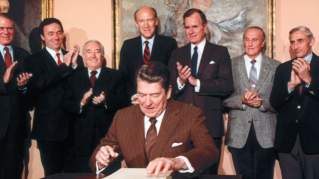
Ronald Reagan signed immigration reform into law in 1986 that was sponsored by former Wyoming US Senator Alan Simpson. The law gave amnesty to 3 million undocumented people.

For the past 150 years, the US government, railroads and agricultural industries welcomed immigrant workers from Mexico. How did they end up coming to the United States in the first place?

Rather than keep immigrants seeking asylum detained, why not give them all temporary visas and put them to work. That’s why they trudged hundreds, if not thousands of miles to America.

I heard there are upwards to 50,000 asylum seekers currently being held around the country awaiting court hearings.

They’re fleeing danger in their homelands, need local sponsors and something to do once they are granted asylum. Anyone who thinks they are going to take their jobs, that’s just hyperbolic race-bait ranting.

What work needs to be done? Here are a couple ideas:

  • Rebuild crumbling roads and bridges
  • Building affordable housing

For the record, I’m not in favor of cutting illegal immigrants any slack. I was an illegal alien and kicked out of Mexico in 1991 for working in Zacatecas on a tourist visa from Jalisco.

My business partner and I were stopped by the federal police, held at machine gun point in the middle of nowhere between a small town of Sombrerete and Fresnillo.

One soldier questioned me in English, my partner in Spanish hoping we would give conflicting stories.

They tossed our pick up truck, groped through my luggage, put everything back and searched again. I think they were looking for drugs. Around this time, the United States and Mexico agreed to stifle cocaine and marijuana traffic. Zacatecas is just south of Colorado.

Luckily for me, they let us go.

I was caught using a Mazatlan tourist visa, but actually working in Zacatecas. I ended up getting my paperwork together and made formal application, along with $97.00 USD and obtained the equivalent of a green card.

A year or so ago, I listened to a presentation by Lu Rocha at a workshop organized by my grad school Center on Domestic Violence at CU-Denver.

She gave a history of the Latino/a/x/ labor force in the United States that dates back to the construction of the transcontinental railroad in the 1800s and propping up the war efforts between 1942 until it’s repeal in 1964.

Immigration issues have been in the news lately. There’s talk of expanding the number of immigrant detention centers in Texas reminiscent of the three war relocation camps set up during World War II to detain and intern Japanese mostly from the West Coast.

daca sign

POTUS 45 repealed DACA put in place by President Obama in 2012 as a stop-gap measure to protect kids of undocumented residents.

The Reagan administration signed the Immigration Reform and Control Act in 1986 which heightened border security but also granted amnesty to 3 million undocumented immigrants. This was a bi-partisan effort led in the US Senate by Wyoming’s Al Simpson.

Red and Blue presidents and congresses failed to act on immigration reform until Obama in his lame duck term issued the Deferred Action on Childhood Arrives (DACA) executive order which cut some slack to kids brought to the US by their undocumented parents. It was a compassionate Band Aid.

POTUS 45 used his bully pulpit, but failed to overturn DACA. Congress continues to be at a standstill, more so now because the House flipped Democratic in 2018.

Immigration reform is a wedge issue for Republicans. They are against immigrants, generally, because of they supposed are “taking of American jobs.” Are all Republicans cleaning toilets, picking beans, or loading dishwashers over at Denny’s in fear of losing their jobs?

At the same time, American business is reliant on immigrant laborers who perform low-end work that regular Americans won’t do which is a throwback to the transcontinental railroad construction and World War II worker shortage.

traqueros

The Transcontinental Railroad was completed by laborers from Mexico.

Traqueros In 1881 Governor Luis Terrazas of Chihuahua drove a silver spike completing a rail line linking Mexico and United States which allowed immigrants transport to the United States and coincided with the West’s construction of the transcontinental railroad.

Mexicans were the dominant immigrant labor laying track in the late 19th and early 20th centuries. Despite low wages compared to their native born coworkers and discrimination, immigrant Mexican laborers became permanent residents, not by law but by fact. By the time of the Great Depression, workers moved to the cities in search of other low-skill work.

Bracero Program

The US Department of Labor and the Immigration and Naturalization Service collaborated on the Bracero Program at the start of World War II. Braceros were allowed in to the US to provide help on farms during wartime.

Braceros The bracero program (Spanish for manual laborer) began in 1942 and operated as a joint program of the State Department, the Department of Labor, and the Immigration and Naturalization Services (INS), as it was known then, in the Department of Justice.

Laborers from Mexico were promised better living conditions in camps, including housing, meals and toilet facilities. They eventually were paid a minimum wage of 30 cents / hour. The pact also stated that braceros supposedly would not be subjected to discrimination and exclusion from “white-only” areas.

During World War II, the bracero program intention was to fill the labor gap, particularly in agriculture. The program lasted 22 years and offered employment contracts to 5 million braceros in 24 U.S. states—becoming the largest foreign worker program in U.S. history.

The bracero program caused problems on both sides of the border with labor shortages in the northern states in Mexico and resulted in illegal immigrants who remained in the United States. Millions of Mexican Americans attribute their roots to their fathers and grandfathers who crossed the border as braceros.

DACA MASS WALKOUTDACA Circle back to DACA kids. They are the modern day traquero/a/x and bracero/a/x. They are people who arrived in the United States under the radar as children.

Like the braceros and traqueros, while they should have returned to Mexico, those families have remained – while looking over their shoulders – without documentation and became productive members of their communities.

The DACA kids ended up with high school and college educations, contribute to society in professional jobs, have families of their own with kids in local school systems. They pay taxes and volunteer in their communities.

DACA kids aren’t Manson women who ran underground and assumed new identities.

When the Bracero Program was ended in 1964, the positive outcomes were better working conditions for farm workers thanks to advocacy by activists including Cesar Chavez and Delores Huerta. There were no immigration laws that turned traqueros back to Mexico.

DACA was a short term fix when Obama acted because Congress didn’t. The immigration issue has come full circle from 1986.

Whether Congress and POTUS 45 get their acts together on immigration reform will be a defining moment for the Republicans like it was for Republicans and Ronald Reagan.

Until then let’s figure out how to engage asylum seekers in useful ways while they awaiting their hearings.

simpson reagan signing“We have consistently supported a legalization program which is both generous to the alien and fair to the countless thousands of people throughout the world who seek legally to come to America. The legalization provisions in this act will go far to improve the lives of a class of individuals who now must hide in the shadows, without access to many of the benefits of a free and open society. Very soon many of these men and women will be able to step into the sunlight and, ultimately, if they choose, they may become Americans.” Ronald Reagan on November 6, 1986 upon signing the Immigration Control and Reform Act.



Affordable retrofit cohousing

plains dairy trip

Baby Boomer neighborhoods were tight knit. Parents knew each other because kids knew each other.

I remember growing up in a neighborhood where the kids all hung around together and the reason our parents knew each other was because bands of kids charged through one another’s houses.

Garage doors were always open and lots of neighborhood birthday parties happened on the weekends.

Those were the golden days of suburbia. After World War II the American Way was to live in a single family home outside the urban core. After 60 years, that lifestyle is now getting tarnished.

There are some estimates that up to two-thirds of renters across the nation say they can’t afford to buy a home. Since home prices are rising at a rate twice that of wage growth, saving up for that down payment is an even bigger challenge.

Millenials and GenXers with high student debt are in this boat, as are some older folks who for one reason or another were unable to build any extra savings.

High-density communities are seen as one way to provide affordable housing to owners and renters. One such configuration is “cohousing.” The cohousing model originated in Denmark in the 1960s. Architects Katie McCamant and Chuck Durrett brought the concept to the United States in the 1980s.

Boulder Senior Cohousing Communities

Lindy Cook and Alan O’Hashi pull weeds from the garden of the community with other residents. The active adult cohousing community for those 55 or older is setup like a usual condo community with every person having their own place, but the sense of community is what is unique. (Photo By Brent Lewis/The Denver Post)

In the traditional cohousing neighborhood, residents own their homes, but agree through a shared vision and list of values to maintain and operate their community through participation in activities like mowing the lawn, weeding the garden and shoveling snow, while enjoying each other’s company at shared meals a couple times a week.

The fact is, traditional cohousing can’t be built fast enough nor inexpensive enough to meet growing demand, particularly for the aging population. There are 10,000 Baby Boomers turning 65 every day through at least the next decade.

If you can’t afford to buy a home or your rent is too high how can cohousing meet your needs?

I’ll introduce you to a couple alternatives to “stick-built” cohousing communities.

Remember, housing is housing and what differentiates cohousing from other configurations is the “secret sauce.”

Research points to a variety of cohousing benefits. The most often mentioned benefits relate to reducing social isolation. The cohousing “secret sauce” provides for intentional socializing, neighborly support when under the weather, sharing chores, sharing expertise, and having neighbors who share similar interests.

What is cohousing “secret sauce”? Cohousing has certain basic characteristics. They are fairly broad, but include:

  • Relationships – Neighbors commit to being part of a community for mutual benefit. Cohousing cultivates a culture of sharing and caring. Design features and the neighborhood size are typically between 30 and 40 homes that promote frequent interaction and close relationships.
  • Balancing Privacy and Community – Cohousing neighborhoods are designed for privacy as well as community. Residents balance privacy and community by choosing their levels of community engagement
  • Participation – Decision-making is participatory and often based on consensus. Selft management empowers residents, builds relationships and can save money.
  • Shared Values – Cohousing communities support residents in actualizing shared values.

Three cohousing configurations: Over the years, the traditional cohousing model has been evolving. I live in Boulder, Colorado where microbreweries are part of the economic base. What are the types of cohousing microbrews?

  • Cohousing UltraLite – “Burning Souls” transform an existing neighborhood or repurpose a building or build a community among members who don’t live in the same location. This is the most cost effective and quicker approach and allows for more rental housing.
beacon hill village

Beacon Hill Village consists of 500 neighbors who agree how to support one another.

Architect and real estate professionals play supportive roles. Residents of retrofit cohousing in one place include more young people, full-time students, renters, racial minorities, single householders, and households with fewer financial assets. When applying the tenets of cohousing, “retrofit” can also be a community of people who don’t live in the same proximity.

Housing is housing, but the cohousing culture is what makes the community. The Beacon Hill Village is an existing dispersed community of 500 seniors who agree upon how to be active and supportive of one another rather than reliant on others to “take care” of them all the time.

They provide neighborly support with one another and coordinate outside social and physical care giving when necessary. The Beacon Hill approach would be appropriate to multigenerational communities as well. Since all are aging, it seems like people don’t get around to planning for their life care until it’s almost too late.

A group in Traverse City, Michigan is forming their community ahead of time. They have their eyes on an existing building that they are planning to retrofit into their physical community.

big bang eating

The apartment house “Big Bang Theory” community routinely share meals together in each other’s apartments.

There also is “accidental cohousing” as is the case of the “Big Bang Theory” apartment house setting where Sheldon, Amy; Leonard, Penny; and Howard, Bernadette; live and the elevator has been out for years.

They use the stairway as a common area where they have conversations every show. They share common meals in their various apartments.

Their decision making is by consensus, with majority often having to compromise towards Sheldon’s minority position.

In real life, a couple in Flushing, New York built an accidental community in their apartment building.

  • Cohousing Lite – The project is architect and real estate professional driven. The “Burning Souls” may or may not be recruiting community members. The development is less time consuming since there is less customization. It is also less capital intensive since the developer is responsible for the development and homeowners only have to obtain financing for their home.
bloomington coho

Bloomington Cohousing is a great example of Coho Lite. The developer is building spec housing as the community forms.

An example is Bloomington Cohousing in Indiana. The developer, Loren Wood, is financing and constructing the project designed by an architect who worked with the “Burning Souls” to come up with some basic floor plans. The community is being organized concurrent with the project development.

Another example is Genesee Garden in Lansing, Michigan. The neighbors transformed an existing area rather than building from the ground up. As homes become available for purchase, the community purchases them. One was converted into the common house.

  • Cohousing Stout – Traditional community structure. “Burning souls” partner with an architect and other real estate professionals. Projects are very capital intensive with the developers and future community members share the risks of the entire development. In addition to finding like-minded people who want to live together, they must also have the financial resources to invest in land, design and construction, patience to decide on countertops and landscaping and have the time to wait while all this happens.
garden-day

Where I live is an example of cohousing stout. It was built from the ground-up.

I live in a  stout community consisting of 16 condos. It is representative of the characteristics of the broader segment of the wider Boulder, Colorado community, in that it tends towards the extremes. The project was heavily subsidized to encourage socioeconomic diversity.

The community has six permanently affordable deed-restricted houses that are 800 sqft in size and priced at $160,000. Those are contrasted with 10 houses that are “market rate” and range in sizes from 1,000 to 3,000 sqft and have values in excess of $800,000.

This ground-up process often takes three to five years or more with potential members coming and going and mostly accessible to people and families who have inherited wealth or adequate disposable savings.

Who is the typical cohouser? There are significant differences among the residents who live in the various cohousing configurations, with coho ultralite residents being the most diverse:

  • Coho Stout and Lite – Caucasian, liberal, high perceived social class, high income, high education level, 70 percent of the time a woman
  • Coho UltraLite – More racially diverse, liberal, middle class, moderate income, high education level, more singles and single parents

What are the three steps to building a cohousing community? In a retrofit situation the community development steps are the same as for a traditional cohousing community. “Burning soul” advocates and other group members may or may not live in the same building or community. They may decide to move into the same apartment or condo complex, but would follow a typical cohousing development process such as these three steps:

Feasibility study

  • Discuss and agree upon community values and perhaps, a higher purpose, which would fill the need to walk their community values talk while participating in service projects;
  • Whether you’re three or thirty people, come up with a name and “elevator speech” identifying the community. Referring to yourselves as a “bunch of housemates” doesn’t tell about your community story;
  • Community cohesiveness could be built around a higher purpose of community service that binds a community together.
  • Once you kick the can down the road a few blocks, check your state laws about homeowner association regulations. You will find they set up HOAs that do not mirror cohousing very well – lots of centralized power and control, lots of voting. Save this until later, because conforming cohousing declarations with state laws is a chore.

Develop budgets

  • There likely will be common expenses that relate to community activities, coordinating transportation, common meals, intra-community communication and a fee structure to pay for all or part.
  • Community values and mission are implemented through the budget by teams – overall steering team equivalent to a board of directors, social events, managing building and grounds, proceed and governance, finances and legal matters,
  • The entire community approves by consensus the budget or any action for that matter, and the steering team ratifies the action also by consensus.

Design and Construction

  • If you’re sharing a big house, there will be design issues about designating common spaces and storage. Some design and construction in retrofits may be necessary if you’re in an existing condo community or apartment building is adapted. This may include renovating an existing dwelling unit into a common space with a guest room and common kitchen which was the case at Boulder Creek cohousing in Colorado;
  • Identify resident needs, how the “site” functions – if it is in an existing physical development like a condo association, apartment complex, or households dispersed within a given boundary;
  • Determine what are considered “common spaces” which may not be literally common, but function in common. These may be in private homes for shared meals and meetings, civic spaces, churches, libraries

Looking for a few cohousing retrofit pioneers. There are plenty of individuals who are interested in cohousing. Some of you may have managed to form into group that has begun the traditional cohousing process but you’ve bumped into obstacles including lack of money, no suitable land available, professionals such as architects who are only willing to give so much upfront service, group members who can no longer wait for the community to get off the ground. There are well-documented war stories.

I want to prove the concept. I’m seeking one or more people, preferably in the Denver-area to organize a retrofit cohousing community and facilitate you through the process.

  • Maybe, you don’t need a place to live or have bumped into some community development obstacles, but want to create connections with other like-minded people as a hedge against loneliness and living in isolation;
  • Maybe you live in an apartment building and your neighbors are interested in a more collaborative lifestyle;
  • Maybe you are affiliated with an existing assisted living community and want to adopt appropriate cohousing principles

There are varying opinions about whether what I describe is actually cohousing, but regardless, I want to hear from you. Email adoecos@yahoo.com

Alan O’Hashi is the incoming president of the national Cohousing of the US board of directors.