The ‘New American Way’ and cohousing


american-way

Superman’s American Way can be updated by applying cohousing secret sauce.

Cohousing Nation, by definition, lives a “New American Way” that emphasizes the good of the community over that of the individual; accepting that all people are different and all are welcome and valued; power and strength are replaced by consensus and shared decision making.

As such, I’m convinced that cohousing communities have the potential to bridge cultural divides that continue to plague our country today.

The average cohouser has at least some social justice blood running through their veins. I think change will have a better chance of happening by efforts by cohousers.

Why?

The data define a typical cohousers as having these characteristics: high perceived social class, high income, highly educated and 70 percent of the time a white women – pretty much a typical member of the dominant culture.

What if cohousers, who largely are members of the dominant culture, and can be gatekeepers who work together and become allies with marginalized groups, rather than marginalized groups trying to break through the glass ceiling, with few allies there with a hammer.

Inclusion will happen organically as the dominant culture becomes more inclusive.

I’ve been presenting diversity and cultural competency workshops and trainings for 25 years for a variety of public agencies, nonprofits and most recently for cohousers.

My approach has evolved and changing again, this time into: “c🕉munification” (cOMunification) training that has a focus on cultural and societal power and privilege dynamics and how only personal change can balance those out.

Remember the old 1950s TV show, The Adventures of Superman? The narrator told my friends and me to model Superman’s can-do behavior because, “he fights a never ending battle for truth, justice, and the American Way.”

Superman’s “American Way” is based on rugged individualism; cultural divides narrowed by assimilation; and quests for power and control.

There isn’t anything inherently wrong with the “Old American Way,” I think it needs to evolve along with society and one way that can happen is through a collaborative approach that results in truth, justice and a “New American Way.”

I continue to believe that racism, as we know it today, began in 1526 when the first people from Africa were enslaved to work at a short-lived settlement in South Carolina.

Public awareness of differences among people, particularly since 1964, enflamed simmering racist attitudes that continue to exist today.

I think people want to change and do what’s right, but based on the audiences I’ve met over the years, most people don’t know how to go about it. Personal change doesn’t happen over night and like anything else that requires better skills, it takes practice, and letting go of personal privilege isn’t exactly something people are too crazy about.

lincoln emancipation

It’s been just 154 years since Lincoln signed the emancipation proclamation.

The current political climate didn’t create racism, it makes it socially acceptable to reveal previously hidden beliefs that oppression of the weak was what, historically, made America great.

Considering America has a 339-year history enslaving people (1526 to 1865) that’s more than double the 154-year history, at least on paper, since President Abraham Lincoln’s emancipation proclamation (1865 to 2019).

While I think it will take a couple more generations, there have been small steps forward in recent years that will continue, but I doubt there will be any giant leaps.

First, some background. After the Civil Rights Act of 1964 was enacted, United States citizens – primarily African Americans – were legally “more equal” than they were in reality. It soon became clear that attaining actual equality among people had a long way to go.

That transition led to Affirmative Action in job hiring that provides quotas for racial diversity. After workplaces changed complexions, a need arose about how to better understand diversity that brought about “diversity training” to define the various cultures with the hopes that more information meant better acceptance by the dominant white culture with no systemic changes.

As the population, and subsequently the labor force, has become more multicultural around race, ethnicity, gender identity and sexual orientation, diversity training that defines demographics is evolving into “cultural competency” training, which is more about understanding one’s self and changing personal perspectives about others, as opposed to getting other people to be like you.

Why I think social change will take a couple generations is because there is a long-standing national culture that’s advocated for racial homogeneity dating back to the United States Naturalization Law of March 26, 1790 that limited naturalization to immigrants who were, “free White persons of good character.”

eo 9066 big

FDR signed Executive Order 9066 that forced Japanese to register and be sent to relocation camps in 1942,

In recent times, rampant American xenophobia was stoked after the bombing of Pearl Harbor in 1941 and the round up of 112,000 Japanese who were herded into 10 “relocation” camps; and the 9/11 World Trade Center bombing that seeded the current Islamophobia epidemic.

The current political climate continues to fuel a growing fear among 30 percent of the U.S. electorate that the country will soon lose its 1776 version of American cultural identity.

Current events around over-crowded detention centers for illegal immigrants and those seeking asylum are indicators why we need to become better cultural change managers, rather than controllers of cultural change.

secret sauce

Cohousing secret sauce can undo the Old American Way.

Cohousing is a market-based solution to the immigration crisis that has beset the United States since at least since the Immigration Act of 1924 that had as its unsaid, but expressed purpose of maintaining the racial homogeneity of the United States.

What does that solution look like? Cohousing brings individuals together to form a community.

Housing is housing, but what differentiates cohousing from other housing configurations is the “secret sauce” that mixes several ingredients. The recipe can be altered to meet differing tastes:

  • Relationships – Neighbors commit to being part of a community for mutual benefit. Cohousing cultivates a culture of sharing and caring. Design features and the neighborhood size are typically between 30 and 40 homes that promote frequent interaction and close relationships.
  • Balancing Privacy and Community – Cohousing neighborhoods are designed for privacy as well as community. Residents balance privacy and community by choosing their levels of community engagement
  • Participation – Decision-making is participatory and often based on consensus. Selft management empowers residents, builds relationships and can save money.
  • Shared Values – Cohousing communities support residents in actualizing shared values.

A certain ilk of the citizenry, mostly Baby Boomers and older, who experienced the Cold War, will try to reposition the conversation by calling intentional communities “creeping socialism.” Granted, this is a lifestyle that’s not for everyone.

I’m not talking about over throwing the government, but rather reacting to how the general market is changing because it’s basically less expensive to live more collaboratively (higher density neighborhoods) and sharing resources (five households don’t each need a lawnmower).

The rugged individualist and free-market capitalists are unwilling to share their wealth and as such, the market reaction is toward cOMunification.

Student Loans

As of June 2018, Forbes reported that total US student debt was $1.52 trillion and that 44.2 million people owed debt. The average student debt is $38,390.

My observation, Millenials and GenXers who are a generation or two removed from World War II are more accepting of individual differences and more supportive of the collective good out of a need to survive.

Being saddled with the the national debt of their parents, grandparents and great grandparents; forced into a college tuition system that will keep them under the thumb of Wall Street until they are old and gray are two reasons why young people are de-commodifying the American Way.

The tenets of a New American Way would say a home is where we live, not an investment. The only time a house should be commodified is when it’s time to move.

Rather than saying, “The yard needs more trees because it will increase our property values,”  The New American Way perspective is, “The yard needs more trees because they will improve the places where kids can play.” As a side benefit, property values may increase.

The cohousing brand of community development is also a hedge against unchecked gentrification, which is one of those jargony terms that get thrown around and used in various contexts.

I define gentrification as what happens when people or businesses look for real estate deals, purchase urban property that may or may not be distressed and update them without much collaboration with existing neighbors.

The data are these.

Cohousing communities consist of members who predominantly liberal, highly educated, high income Caucasians women with high perceived social class who, I think, are a more open to bridging cultural divides by “undoing” the Old American Way from within.

That is to say, members of the dominant culture who live in cohousing, have agreed among themselves to change their perspectives towards a New American Way.

Communification logo-1

“Om” is sanskrit that basically includes everything – past, present, future; beginning, middle end; emotionally and physically.

The end result of cOMunification, by definition, is an attitudinal paradigm shift by members of the dominant culture who have agreed to increase cultural diversity in the wider culture, one cohousing community at a time.

This doesn’t happen by public policy but by community-based societal change:

  • The group is more important than the individual
  • smaller and less are better
  • decisions are by consensus giving a voice to all, including minority positions
  • there is recognition that everyone is different and all are included

While the tenets of cohousing are noble, they are easier said than done since the American Way is pounded into our heads from the moment we pop out of the womb.

melting pot boiling

The melting pot is no longer a relevant metaphor.

In the 20th century, the United States was metaphorically characterized as a “Melting Pot” in which races and ethnicities would learn English and assimilate themselves into homogenous Americans.

That was true during racial segregation when the pot contained white cheeses like swiss, edam, gouda, and feta, they blended together to make a mixed pot of white cheese.

Immigrants from Europe who all looked like each other, had the old American Way ahead of them after they learned English and otherwise assimilated.

These days, the country has become racially and ethnically multicultural as a result of immigration and can be a part of the New American Way.

Today, the blended food metaphor would be more like a “Tossed Salad” consisting of separate fixings like frijoles, cassavas, napa cabbage, and all kinds of lettuce that are unified with a common dressing.

In my mind, that common dressing is the cohousing cOMunification secret sauce, soon available at a farmer’s market near you.

Affordable retrofit cohousing

plains dairy trip

Baby Boomer neighborhoods were tight knit. Parents knew each other because kids knew each other.

I remember growing up in a neighborhood where the kids all hung around together and the reason our parents knew each other was because bands of kids charged through one another’s houses.

Garage doors were always open and lots of neighborhood birthday parties happened on the weekends.

Those were the golden days of suburbia. After World War II the American Way was to live in a single family home outside the urban core. After 60 years, that lifestyle is now getting tarnished.

There are some estimates that up to two-thirds of renters across the nation say they can’t afford to buy a home. Since home prices are rising at a rate twice that of wage growth, saving up for that down payment is an even bigger challenge.

Millenials and GenXers with high student debt are in this boat, as are some older folks who for one reason or another were unable to build any extra savings.

High-density communities are seen as one way to provide affordable housing to owners and renters. One such configuration is “cohousing.” The cohousing model originated in Denmark in the 1960s. Architects Katie McCamant and Chuck Durrett brought the concept to the United States in the 1980s.

Boulder Senior Cohousing Communities

Lindy Cook and Alan O’Hashi pull weeds from the garden of the community with other residents. The active adult cohousing community for those 55 or older is setup like a usual condo community with every person having their own place, but the sense of community is what is unique. (Photo By Brent Lewis/The Denver Post)

In the traditional cohousing neighborhood, residents own their homes, but agree through a shared vision and list of values to maintain and operate their community through participation in activities like mowing the lawn, weeding the garden and shoveling snow, while enjoying each other’s company at shared meals a couple times a week.

The fact is, traditional cohousing can’t be built fast enough nor inexpensive enough to meet growing demand, particularly for the aging population. There are 10,000 Baby Boomers turning 65 every day through at least the next decade.

If you can’t afford to buy a home or your rent is too high how can cohousing meet your needs?

I’ll introduce you to a couple alternatives to “stick-built” cohousing communities.

Remember, housing is housing and what differentiates cohousing from other configurations is the “secret sauce.”

Research points to a variety of cohousing benefits. The most often mentioned benefits relate to reducing social isolation. The cohousing “secret sauce” provides for intentional socializing, neighborly support when under the weather, sharing chores, sharing expertise, and having neighbors who share similar interests.

What is cohousing “secret sauce”? Cohousing has certain basic characteristics. They are fairly broad, but include:

  • Relationships – Neighbors commit to being part of a community for mutual benefit. Cohousing cultivates a culture of sharing and caring. Design features and the neighborhood size are typically between 30 and 40 homes that promote frequent interaction and close relationships.
  • Balancing Privacy and Community – Cohousing neighborhoods are designed for privacy as well as community. Residents balance privacy and community by choosing their levels of community engagement
  • Participation – Decision-making is participatory and often based on consensus. Selft management empowers residents, builds relationships and can save money.
  • Shared Values – Cohousing communities support residents in actualizing shared values.

Three cohousing configurations: Over the years, the traditional cohousing model has been evolving. I live in Boulder, Colorado where microbreweries are part of the economic base. What are the types of cohousing microbrews?

  • Cohousing UltraLite – “Burning Souls” transform an existing neighborhood or repurpose a building or build a community among members who don’t live in the same location. This is the most cost effective and quicker approach and allows for more rental housing.
beacon hill village

Beacon Hill Village consists of 500 neighbors who agree how to support one another.

Architect and real estate professionals play supportive roles. Residents of retrofit cohousing in one place include more young people, full-time students, renters, racial minorities, single householders, and households with fewer financial assets. When applying the tenets of cohousing, “retrofit” can also be a community of people who don’t live in the same proximity.

Housing is housing, but the cohousing culture is what makes the community. The Beacon Hill Village is an existing dispersed community of 500 seniors who agree upon how to be active and supportive of one another rather than reliant on others to “take care” of them all the time.

They provide neighborly support with one another and coordinate outside social and physical care giving when necessary. The Beacon Hill approach would be appropriate to multigenerational communities as well. Since all are aging, it seems like people don’t get around to planning for their life care until it’s almost too late.

A group in Traverse City, Michigan is forming their community ahead of time. They have their eyes on an existing building that they are planning to retrofit into their physical community.

big bang eating

The apartment house “Big Bang Theory” community routinely share meals together in each other’s apartments.

There also is “accidental cohousing” as is the case of the “Big Bang Theory” apartment house setting where Sheldon, Amy; Leonard, Penny; and Howard, Bernadette; live and the elevator has been out for years.

They use the stairway as a common area where they have conversations every show. They share common meals in their various apartments.

Their decision making is by consensus, with majority often having to compromise towards Sheldon’s minority position.

In real life, a couple in Flushing, New York built an accidental community in their apartment building.

  • Cohousing Lite – The project is architect and real estate professional driven. The “Burning Souls” may or may not be recruiting community members. The development is less time consuming since there is less customization. It is also less capital intensive since the developer is responsible for the development and homeowners only have to obtain financing for their home.
bloomington coho

Bloomington Cohousing is a great example of Coho Lite. The developer is building spec housing as the community forms.

An example is Bloomington Cohousing in Indiana. The developer, Loren Wood, is financing and constructing the project designed by an architect who worked with the “Burning Souls” to come up with some basic floor plans. The community is being organized concurrent with the project development.

Another example is Genesee Garden in Lansing, Michigan. The neighbors transformed an existing area rather than building from the ground up. As homes become available for purchase, the community purchases them. One was converted into the common house.

  • Cohousing Stout – Traditional community structure. “Burning souls” partner with an architect and other real estate professionals. Projects are very capital intensive with the developers and future community members share the risks of the entire development. In addition to finding like-minded people who want to live together, they must also have the financial resources to invest in land, design and construction, patience to decide on countertops and landscaping and have the time to wait while all this happens.
garden-day

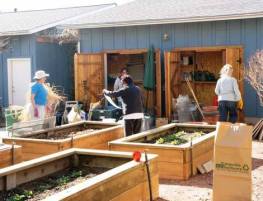
Where I live is an example of cohousing stout. It was built from the ground-up.

I live in a  stout community consisting of 16 condos. It is representative of the characteristics of the broader segment of the wider Boulder, Colorado community, in that it tends towards the extremes. The project was heavily subsidized to encourage socioeconomic diversity.

The community has six permanently affordable deed-restricted houses that are 800 sqft in size and priced at $160,000. Those are contrasted with 10 houses that are “market rate” and range in sizes from 1,000 to 3,000 sqft and have values in excess of $800,000.

This ground-up process often takes three to five years or more with potential members coming and going and mostly accessible to people and families who have inherited wealth or adequate disposable savings.

Who is the typical cohouser? There are significant differences among the residents who live in the various cohousing configurations, with coho ultralite residents being the most diverse:

  • Coho Stout and Lite – Caucasian, liberal, high perceived social class, high income, high education level, 70 percent of the time a woman
  • Coho UltraLite – More racially diverse, liberal, middle class, moderate income, high education level, more singles and single parents

What are the three steps to building a cohousing community? In a retrofit situation the community development steps are the same as for a traditional cohousing community. “Burning soul” advocates and other group members may or may not live in the same building or community. They may decide to move into the same apartment or condo complex, but would follow a typical cohousing development process such as these three steps:

Feasibility study

  • Discuss and agree upon community values and perhaps, a higher purpose, which would fill the need to walk their community values talk while participating in service projects;
  • Whether you’re three or thirty people, come up with a name and “elevator speech” identifying the community. Referring to yourselves as a “bunch of housemates” doesn’t tell about your community story;
  • Community cohesiveness could be built around a higher purpose of community service that binds a community together.
  • Once you kick the can down the road a few blocks, check your state laws about homeowner association regulations. You will find they set up HOAs that do not mirror cohousing very well – lots of centralized power and control, lots of voting. Save this until later, because conforming cohousing declarations with state laws is a chore.

Develop budgets

  • There likely will be common expenses that relate to community activities, coordinating transportation, common meals, intra-community communication and a fee structure to pay for all or part.
  • Community values and mission are implemented through the budget by teams – overall steering team equivalent to a board of directors, social events, managing building and grounds, proceed and governance, finances and legal matters,
  • The entire community approves by consensus the budget or any action for that matter, and the steering team ratifies the action also by consensus.

Design and Construction

  • If you’re sharing a big house, there will be design issues about designating common spaces and storage. Some design and construction in retrofits may be necessary if you’re in an existing condo community or apartment building is adapted. This may include renovating an existing dwelling unit into a common space with a guest room and common kitchen which was the case at Boulder Creek cohousing in Colorado;
  • Identify resident needs, how the “site” functions – if it is in an existing physical development like a condo association, apartment complex, or households dispersed within a given boundary;
  • Determine what are considered “common spaces” which may not be literally common, but function in common. These may be in private homes for shared meals and meetings, civic spaces, churches, libraries

Looking for a few cohousing retrofit pioneers. There are plenty of individuals who are interested in cohousing. Some of you may have managed to form into group that has begun the traditional cohousing process but you’ve bumped into obstacles including lack of money, no suitable land available, professionals such as architects who are only willing to give so much upfront service, group members who can no longer wait for the community to get off the ground. There are well-documented war stories.

I want to prove the concept. I’m seeking one or more people, preferably in the Denver-area to organize a retrofit cohousing community and facilitate you through the process.

  • Maybe, you don’t need a place to live or have bumped into some community development obstacles, but want to create connections with other like-minded people as a hedge against loneliness and living in isolation;
  • Maybe you live in an apartment building and your neighbors are interested in a more collaborative lifestyle;
  • Maybe you are affiliated with an existing assisted living community and want to adopt appropriate cohousing principles

There are varying opinions about whether what I describe is actually cohousing, but regardless, I want to hear from you. Email adoecos@yahoo.com

Alan O’Hashi is the incoming president of the national Cohousing of the US board of directors.

Views from my deathbed: Cohousing taught me it’s okay to ask for help

hospital monitors

My robot care givers – monitors that check out how I was doing at any moment. In the cover photo, those are 1 pound weights on my walker that I struggled with lifting. I wondered what I was going to do with my grandfather’s bamboo cane – use it of course. The rubber bands were for physical therapy.

Here it is February 1, 2019. Five years ago today I returned home from the hospital and rehab after six weeks on my deathbed, losing 30 pounds (20 percent of my body weight), and surviving two surgeries.

I’m glad that my visit from the Ghost of Christmases Yet to Come is behind me. It gave me a view of what the end of my life would be like and I better keep living it up while I can.

I made a documentary about my experience called “Aging Gratefully: The Power of Community” that’s available to watch.

During the ensuing five years, I’ve become Medicare-eligible and my memory isn’t the steel trap it used to be and I’ve learned to quit living in denial and ask for help.

My experience was so profound, I’m more than willing to talk to you or your community about the “why” part of cohousing.

When I moved into a senior cohousing community, I didn’t really know what that was about until I was unable to take care of myself. I knew I was aging, but didn’t think it would happen this fast!

In the cohousing community, we all own our own homes, and have agreed to be supportive of one another as good neighbors and chipping in on chores around the complex – it’s akin to running a family business and everyone lives on site.

Cohousing goes contrary to the American tenets of rugged individualism and self determination. In the non-cohousing world, asking for help is seen as a sign of weakness or a sign of superiority. In the cohousing world, it is neither. I have had to learn how to ask for help.

When I was in the hospital, I couldn’t walk and could barely lift my arms. I was fed gunk through a tube that flowed directly into my heart. I generally don’t speak in absolutes, but in this case, I had never felt so helpless in my life. I was left for dead until a laboratory at the University of Michigan figured out that I had an odd ball interstitial lung disease, some sort of fungal pneumonia, which was easily treatable with run-of-the-mill sulfa drugs. It’s the type of pneumonia AIDS patients and over-worked people like me get when the immune system gets beat to crap. Much of that was “out of network”, but I digress.

Go Wolverines!

I’m self-employed and have always been able to take care of all my assignments, except those that were due in January 2014. The last thing I thought I wanted was a lot of people knowing that I was flat on my back and unable to finish what I had committed to do.

As far as most people knew, I was fit as a fiddle. I needed help and I didn’t know how to ask for it, even in desperation.

I had a contract to travel around Wyoming and make tribute videos for the Wyoming Governor’s Art Award recipients. I liked the gig because it got me on the road and a chance to meet some interesting people. A friend and colleague, Michael,  stepped up to finish this job that entailed driving around Wyoming in the dead of winter.

There was a huge final report on a state of Wyoming film incentive grant for a movie project shot over the summer of 2013. Another friend and colleague, Barbara, finished counting all those beans for me.

Every year, I produce news coverage of the Boulder International Film Festival, which includes scheduling production crews. That turned out to be a bit of a debacle, the guy I lined up wasn’t as good at fast filmmaking and how to produce quick-turn-around news packages as I had hoped. Now, I’ve shared the responsibility with another guy, Glenn, who could easily pick up if I dropped out of sight.

I now come up with a  “plan B” for short term projects. Michael, Barbara and I collaborated on a short movie a few years back and want them to disassemble my business if I get too out of it. I still have to find someone to handle my baseball card collection.

When I returned home from rehab the day before Super Bowl XLVIII the community was very welcoming. I wheel chaired myself to the common house for the Super Bowl party, but had to leave at halftime since the tube sticking out of my abdomen started to leak (TMI).

My digestive system wasn’t quite ready for nachos. My septic ulcer repair wasn’t totally healed up.

For Broncos fans, it wasn’t much of a game, anyway, 43-8 Seattle.

I intellectually understood the “what” of cohousing, but didn’t get the “why” of cohousing until I was nearly dead.

Learning how to cram a cohousing  square peg into the rugged individualism round hole is by far the toughest aspect of living in what amounts to, a socialistic system where work is spread equally for the common good.

Asking for help is a constant in cohousing for the good of the whole.

We’re trying to keep the ship moving in the same direction and it’s tough to make that happen if crew members are off doing their own thing, don’t instinctively pick up any slack, or forget to perform a task – never ending reminder emails are a reality in a community of seniors with various stages of memory loss.

By the way, have you seen my keys?

In the outside world, people ask, to be polite, “Let me know if I can help.” In the cohousing world people ask, “What can I do to help you now?” being intentional about it. At my place, for example, we have a list of people who will contact caregivers, drive a neighbor to the doctor or hospital, at any moment. I look at it as paying it forward – You need a jump? I have cables. You’re in the hospital? I’ll stop by when I’m out today.

In my way of thinking, cohousing is very mission driven and best functions using the team approach. When I was in high school, there were the kids who had to be involved in every school activity and be on every page of the yearbook – drama club, 1,2,3,4; newspaper staff 1,2,3,4…

Clawing your way to the top in the outside world is the norm, but in cohousing, the norm is clawing your way to the middle. When I was younger, I was one of those chronic over achievers and have dialed that down.

My community has evolved to become more transparent. Every year, for example, everyone’s HOA dues are known. Intellectually, we strive for fairness, but any objective formula, while “equal” isn’t always subjectively “fair.”

We’re having very frank and open discussions about MONEY issues. It’s taken 10 years of community maturity, but everyone is letting loose of wanting control.

I don’t have much interest in Super Bowl LIII, but a soft spot for the Rams and three Broncos castoffs – Wade Phillips, Aqib Talib and CJ Anderson.

While I wouldn’t trade my stint in the ICU for anything, what I learned about myself was life changing, but I don’t recommend it as the best way to lose weight.