Understanding the Tipping Point of Social Movements

I’m on the lookout for new stories. When Hemingway ran out of ideas, he joined the Army. I’m curious, but not that curious. There was another No Kings rally on October 18th. I used to go to those. I went to one in April and stayed home in June. The most recent time, I watched Wyoming football, and rationalized that I was at Boulder’s Central Park in spirit.

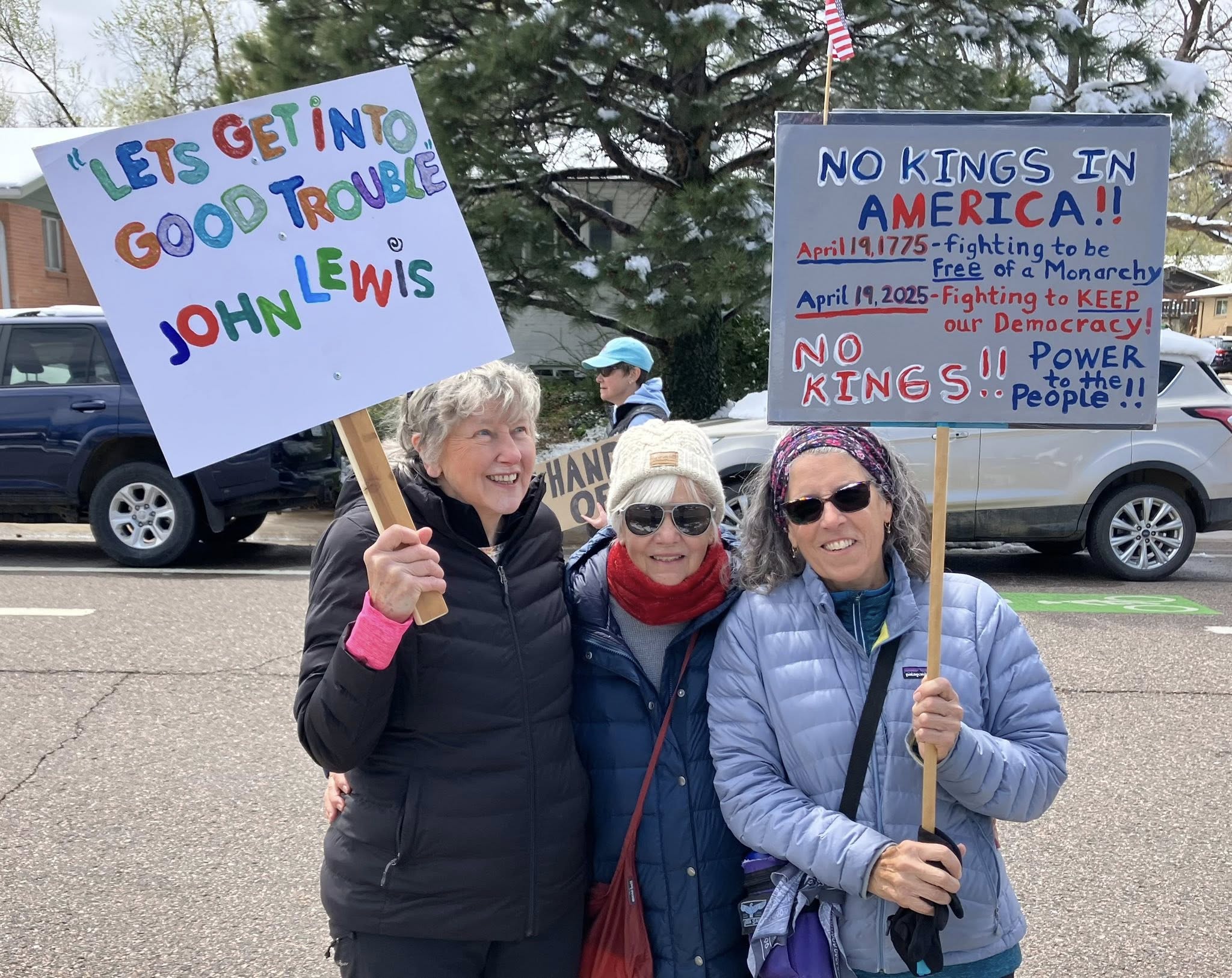
The rally I attended in April felt to me like a mix between a block party and a civics class. A few thousand of us milled around on South Broadway outside the National Oceanic and Atmospheric Administration (NOAA) building, along with a couple of my neighbors and some acquaintances.

The Department of Government Efficiency (DOGE) purged a bunch of scientists soon after the Inauguration in January. Weather research and forecasting had become too political. Climate change will do that. I made a sign that read “Melt ICE,” and caught the bus with a crowd of like-minded people. The slogan is a double entendre, referencing global warming thawing the icecaps, and ICE rounding up immigrants and sending them to points unknown.

We chanted and waved our signs. There were a few horn honks from well-wishers driving by.

The only real drama came when a red pickup roared by and blasted us with black diesel smoke. That was a rolling metaphor for the times.

The plume reminded me of the time I was walking in a crowd when soldiers tear-gassed us after Nixon’s inauguration in 1973. It’s ironic that I was waving my sign, since my first presidential vote was for Nixon and I was president of the now-infamous College Republicans at the University of Wyoming. I’m still regretting that vote.

It was chilly in April. We’d seen enough. The crowd dispersed, and we walked back toward town.

The pundits said these rallies mattered because democracy depends on people in the streets. The next morning, the same president was still in office, with the only visible change being that the dumpsters were now full of clever slogans scrawled on signs.

The rally in April stoked me up. I made a hat with my “Melt ICE” slogan. It gets reactions. Some are supportive, while others, not so much, but at least it starts conversations.

The novelty had worn off, and I had sat out the June event, but I was ready to go in October until I lost interest.

“The movement has lost steam,” I said to myself. There were too many mixed messages. Too many baby boomer faces who’d been protesting since Nixon, now armed with newer cardboard. The energy was real, but it felt scattered.

Then I heard the numbers.

The time I turned out in April, about 3 million marched.

In June, the number bloomed to around 5 million.

News reports estimated 7 million had hit the streets nationwide on October 18th.

That’s not a slump. That’s a surge.

What’s more interesting to me is who showed up. According to a survey from American University, women comprised 57 percent, and most were highly educated.

At first glance, that’s the same old coalition, but the data tell another story. Local media indicated campus groups joined in from places like Penn State, Towson University, and the University of Florida.

The same poll found that the median age of protesters in Washington, D.C. was 44. Younger voices mixed into the chorus.

I’m a Malcolm Gladwell fan. He wrote The Tipping PointNo Kings feels like what Gladwell defined as the mysterious moment when an idea stops needing to be pushed and starts growing under its own power.

Something has shifted over the past six months. Young people are showing up. Folks who don’t fit the old protester profile are finding their way into the crowd.

Maybe they don’t know exactly why they’re milling around, but they know they are mad as hell and not going to take it any more.

When democracy wakes up groggy, it’s slobbery, noisy, sluggish, but undeniably alive. Movements begin with emotion, not policy. It’s evolution, not chaos.

Maybe I was wrong to stand on the sidelines admiring the T-shirts with clever slogans and frog costumes. Spontaneous growth is immune to counter-messages.

Detractors paint the millions and millions of us as anti-American and paid to riot. I must have missed the gravy train.

The naysayers claim photos and videos documenting the 2,500 events around all 50 states were created by AI.

Pay no mind to the conspiracy theorists behind the curtain.

We each only have control over what we can control. The tipping point creates change on its own. For some, that’s marching. For me, it’s about mentoring, voting, or engaging with people who disagree with me.

The four-hour No Kings events are about participation. Being around people of like minds leads to the long, quiet actions that last beyond the rants and raves.

March if you must for the day, but keep moving, because change doesn’t live on a poster board.

Change begins in the streets, and tipping points gain momentum when the news cycle shifts to the next mass shooting or devastating flood.

No Kings rallies echo past protests. Now the crowds have expanded since April. The message is spreading, and people who once stayed home are finding their way into the crowds. Parents push baby strollers down the sidewalk. Kids show up and pass footballs around the medians.

It doesn’t matter where you are on the sociopolitical spectrum. Make something better. Make someone think. Make noise when the streets are quiet.

Copy and Paste this Post to Your Social Media

The No Kings rallies started as echoes of the past with the same signs and outrage. Something’s shifting. The crowds are growing. The energy is younger. The message is spreading.
What began as protests is turning into practice. We can’t control the whole storm, only how we show up in it. March if you must, but keep moving. Change doesn’t live on a poster board. It lives in what we build when the streets are quiet. #NoKings #MarchLessMoveMore #EverydayActivism #QuietChange #TippingPoint #MakeMeaning #DemocracyAlive #YouthMovement #DoTheWork #ZenOfAction https://alanohashi.com/2025/10/21/understanding-the-tipping-point-of-social-movements/TippingPoint #MakeMeaning #DemocracyAlive #YouthMovement #DoTheWork #ZenOfAction

Do You Have Questions? Start a Conversation with Alan Bot!

Go back

Your message has been sent

Warning
Warning
Warning
Warning.

How affordable cohousing can unite a divided America: ‘Get Up Off the Couch!’

ssv gardening lindy rica 2017

Cohousing residents share in the upkeep and maintenance of their communities through a collaborative, sharing, caringand consensus culture, 24-7-365.

Above, the cover photo was taken in Memel, South Africa. Former CoHoUS board member Steven Ablondi and his wife Cindy Burns are building cohousing there to help fill the housing gap in post-Apartheid South Africa. They are teaching construction trades and use “rammed earth” blocks to construct the homes.

America has always been a country divided. What is it about cohousing that can close those social and cultural divides?

Cohousing, as a national m ovement, is just beginning to come to grips with the potential influence intentional communities can have when influencing social change efforts.

In fact, the Cohousing Association of the U.S. (CoHoUS) is exploring retrofit, adaptive reuse alternatives to traditional cohousing that is largely accessible to people with lots of money and time.

Check out the “Affordable Conference on Affordable Cohousing.”

I provide this historical information to provide context about how cohousing can have an impact on making social change happen.

When the United States were founded, never in their wildest dreams did settlers from Western Europe think that there were local people freely migrating across what is now the southern border, or coming and going along the Pacific Ocean coast.

Today, the divides are more apparent. In my view, on one side of the canyon are those who haven’t been paying attention to those standing on the other side who see themselves as being increasingly disenfranchised since the end of the Cold War.

Life was good for main stream Americans during suburbanization following World War II. Beginning during the 1960s, their sense of privilege was challenged by legislated civil rights for people, primarily African Americans disenfranchised since the Lincoln signed the Emancipation Proclamation, and Lyndon Johnson’s Great Society that brought about the Civil Rights Act of 1964. Then Affirmative Action was viewed as a program that took jobs and college placements away from the dominant culture as ways to level the academic and employment playing fields.

In the 1930s, the two main political parties flipped ideology. The Republican Party that included Lincoln, was once the party of inclusion and a strong national government, which evolved into the opposite, when Democratic President Franklin Roosevelt and his New Deal grew the federal government to pull the nation out of the Great Depression starting in 1932.

Seems that now, party identifications are flipping again. The Republicans are now the party with a galvanized working class base, while the Democrats have become the party for a highly educated, but fragmented elite class and have lost it’s historic New Deal base.

What does this have to do with affordable cohousing, diversity and inclusion? Those include an infinite number of subtle intersections and collaborations around class, race, ethnicity, ability, gender, sexual orientation, etc. It’s a daunting task to deal with each of these differences on their own.

I’d say that every cohousing community has as a value, one about diversity and inclusion. Based on the conversations I hear about these topics, there’s a sense of frustration around what to do.

Living in cohousing changes the way each of us looks at the world and how we better accept people different from ourselves. Affordable cohousing results in greater diversity.

I’d say, people are generally uncomfortable about discussing personal issues and views around Superman’s American Way, money, race, class, gender identity, sexual preference. But those discussions are key to forming strong and cohesive communities – intentional or not.

While the bricks and mortar of cohousing are the buildings where residents live, the individuals who form a community are the most important aspect.

alan-shoveling

Cohousing members chip in their time and effort to keep the community operating 24-7-365.

I live in cohousing and while, at least in my experience, it’s far from perfect, the intentionality brings neighbors together to work through tough issues – even though some may be on the petty side – like do we get rid of that old chair or not – they might as well be matters of life and death.

The upshot is, if there’s a housing configuration that is suited to forcing conversations among divergent opinions it’s cohousing.

There are 170 existing communities and 15,000 residents. The typical cohouser are characterized as: Caucasian; having high perceived social class; high income; high levels of education; progressive; 65 percent of the time an introvert; 70 percent of the time a woman.

To me the biggest frustration about cohousing is this. Cohousers by definition, because we’ve chosen this collaborative, cooperative, consensus-based lifestyle, we should be able to organize ourselves into some higher “saving the world” purpose.

  • Changing Superman’s American Way, we are driven to pull ourselves up by our bootstraps, make a lot of money and be on top. These cultural norms create roadblocks for the advancement of caring and interactive communities beyond what is familiar.
  • Cohousing communities, by definition, bring diverse people together.  Cohousers look at their personal histories and make changes so as to become more inclusive as opposed to just believing it’s a good idea and how to outreach to diverse communities.
  • There are institutional barriers such as city councils and planning boards Cohousing “burning souls” create and maintain high-quality conversations and relationships personally, in community, and with city and county planners with innovative projects.
  • American culture of rugged individualism precludes cohousing from entering the mainstream as it has in other countries. Cohousing is just starting to go viral. There are untapped numbers of diverse people who are parts of the “non-traditional” cohousing demographic and learn ways to approach that market.

According to the Cohousing Research Network, retrofit cohouser demographics are more likely to include: more racial and ethnical diverse; lower and middle perceived social class; low to moderate income earners; progressives; more single mothers.

The cohousing movement can become a catalyst for positive change including, non-traditional and diverse cohousing communities that bridge the gap between the left and right, the haves and have nots, in the U.S. today.

Sign up today for the Affordable Conference on Affordable Cohousing. There’s a little something for everyone.