Unknown's avatar

About Alan O’Hashi, Whole Brain Thinker

I’ve been involved with community journalism since 1968 when I wrote for my junior school paper, the "Tumbleweed," through high school and college and then wrote for the "Wyoming State Journal." I put aside my newspaper pen and began Boulder Community Media in 2005. There wasn’t much community journalism opportunity, so I resurrected my writing career as a screenwriter. My first short screenplay, “Stardust”, won an award in the 2005 Denver Screenwriting Center contest. I've made a number of movies over the years. Filmmaking is time-consuming, labor and equipment intensive. I recently changed my workflow to first write a book and make a movie based on that content. - Electric Vehicle Anxiety and Advice - This is a memoir travelogue of three trips covering 2,600 EV miles around Wyoming (2022) - Beyond Heart Mountain - Winter Goose Publishers released my memoir in February (2022) - The Zen of Writing with Confidence and Imperfection - This is a book recounting how luck planed into my signing a book deal after a 15-minute pitch meeting. (2020) - True Stories of an Aging Baby Boomer - War stories about living in a cohousing and lessons others can learn when starting their communities (2021) - Beyond Sand Creek - About Arapaho tribal efforts to repatriate land in Colorado (PBS - TBA) - Beyond Heart Mountain - Based on my memoir about my childhood in Cheyenne facing overt and subtle racism toward the Japanese following World War II (PBS - 2021) - New Deal Artist Public Art Legacy - About artists who created work in Wyoming during the Great Depression (PBS - 2018) - Mahjong and the West - SAG indie feature which premiered at the semi-important Woodstock Film Festival (2014) Over the years, I’ve produced directed, filmed and/or edited several short movies, “Running Horses” (Runner Up – Wyoming Short Film Contest), “On the Trail: Jack Kerouac in Cheyenne” (Lowell Celebrates Kerouac Festival, Top 10 Wyoming Short Film Contest), “Gold Digger” (Boulder Asian Film Festival), “Adobo” (Boulder International Film Festival), “A Little Bit of Discipline” (Rosebud Film Series), and two feature length documentaries “Your Neighbor’s Child” (Wyoming PBS and Rocky Mountain PBS), and “Serotonin Rising” (American Film Market, Vail Film Festival). He also directed and produced the award winning stage play “Webster Street Blues” by my childhood friend Warren Kubota. Boulder Community Media is a non-profit production company dedicated to democratzing media in all their forms - large and small screens, printed page and stage by providing sustainable and community-based content. I mostly work with community-based media producers, organizations, and socially-responsible businesses to develop their content via – the written word, electronic and new media, the visual and performing arts in a culturally competent manner – I’m what’s commonly called a niche TV and movie producer. Along with all this is plying my forte’ – fund development through grant writing, sponsorship nurturing and event planning.

D’oh! Mile High Miracle: Homer Simpson and the Broncos vie for Super Bowl LX

In 1996, Homer Simpson’s boss, Montgomery Burns, gifted him the Denver Broncos NFL football team. The transaction disrupted the space-time continuum and changed Homer’s relationship with hot dogs forever.

Gifted, like a bowling ball with your name already engraved on it, except this Brunswick came with John Elway and a destiny.
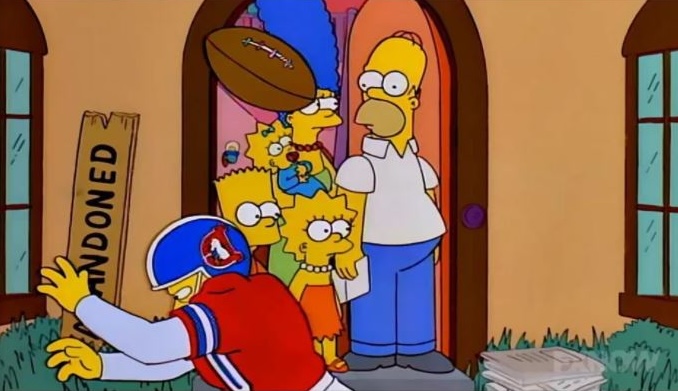
Shortly thereafter, the Broncos won Super Bowls XXXII and XXXIII.

Coincidence? The NFL says yes. The Simpsons prophecy industrial complex says absolutely not. Let’s review the facts.

  • 1996: Homer becomes the owner of the Denver Broncos after Burns gets bored.
  • 1997 & 1998: Broncos win back-to-back Super Bowls.
  • 2018: Broncos win Super Bowl L (That’s 50, not Large) behind Peyton Manning.
  • 2022: The Walton-Penner group buys out Homer. He keeps a minority stake, along with Condoleezza Rice.

The Broncos have been playing the long game. There have been ups (Super Bowl 50) and downs (14 starting quarterbacks and five head coaches) since Peyton Manning retired. The Broncos have been fermenting, like bleu cheese in a dark cave.

Now the Roquefort is ready for the charcuterie board.

Enter Super Bowl LX (That’s 60, not extra large)

Super Bowl LX arrives, and suddenly the Denver Broncos are back on the biggest return attraction in football, like the Eagles’ “Hell Freezes Over” comeback tour, which was the first event played at the brand new Invesco Field at Mile High in 1995.

Who owned the team then?

Homer Simpson.

Homer’s Front Office Philosophy

How did the Homer-owned Broncos get this far? He ran the team using three principles:

  1. Always draft the best player with the coolest name (Bo Nix). 
  2. Timeouts are for snacks (30-second timeouts last four minutes).
  3. Rely on advanced vibes (Nine consecutive come-back wins).

Sources say every major decision this season was finalized after Homer asked:

“What’s the name of our kicker, again?”

Curse or Blessing?

For years, fans wondered if Homer’s ownership was a curse. The team wandered. Quarterbacks came and went. Coaches aged visibly on the sideline.

True Simpsons scholars know:

  • The show never predicts things immediately. It lets them marinate.
  • Trump presidency. Smartwatches. Disney owns everything.
  • You think the Broncos were going to peak right away again?

This is television-level foreshadowing.

Homer was a blessing.

Mile High Meets Springfield

As Super Bowl LX approaches, expect the following:

  • Homer mistakes the Lombardi Trophy for a large Hershey kiss and tries to eat it.
  • Bart and Taylor Swift call audibles from the Simpson party suite.
  • Lisa runs the analytics department for Fan Duel
  • Marge reminds everyone to “just have fun out there.”
  • Mr. Burns leans forward in his box seat and whispers, “Excellent.”

Final Prediction

Will the Walton-Penner-Simpson-owned Broncos win Super Bowl LX?

If they do, remember this. It was foretold in 1996 and powered by chaos, nacho cheese, and blind optimism.

D’oh, Broncos!

Are Venezuela and the U.S. reenacting ‘The Capybara that Roared?’

Do you remember reading “The Mouse that Roared,” a 1955 novel in high school English class? In the book, the Duchy of Grand Fenwick, faced with bankruptcy, decides to declare war on the United States. The plan was to surrender immediately and then reap Marshall Plan reconstruction cash.

The Capybara that Roared

Lately, watching the diplomatic fireworks between Caracas and Washington feels like a geopolitical crisis and a high-stakes remake of Leonard Wibberly’s story that I call, “The Capybara that Roared.” Capybaras are big rodents native to Venezuela.

In the novel, Grand Fenwick’s army is a handful of guys with longbows. Venezuela, of course, has a real military and world-class oil reserves, but the theatre is similar.

When a nation, like Venezuela,with a struggling economy spends its time calling the world’s largest military power an ailing empire it’s looking for a dogfight and to create foreign policy.

In the book, Grand Fenwick accidentally wins because they stumble upon a weapon so powerful it forces the U.S. to take them seriously.

Venezuela has its own secret weapon inviting Russia, China, and Iran to the party, ensuring that a local dispute  becomes a global catastrophe.

It’s the ultimate “don’t make me call my big brothers” scenario, which turned a bankrupt nation into a strategic centerpiece the U.S. could no longer ignore.

The Eagle lost its patience, swooped into Caracas with cinematic bravado,  and kidnapped President Maduro and his wife.

In an action movie, that’s when the credits roll. In “The Capybara that Roared,” that’s when the story begins.

The ousted President sits in a holding cell sh!thole complaining about the food. 

Back in Caracas, instead of planning a counter-strike, Maduro’s insiders frantically mail the U.S. Treasury, a massive stack of unpaid oil well repair bills, a list of crumbling bridges, and a formal invitation to the “Grand Opening of the 51st State.”

The U.S. spoils of conquest include more oil reserves than Saudi Arabia. On top of that, unreliable electricity and broken down oil extraction infrastructure, force America to withdraw.

The oil wasn’t worth 30 million new dependents demanding Medicaid and SNAP benefits – “Peace with Honor.”

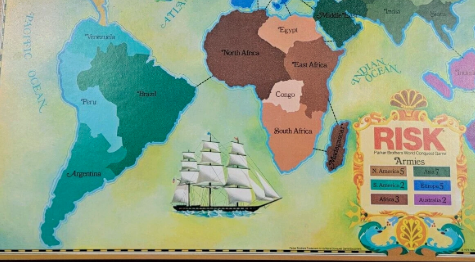
Hasbro Announces Venezuela Replaced by Ecuador on the new Risk board

CARACAS (SNS)  In a move that has sent shockwaves through both the geopolitical and tabletop gaming communities, Hasbro Inc. announced today that all future printings of the board game Risk will officially scrub “Venezuela” from the map.

The territory, a longtime staple of South America and a favorite jumping-off point for players looking to harass North America, will be replaced by Ecuador.

Too Expensive to Play

According to unnamed sources familiar with the situation, the decision came after a “playtesting disaster” in which players who conquered the Venezuela territory were immediately forced to repair hundreds of defunct oil wells.

“It was ruining the game’s flow,” said one lead designer. “In the old version, you’d take Venezuela with three infantries. In the new version, the moment you roll a six, you are legally responsible for the territory’s external debt, its crumbling power grid.”

The Ecuador Swap

The decision to swap in Ecuador was described as a stability play.

“Ecuador is manageable,” the source continued. “It’s compact, it’s got great tourism potential, and the U.S. dollar is the accepted currency.”

The change has drawn mixed reviews. Casual gamers are happy they no longer have to manage hyperinflation during family game night, but hardcore strategy fans are disappointed.

“The Venezuela-to-Ecuador swap takes the teeth out of the game,” said one Grandmaster-ranked player. “Part of the fun of Risk was the high-stakes taunting. Now, if I occupy South America, I just get a reasonable trade agreement and a steady supply of bananas. Where’s the drama in that?”

At press time, sources say Hasbro is also considering replacing Ukraine with a “Permanently Contested Neutral Zone” consisting entirely of mud and broken drone parts to “better reflect the 2026 gaming meta data.”