Exploring the Shift: Sports Betting from Casinos to Your Couch

As technologically savvy as I like to think I am, I have a confession. I don’t have a single sports app on my iPhone.

No DraftKings. No FanDuel. No betting app of any kind.

When I was younger and more competitive, gambling didn’t do much for me. I couldn’t win enough to make me happy, and I couldn’t lose enough to make me angry.

A man sitting at a casino table with a concerned expression, wearing a baseball cap and a light sweater, in a vibrant casino environment with digital screens in the background.

What kind of entertainment is that?

My last bet was a hand of blackjack at the Tropicana in Las Vegas, shortly before its new owners razed the place. That was an appropriate ending to my gambling career. I lost the casino, and the casino lost its building.

Gambling hasn’t changed, but gambling is now more accessible.

From the casino to the couch

I remember sitting in old casino sportsbooks.

I liked the Flamingo.

A wall of televisions showed different games. Baseball here. Horse racing there. Basketball on another screen.

My fantasy Buttheads Baseball League made pilgrimages to Vegas. A few Buttheads gambled heavily. I placed a few bets and enjoyed hanging with my friends.

Today, you don’t have to travel to Sin City to enjoy that experience. You don’t even have to leave the couch.

Modern televisions can display four games on one screen. Add another big screen, a tablet, and a smartphone, and turn your living room into a casino sportsbook.

Except you don’t have to tip a cocktail server.

The smartphone provides the betting window. You can check the score, look up the odds, and place a wager without getting up.
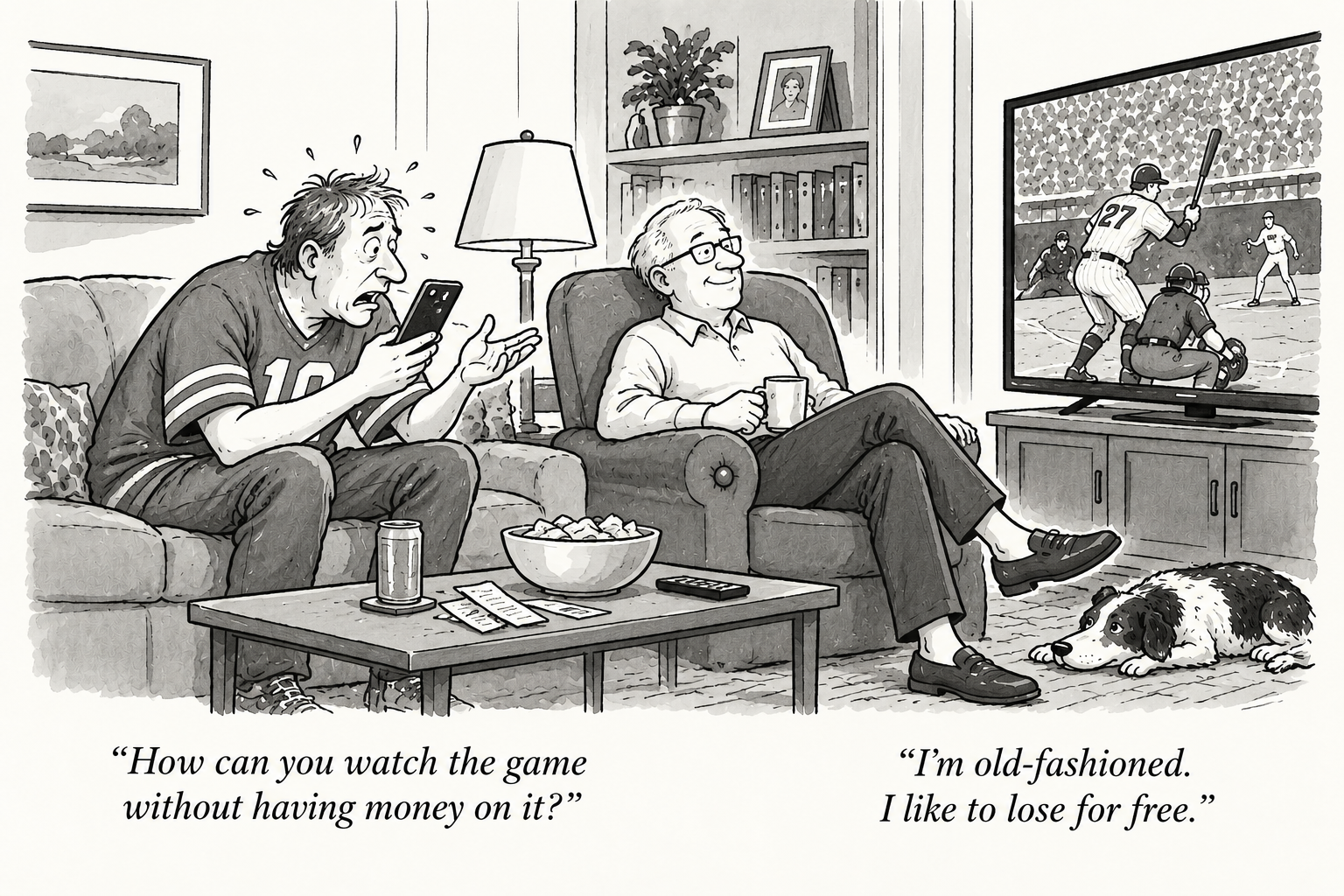
A cartoon depicting two men watching a baseball game. One man, visibly anxious and holding a phone, asks how to watch without betting money. The other man, relaxed with a drink, humorously replies that he prefers to lose for free.

The transformation accelerated in 2018, when the U.S. Supreme Court struck down the federal law that had prohibited most states from authorizing sports betting. The decision allowed states to decide for themselves, and online wagering spread rapidly.

Professional sports leagues, which once treated gambling as a threat to the integrity of their games, have embraced partnerships with betting companies.

The NFL has partnered with DraftKings, FanDuel and Fanatics. Casinos like MGM have joined the online action. The NBA, MLB, NHL and WNBA have also established relationships with sportsbook operators.

At one time, casinos wanted you to visit their establishment.

Now the casinos want to come home with you.

The sports year used to have a rhythm.

Now the seasons overlap. The sports calendar is like the 24-hour Denny’s menu.

Baseball stretches from spring into fall. The WNBA occupies the warmer months. Football begins in September. Hockey and the NBA arrive in October.

I have YouTube TV and discovered that I now get a cricket channel. I tried to understand the game when I went to South Africa for a movie project.

I’ll never figure out the T20/Limited Overs statistic.

All leagues always play on weekends.

Tuesday? There are NBA games.

Wednesday? Any sport except NFL games.

Thursday? Another football game.

Friday? More games, but I don’t think you can bet on high school football.

You’d better have stopped at Costco for snacks.

A minority with a lot of money

Most Americans don’t bet on sports online.
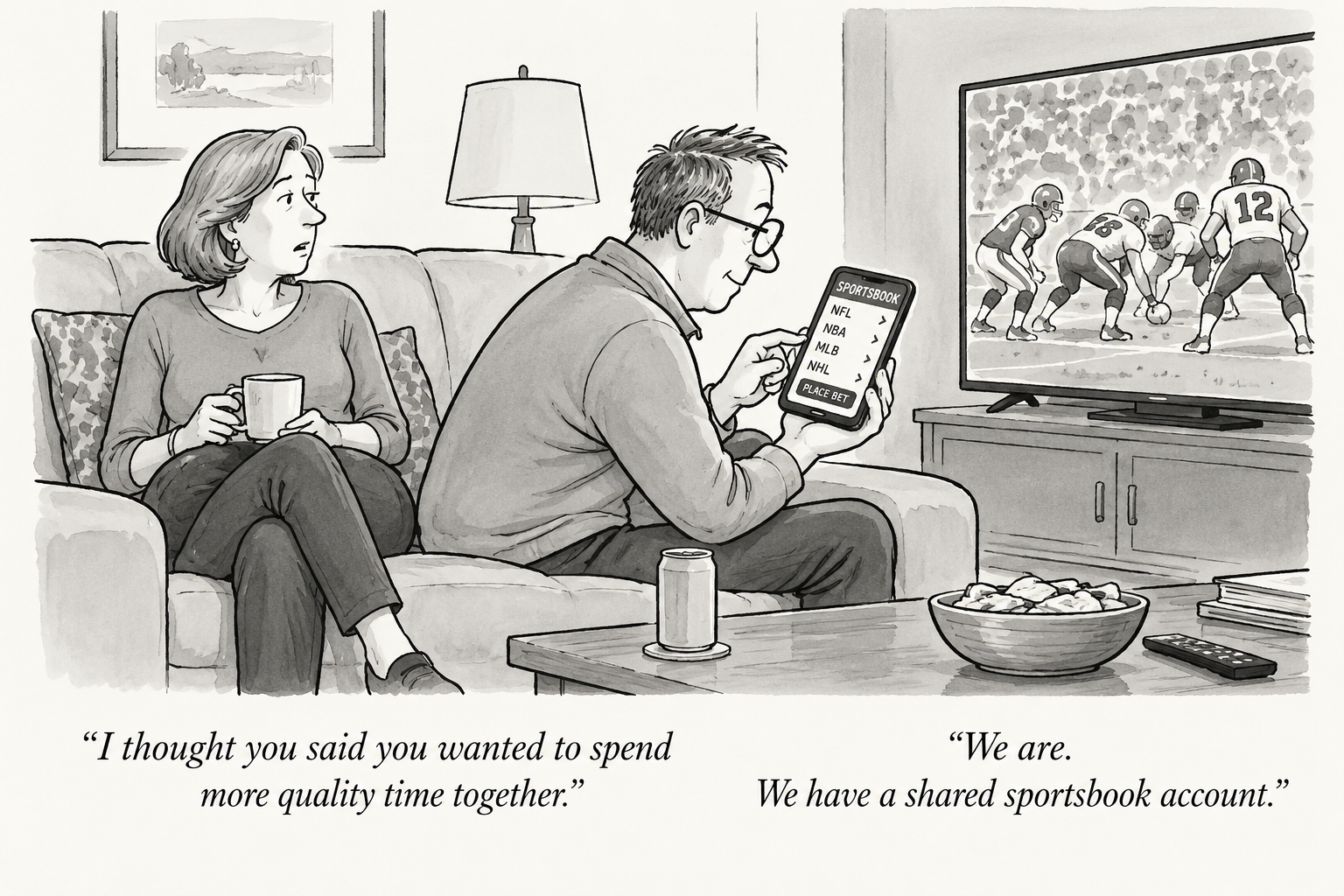
A couple sitting on a couch, with the woman looking at the man holding a tablet, expressing confusion about quality time together. They are watching a football game on TV, emphasizing their shared sportsbook account.

Pew Research Center reports that in 2025, about one in ten U.S. adults had placed an online sports bet during the previous year. The percentage was higher among younger adults.

Despite few sports bettors, gambling has become a multibillion-dollar business.

The American Gaming Association reports that in 2025, gamblers accounted for $17 billion in U.S. commercial sports-betting revenue. That’s the money sportsbooks retained after paying winning bets, not the total amount wagered.

You don’t need every sports fan to gamble. You need a small group of customers who place bets frequently enough, and in large enough amounts, to support a very profitable business.

Broadcasters get more ways to hold our attention. The rest of us get to watch the games, whether we bet or not.

That’s the irony. The gambling minority has financed a business that influences the sports-watching experience of millions of people who never place a wager.

Multiscreen America

This is where technology has changed how I watch sports.
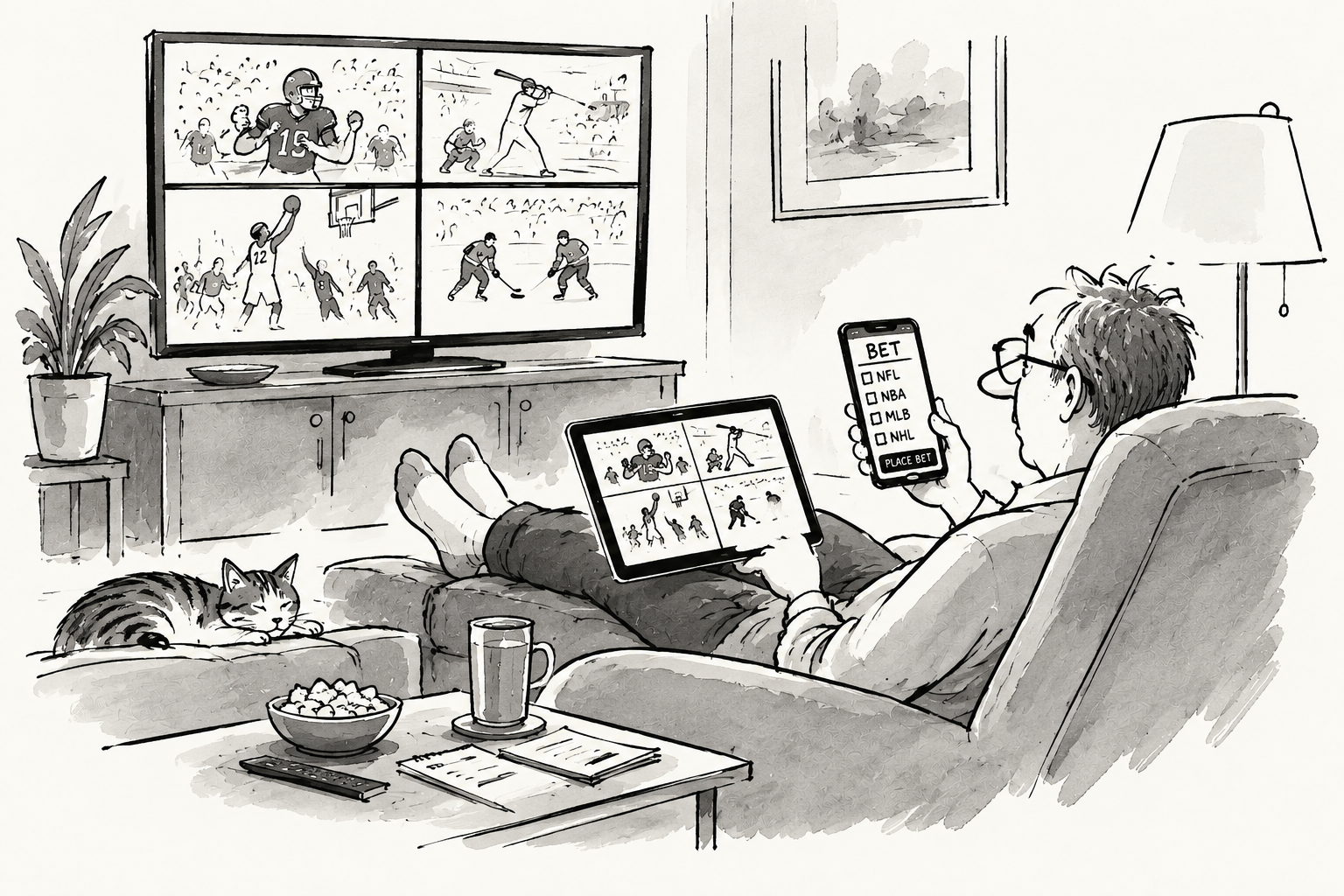
A man sitting on a couch watching multiple sports games on a large TV while using a tablet and a smartphone to place bets. A cat is resting nearby, and there are snacks on the coffee table.

I like NFL RedZone.

RedZone solved one of my least favorite Sunday football activities: channel surfing.

I used to spend Sunday afternoons with the remote in my hand, searching for another game during commercials. Now the two-minute timeout equals five minutes of TV ads.

I’d switch channels just in time to see a replay, or the announcer explaining what I’d missed.

RedZone does the searching for me. It jumps among games and shows scoring opportunities across the league.

I can see a key play in Cleveland without missing a touchdown in Kansas City.

Now I can watch the Broncos on one multi-view screen and RedZone on another. Baseball plays on the third screen, and news on the fourth.

The old casino sportsbook had a wall of televisions because bettors didn’t want to miss anything. Now we can reproduce that convenience in our living rooms.

The difference is that the casino provided the televisions. Now, we have to buy our own.

The smartphone lets us carry the betting window in our pocket.

The gaming transformation fascinates me, even if I have no intention of joining the betting public. I’m interested in the technology, the economics, and the way a business can change an entire viewing culture without requiring most viewers to become customers.

I don’t need to bet

For all this technology, I can still enjoy a Yankees game without having 20 bucks riding on the outcome. I can get emotionally invested in a Cleveland Browns football game without consulting the point spread. I can watch a spectacular catch, an acrobatic interception, or a last-second field goal without calculating what it means for my betting account.
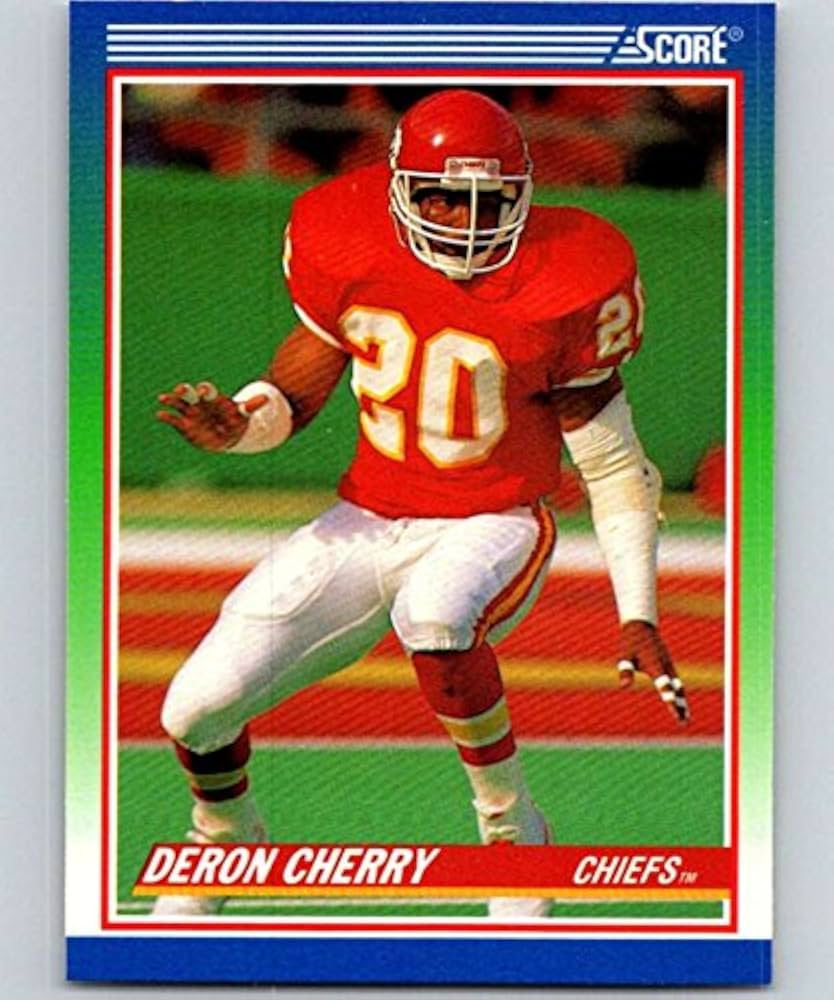
Football trading card featuring a player in a red uniform with the number 20, representing the Kansas City Chiefs.

I prefer sports pools that are based on the luck of the draw.

I once won $2,500 on a progressive football pool at the Stockgrowers Bar in Lander, Wyoming. Patrons chipped in $5 a week for the entire season.

There were weekly winners, but the bar reserved the big prize for the last game. I sat at home and watched the Chief’s DB Deron Cherry intercept a pass, stalling what would have been the Vikings’ game-winning drive.

My numbers hit.

When my birthday falls on Kentucky Derby Day, my upstairs neighbor from Kentucky runs several horse-race pools. I’ll buy a $2 chance.

Over my life, I’ve learned there’s freedom in not having to watch every game. I missed the Browns game yesterday, but my dashboard screen showed live updates from Google.
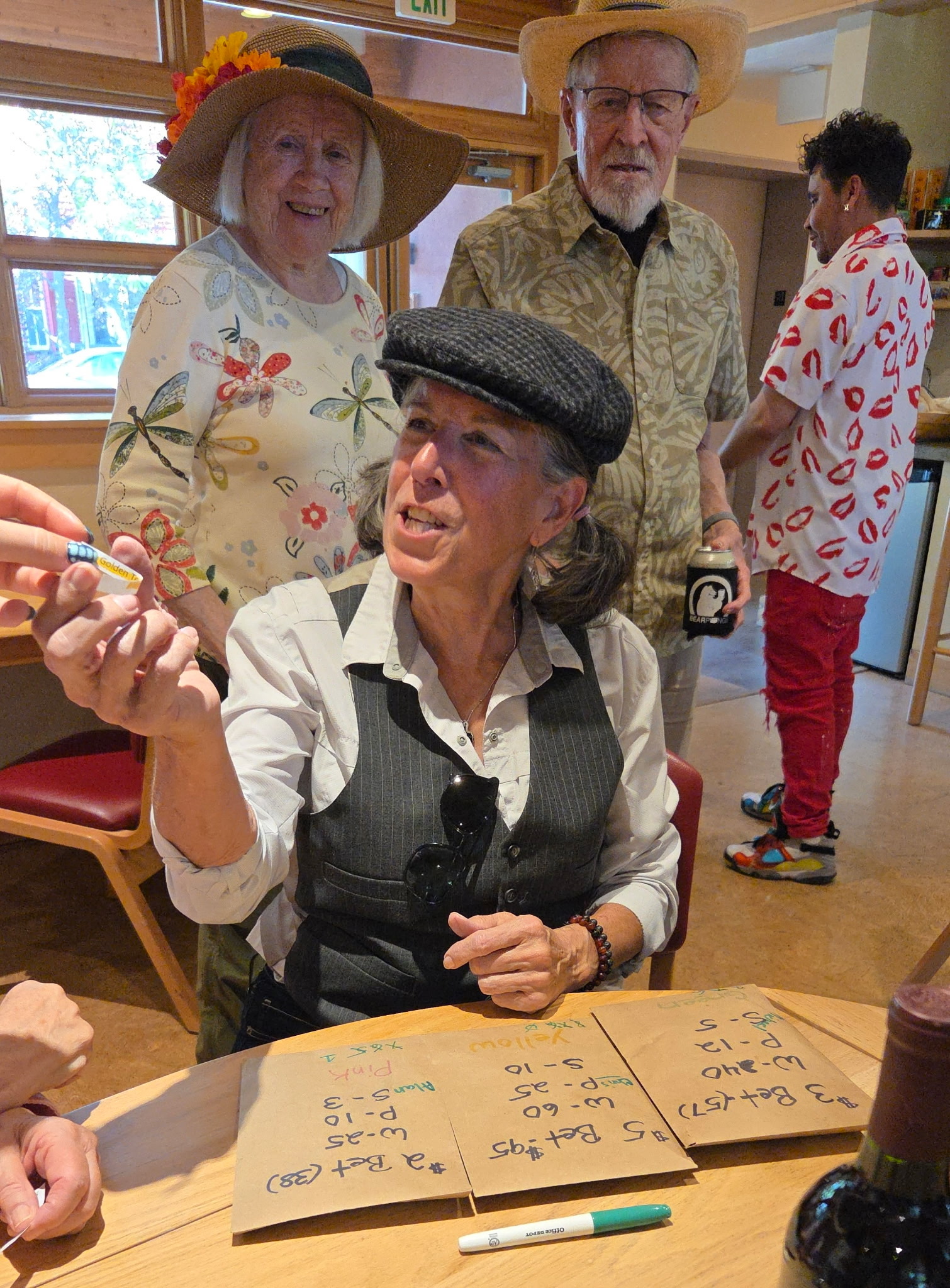
A group of people engaged in a discussion around a table with brown paper bags marked with numbers. A woman in a black hat is displaying an object, while others watch and interact in a casual setting.

I made it home in time to see Andre Szmyt kick a game-winning field goal as time expired.

I don’t need to know every betting line. I know enough betting jargon to have a conversation with my gambling friends.

When I gambled in Las Vegas, I had to go to the sportsbook. Now, if I choose, the sportsbook can come to me on my 65-inch, four-screen setup.

I still won’t download a sports-betting app on my iPhone. Some vices are better left out of the house.

Facebook Community Boost videos: At least, make them look good

Facebook brought an event called the Community Boost to Denver

Facebook is putting on a full court press to get the gig economy to become an integral part of the macro-economy. How do we turn our hobbies and cottage businesses into real money using facebook groups, ads, photos and video?

I attended the free grassroots road show, Community Boost, that recently rolled into Denver. It was a classy event at the Cable Center near the University of Denver.

The Cable Center is a non-profit organization that educates the public about, I suppose, the great things that cable TV has done for the good of society.

My background is public access TV, which was a provision of the original Cable Communications Act of 1984 that set up community access channels as a ploy to avoid regulation as a public utility and dodge FCC oversight.

I had to check out the CATV museum with the history of cable and honors all the pioneers who made billions of dollars.

Not that there’s anything wrong with that, but I digress.

The event’s goal was to provide basic information and some hands-on experience about how to use facebook to increase website traffic, get more buyers / customers and ultimately how to buy more facebook ads through micro-market targeting and subsequently make more money for your fledgling business and for facebook.

facebook booster creative

The facebook Community Boost exhibit area include the Mobile Studio that provides in-phone apps to edit pix and video.

I’m a filmmaker and facebook is trying to turn everyone into rough-around-the-edges filmmakers, which devalues the work that I and all of my colleagues do.

Nonetheless, if you’re going to make video, you might as well post stuff that at least looks halfway decent.

Here are a few tips to improve your videos:

  • Have a story in mind. Even on the spot, you can mentally compose a beginning, middle and end to your movie, even if it’s only 15 seconds long. If you use an in-phone app like Splice or iMovie, you can shoot clips, trim and reassemble them. If you don’t edit, lots of creativity can come about from the continuous shot – going from scene to scene while keeping the phone camera steady. The climax to your story is some sort of call to action – “Click here”, “Call us”, “Donate now.”
  • Hold your camera steady. Move smoothly hand-held. My preference is to shoot with the phone camera horizontally. TV screens and monitors are not vertical and horizontal video displays and looks better. If you’re webcasting facebook live, turn the camera horizontally until the image flips then start the recording.
  • Movies are 80% sound. Viewers can take video that’s a little shaky or out of focus but if the sound is bad, your potential customers will skip to the next video. The microphone is at the bottom of the phone. Get as close as you can to your action or subjects. Normal voices from across the room won’t be picked up. If you decide you want your voice in the recording, try to let your subject complete their statement and avoid “walking over” their audio with your excited utterances or laughing.
  • Fill out the meta-data fields. Facebook has figured out the meta-data thing and prompts you through the video upload with titles and key word fields. Fill them out and write the post narrative. Pick out a few key hashtags that are common-sensical. I see posts with six or more hashtags – many of which are nonsense which detract from the content.

If you’re interested in turning your volunteers or staff into better social media movie makers, I offer workshops about how to tell your organization or business story in a 140 character elevator speech. I also teach practical ways to light a scene, get good sound using inexpensive, everyday items.

facebook creative sources

The Community Boost mobile studio pushed 10 apps to edit images and movies.

What I learned from the Community Boost is that real filmmakers need to differentiate themselves from short-form shooters who know may how to point the camera and record, but make bad video look better with the bells and whistles graphic overlay apps.

At the same time, filmmakers can better promote their work using the short and rough cut formats.

Since attending the Community Boost, I’ve pushed out short videos a couple times for Boulder Community Media production projects that generated some pretty good organic engagement – a couple thousand views of one and nearing 1,000 views of another.

How that translates into more business is anyone’s guess but the phone keeps ringing and my friends keep making referrals.

The Community Boost was set up for lots of face-to-face networking, but during the breaks most everyone was sitting in the corners staring at their phones, computers and other screens.

The lunch was good, but nearly missed out since I ran into a filmmaker in the hallway after the facebook ads workshop.

Community Boost “Aha” Moment – Campaign 2016

facebook parscale stahl

The Trump presidential campaign successfully employed the same techniques as taught at the Community Boost. The Hillary campaign didn’t and the rest is history.

I had a big “Aha” moment during the facebook ads workshop.

It was about how to target the ads to particular markets and how different messages and their words, images, colors and other variables can be tweaked to maximize viewership and interaction.

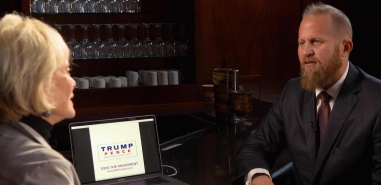
Earlier, I watched a 60 Minute TV news magazine segment by Leslie Stahl. She interviewed the Donald Trump campaign 2016 social media guy Brad Parscale. Apparently, facebook offered to embed staff members into campaign organizations who advised about how to maximize use of facebook ads.

Parscale explained how they decided to focus on 3,000 voters in Wisconsin which ended up turning the course of the election. The Trump campaign tried out the facebook offer. The Hillary campaign didn’t and the rest is history.

Those of us in the Community Boost ad workshop learned in 30 minutes what was taught during the 2016 presidential election.

Facebook ads, with practice, can be a very effective way to micro-target market and maximize advertising budgets.

I get chided by friends about why I spend so much time on my facebook account and pages that I manage. I’d say three quarters of my business leads come as a result of my presence on facebook. “If I didn’t make money from facebook, I wouldn’t waste my time there,” I tell them.

I still don’t understand the psychology behind facebook and why people respond, but then again, it really doesn’t matter.