To Have and to Have Not

Ernest Hemingway wrote a novel called “To Have and to Have Not” Not being much of a reader, I saw the movie with Humphrey Bogart. I’m not exactly sure how that story fits into this post, but it may have something to do with relative misery and happiness of people with lots and material possessions and those with not so much and their interactions.

alan-shoveling

Cohousing community members share in the upkeep of the common spaces.

In a community context, it’s about values and how people chose to live together. That’s relevant since I live in a cohousing community that consists of a couple dozen neighbors in the condo homeowners association. Each household owns their home has private lives, but share in ownership of common spaces and a common house which are jointly operated and maintained in a community life. The community had a retreat recently and one of the topics that bubbled to the surface was one of perceived conflicts among families around the value of money.

As a follow up to that, the community is organizing a workshop around the touchy subject of money matters and we were each asked to fill out a “financial autobiography”.
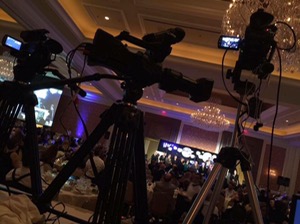
Set up a three camera switched shoot at a big awards banquet in Cheyenne. My roots are still in Wyoming. I also went to Laramie to pay my respects to a friend who recently died.

I’ll be working out of town that weekend, but thought I’d fill it out, anyway. Being a cohousing wonk, I think this is the type of personal information potential cohousing community members should share among themselves as a part of their initial development planning. I think that learning about people on a deeper personal level right off the bat will weed out those who don’t belong in a particular community or cohousing, generally. It’s not for everybody – although I’d say most people intellectually understand the benefits of community living.

maris topps

Roger Maris broke Babe Ruth’s single season home run record in 1961. Baseball cards were among the first things I bought with my own money. This is from a cereal box. I went to the store with my mom. She shopped. I was in the cereal aisle looking for the box with the most Yankees.

What was your-first memory of money? When I started to get allowance, 15cents per week starting when I was seven. I got a raise to a quarter a couple years later. Back in the 1960s, there really wasn’t much I had any interest in buying except baseball cards starting in 1961, then Beatles cards in 1964. There were two drug stores nearby – Save More and Thrifty where my dad would take my sister and me, generally on Saturday to see what there was to get. I didn’t buy much candy or gum, since my grandparents owned a restaurant and we, pretty much, had free run of the candy counter.

What was your happiest moment with money? When I won over $1000 in a football pool at the Stockgrower’s Bar in Lander, Wyoming. I don’t remember the exact year, but it was in the 1990s. The pool was set up so the pot was progressive. Throughout the season, there was a winner every week or two. The last pot accumulated over several weeks. I don’t recall more details nor my numbers, but I had Kansas City and the Minnesota Vikings. Chiefs defensive back Deron Cherry intercepted a pass that stopped a Vikings drive at the end of the game which gave me the pot.

Your unhappiest? When I was laid off a job in 2004 and had to use my grad student loan money to augment my unemployment insurance benefit. I’m still paying that off, luckily the interest rate is 2percent. When I got sick at the end of 2013, my insurance was ready to lapse and I had to sign up for the first round of Obamacare. I ended up with two deductibles – don’t get sick in December – and re-upped with a higher deductible plan to keep my premiums lower. It took almost two years to pay off my out of pocket costs.

plains dairy trip

One of the dads organized field trips for the neighborhood kids. This was from a tour of a local dairy. We all got Popsicles.

How did you feel as a child, teenager, young adult – Did you feel poor, comfortable, or rich? I grew up in Cheyenne, Wyoming. My dad was the manager of the Coca Cola Bottling Company there. My mom stayed at home. That was, pretty much, the case with all the families in the Cole Addition, which was a “suburb” that popped up during the Cold War. There was huge nuclear proliferation and Cheyenne was one of the “ground zero” locations with the highest concentration of intercontinental ballistic missiles in the country. We weren’t the wealthiest family in the neighborhood. There were a few “merchant class” families who ran family businesses, but most everyone worked for wages. In a sense, it was a mass society. Every kid had a bike, for instance, but some had Schwinns, others Hawthorne which was the Wards brand. Mine was a refurbished one that was rebuilt by one of the guys who worked for my dad. To this day, I prefer self-customized used over new. My dad was an “early adopter” we had the first TV back in 1957 or 58; the first automatic dishwashers, the first seat belts (they were after-market).

alan grandpa ohashi

All my direct family members lived in the same town and were close knit.

Were you anxious about money? Growing up, I was never anxious about money. I always had a nickle in my pocket and knew I had a place to come home. Being an entrepreneur the past 15 years-or-so, I’ve learned to wake up unemployed everyday and get with the program. So far, I haven’t grown tired of it since my work is a lot of fun and different everyday. There are a few of us who live in the community who still work and the place, otherwise, operates on a “retiree” schedule.

What did your parents do to earn money? I answered that above. We were always comfortable. I ended up working for wages for most of my jobs as an adult and didn’t get the entrepreneurial bug until I was old enough to know better.

Who handled the money In your family, and how? I’m pretty sure my dad handled most of the finances. When my sister and I left the house, my mother began working again and turned her water color painting hobby into a business. She handled much of her own book work for that. As a kid, I managed my own bank account, although I often needed a ride to the savings and loan to make deposits.

Was money discussed in your family? Money wasn’t discussed when I was a kid. It was talked about when I applied for college to get loans and scholarships. Money wasn’t really discussed until we decided to put all the family assets into trust.

pat nichols birthday

All kids invited one another to birthday parties. There was no exclusion.

How did your family discuss and express generosity? Generosity was about helping others out. My parents gave to the church, as did my sister and I – which we had to take out of our allowance. Most of the kids in the neighborhood must have received similar “be independent” messages. There wasn’t a lot of collaboration or group projects. It was all about the relationship-building, more so than doing things for each other, other than at random. In Cheyenne, all the new subdivisions had swimming pools. That was the major gathering place for kids during the summer. Parents all knew each other because of the kids. Most everything was on a neighborhood basis back then – neighborhood schools, the swimming pool, neighborhood 4-H clubs, neighborhood Cub Scout dens and packs. There was a lot of reciprocity – every kid invited the other kids to their birthday parties, for example. Generosity was expressed all the time. Intentionality was part of the culture.

Did your parents trust you to go to the store to buy something? Me going to the store was not part of the division of labor. When I was in high school and drove, I may have gone to the store from time to time, but nothing memorable. It wasn’t a rite of passage.

Did you ever steal from your parents, other family members, or stores as a child? When I was in high school, I tried to steal a paperback book for an English class from the local grocery store and was caught. I did it to see if I could get away with it, since I didn’t want to fork out for “Love Story.” The worst part was having to tell my father. He had to call the store and talk to the manager – Verlin – about it. He was a friend of my dad’s employee who built my first bike. I was cut some slack and I don’t think my dad ever told my mother about it.

How much money did your family have compared to your childhood friends? As I mentioned before the neighborhood was a mass society. The social class thing wasn’t evident. It may have been among the adults, but that wasn’t a friendship factor. Although there were some families who had more social mobility and had friends from other parts of town, all my friends were in the neighborhood and church.

How did your parents respond when you asked for something? I wasn’t much of an “asker.” I was always of simple means and didn’t want much. I began to work at a very early age so I could even further be a little more independent.

Did you have to start working or did you want to start working? I didn’t think one way or the other about working. When I was offered the Hitching Post job I got a bug for it. During the summer I worked sometimes 60 hours per week at $1.35/hour and time-and-a-half over 40. For a 12 year old kid, I was socking away a lot of money. My only expense was $.75 greens fee at the public golf course on Mondays. I didn’t work during the school year because I was in sports. It was good to have my own money and not have to lean on my parents.

hitchingpost

The Hitching Post was one of the CFD hot spots. It was my best job.

At what age did you start working ? I worked at my grandparent’s business, the Highway Cafe when I was probably 10 or 11. I washed dishes and paid under the table since the legal working age was 12 at that time. I mostly worked when my dad went there to cook after he got off his job a few times a week. My first real job was when I was 12 and my neighbor on the corner, Mr. Contos, got me a job as a busboy at the Hitching Post Inn. I imagine that came about from some conversation my dad had with him. That service-sector job gave me an early exposure to jerks, picky people, control freaks, and bad tippers at a young age. My favorite shift was working from 10pm to 6am during Cheyenne Frontier Days. My job was to run booze from the bar to the Coach Rooms where huge parties took place. Now that was an eye 0pening experience.

What Is the first money you recall earning and how did you earn it? Working at my grandparent’s restaurant was more like getting tipped. My first money making project was selling pop at the Cheyenne Frontier Days parade. During CFD, there were three parades at the end of July. My sister, cousin and neighbor chipped in, shopped the sales and bought up canned sodas throughout the year and stock piled it in our bomb shelter. Even though my dad worked for Coke, we sold the grocery store brand because parade goers weren’t that brand conscious and the profit margin was better. The first year, after dead-heading to resupply wasted a lot of time and after about three summers we figured out where to set up soda caches along the route. The last I checked, my cousin still has the first bag of money he made from that parade gig.

How did you begin saving money? My first account was Cheyenne Federal Savings and Loan. Relatives would give me silver dollars for birthday presents and those were put into the account. After silver money was taken out of circulation, I thought I would be able to withdraw silver dollars from the bank, but much to my rude awakening I was not able to do so. After that I like to have tangible investments.

hc alan debbie karen mary coors

I’ve lived gregariously much of my life, including in the dorms. Not only the same dorm, but the same dorm room for four years.

Did anyone help you decide on a career based on how much money you wanted to make? In high school, I didn’t talk to a guidance counselor at all. Maybe at the end of my senior year to determine if I had enough credits to graduate. I had absolutely no idea what to expect in college. I graduated high school and college at the end of the Vietnam War with degrees in political systems analysis and environmental biology. There weren’t many jobs out there counting smooth and wrinkled peas. I ended up sitting out post-war recession studying environmental politics and teaching at the University of Wyoming. I had no career counseling. If I were to do it all over, I’d go to two years at a community college so as to avoid taking the SAT and ACT.

What messages did you get from your parents about career, earning money and spending money? I didn’t get much information or advice from my parents about money matters. They were both high school grads and didn’t have much knowledge or experience, other than to say “go to college.”

What was/ls your view on money and dating? Who should pay for dates? I didn’t date much in high school. It was a non-issue for me.

When did you get your first credit card? What were your feelings about it? When I was in college I got a Diners Club card. That was before Visa and MasterCard. I worked in the student union checking out pool equipment from 9pm to 2am. I got paid to play billiards and earned money to pay a credit card each month. I lived on campus, at the student union food and didn’t have many discretionary expenses.

Will you Inherit money? How does that make you feel? All my family property is in trust, so I didn’t “inherit” it, per se. There hasn’t been reason to sell anything yet.

Will you have money to leave to your relatives? How does that make you feel? Likely, but in the back of my mind I want to be on my death bed with no money in the bank having spent or given it away while I’m still alive.

Could you ask a close relative for a business loan? For rent/grocery money? I could, but wouldn’t.

How do you feel about your present financial situation? I’m happy with it.

Do you know how much money you have right now?  Do you know how much you owe right now? Yes and I know exactly how much I owe on a credit card, car loan and student loan.

Who handles the money in your current household, and how? We handle our own money.

Is money easily discussed? There’s no reason to discuss finances.

Is money abundant or scarce? Neither abundant nor scarce.

How does your family discuss and express generosity? It’s not discussed.

In what ways are you a good manager of money? In what ways are you a poor manager of money? I’m pretty good at keeping track of my business money mostly because I have a good CPA. Personally, I don’t have many expenses to track.

Do you have a personal budget? Yes

Have you made decisions concerning retirement, insurance, drafting a will, and so on? I’ll keep working until I get tired of it. So far, I don’t know what I’d do if I had a bunch of idle time on my hands. I’m not much of a traveler just to travel. When I go someplace it has to be purposeful. The Talking Heads have this record called “Stop Making Sense.” The album jacket has a “scrapbook” of photos. One caption of a group of women doing their laundry in the river says, “Rich people travel thousands of miles to take pictures of poor people.” That’s not my thing. I have a will and a charitable remainder trust set up.

What kinds of things do you buy on your credit card? Do you ever buy groceries or necessities? I seldom buy any day to day stuff on a credit card. My card has no “miles” attached to it.

IMG_1510

I bought my first new car – VW Golf – since 1974 and traded in my 1993 Eurovan

Do you make big purchases like cars, appliance or other expensive things with your credit card? If I make big purchases, I buy on credit. Recently, I bought my first new car since 1974 on credit from the dealer at 2.5% which is pretty good.

Do you know what interest rate you are paying and how much you owe? Yes

Do you have any money secrets that you have never told anyone about? Let me think …

Do you talk to your friends and family about money—how much you have or don’t have, how much you make or how much they have and make? I talk about money in general terms with business colleagues.

How much money would you like to be making? What feelings does that bring up for you? I want to make accessible money while I’m sleeping. I keep putting myself into positions to do that and one of these days …

How do you feel about spending money on yourself? About the only non-essential things I get for my self have to do with my sports card collection. That’s more like a hobby business since no money changes hands.

Have you ever felt guilty about your prosperity? Yes, when I was held by police in Uganda and had to pay a bribe to a cop.

Have you ever felt guilty that you don’t have enough money? Is this a result of your mismanagement? I don’t feel guilty about having money or not. I’m not much of an extravagant person. It’s mostly a guy thing. I don’t buy new clothes, I don’t buy new shoes. If you look in my closet it looks like Batman’s closet – a rack of gray outfits.

ghost of xmas future

People should take a visit from the Ghost of Christmases Yet to Come and find out what people thought about them.

How do you feel about the money situations of those who are more or less well-off than you? At one level, I feel sorry for them. I know plenty of people who are very well off and in retirement or close to retirement. They spend lots of money on themselves but don’t seem to be very happy. Many seem to have their own circle of acquaintances and I see them once or twice a year. A friend of mine who had been planning for retirement died suddenly and I’ll be at her funeral on Saturday. I’m a non-profit fundraiser and teach workshops about donor development. There’s a datum out there that as a percentage of income, more money is given to charity by low / moderate income people than by wealthy people. The stereotypical notion that rich people should be hit up for donations is false. It’s better to nurture a larger number of willing regular people than trying to convince a rich person. More well off people need to be visited by Ebenezer Scrooge’s Ghost of Christmases Yet to Come.

How do you feel about begging? Welfare? I have been on the public feedbag and I am very forthright about that and don’t disparage anyone who has had to seek an outside hand up. As for panhandlers, I used to think me giving someone money was some sort of social contract and the recipient wouldn’t spend my money on booze or smokes. But then I got to thinking about all the frivolous and wasteful things I’d spent money on like beer or a hamburger or whatever. When i give money to a stranger, they can spend it how ever they want.

In what ways can you be generous? In what ways can you be stingy? Do you treat? Do you tip? I’m randomly generous, throw parties, pick up tabs, treat, offer up goods and services for events and activities with no reciprocity expected. I’m not stingy, but don’t prefer to be with people who don’t carry their expected part of the load, or are constant “takers.”

We’re all “haves” and “have nots.” It depends on the time and circumstances. Everyone just needs to look themselves in the mirror and know that their experiences are not the same as anyone else’s and take those differences into account on a daily basis.

If you’re still frustrated and undecided, watch ‘TrumpLand’

If you haven't voted yet and a presidential fence sitter, click on the above image and watch the Trumpland trailerLast night, a movie called “TrumpLand” played in Boulder as part of the International Film Series. The “documentary” is a cut of a one-man show by Oscar winner Michael Moore.

HBO no longer has the full movie online. It is available for $4.99 on Amazon and iTunes.

Anyway, if you haven’t yet voted, don’t like Trump because he’s a misogynist lying millionaire, don’t like Hillary because she’s a feminist lying millionaire and leaning toward Trump, Hillary of a third party candidate, watch this movie before you vote.

He goes into the solid Republican territory of Wilmington, Ohio – home of the original banana split – and speaks to an audience that overwhelmingly consists of Trump supporters. Moore makes a point that he is NOT a Hillary supporter. He’s pretty good about meeting people where they are and finds the commonalities among differing perspectives.

I’m not going to spoil the movie for you, but if you’re a fence sitter and really care about the direction of the country watch this movie.

Yes: Amendments T, 69, 70, 72, sugary drink tax, schools … Hillary

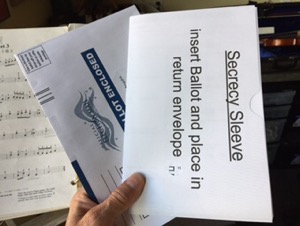
My ballot is ready for delivery. There’s a law in Colurado that photos of filled out ballots are not allowed. Mine is in the secrecy sleeve.

The election ballot came in the mail the other day. I hear a bunch of people haven’t quite made up their minds yet. I don’t get that. Not that I’m any kind of political guru, but here are my takes on the election.

While I like the convenience of mail-in ballots, having to place first class postage on them is a form of a poll tax. Old school student that I am, I will drop off my ballot at the polling place on election day.

I predict the Democrats will take back the Senate and make a big dent in the House GOP majority. What will continue to stalemate congress is the heavily gerrymandered districts that benefit the Republicans. Democrats who get elected in Republican districts will likely be there for one, maybe two terms. The SCOTUS decision upholding the Arizona election commission as a non-partisan redistricting tool and the 2020 census should enable the creation of more competitive districts.

Presidential Electors – Hillary and Kaine: I was/am an ardent Bernie supporter but now reluctantly for Hillary – but solidly, 100 percent behind her. A vote for Hillary / Kaine is a vote for the Bernie movement. If you’re for social justice, getting money out of politics, balancing income disparity, cracking down on Wall Street, further health care reform, fixing trade deals, then, maintaining a Democrat in the White House  will move that agenda.

I predict Hillary will win by a landslide. It will be unbelievably huge – believe me. Hillary is lucky she’s isn’t running against McCain or Romney this time. It would have been a tight 2016 race.

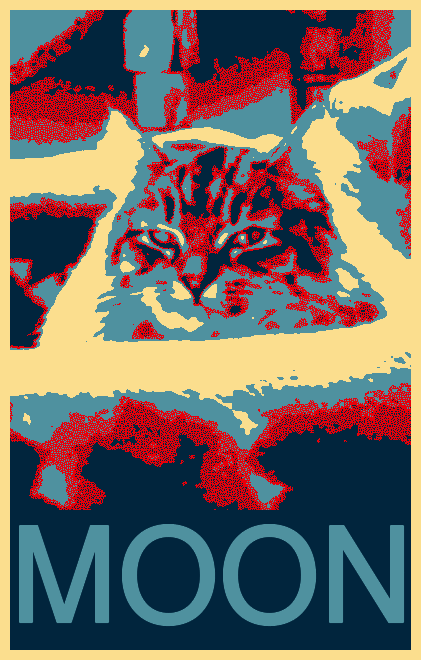
Write in Moon

If you’re one of those “Bernie or Nobody” or “Hillary and Trump are both terrible” voters, it’s not like you don’t have choices. There are 22 pairs of candidates on the Colorado ballot. If you don’t like any of them, there’s a “write-in” blank. Because of third party candidates, Hillary is likely to win in Utah … WHA’???!!!

If it’s any consolation to my Wyoming friends voting for Trump, in any scenario from a Hillary landslide to a Hillary squeaker, Wyoming goes solidly for Trump. Trump is guaranteed three electoral votes.

For those of you who have forgotten what you learned in political science class, we don’t vote for candidates, but rather for electors who, in turn cast each state’s vote for president. Electors aren’t bound to vote how the state directs them, however. There are people who don’t like this approach, but we’re a nation of states not a nation of people, as we are sometimes led to believe. The electoral college system provides equity to the least populated states.

US Senator – Michael Bennet: This is a no-brainer for me. In a purple state like Colorado, the US Senators have to govern to the center. Michael Bennet after being appointed by Governor Hickenlooper, had a tough reelection campaign in 2010 against Ken Buck. He’s proven his ability to work on both sides of the aisle including with junior Senator Cory Gardner. He stays out of papers and governs quietly.

Representative CD 2 – Jared Polis: I’ve known Jared and his partner Marlon Reis for a number of years. I think I first met Jared when he was managing his foundation and eventually on the state board of education. He is another guy who has to be sensitive to the Republicans in his district, which expands north and east. I’m okay with that.

I tend to support people I know – Republican or Democrat – and that’s no exception for these contested races:

CU Regent – Alice Madden

State Senator – Steve Fenberg

County Commissioners – Elise Jones, Deb Gardener

As for the judges, the blue book gave them all a pass. I’ll let them ride another term.

Constitutional Amendment T – YES: This reminds me of that Seinfeld pilot episode within an episode when a guy is sentenced to be Jerry’s butler. Rather than take this provision out of the constitution, the reference to slavery and involuntary servitude should have just been removed. There are plenty of similar punishments that happen in the forms of community service, restorative justice retribution, etc.

Constitutional Amendment U – NO: People / Corporations who use public land for private purposes should continue to pay taxes. The constitution is no place to be dealing with administrative costs as being a reason to exempt users from paying tax.

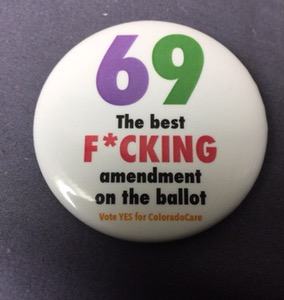
Constitutional Amendment 69 – YES: Big pharma and mega-insurance companies are against this one. If it passes, it will signal other states to opt out of the Affordable Care Act which has been a boon to big medicine. There are many people who will be turning 65 soon and enrolled in Medicare. Why should I be okay with paying a little more income tax? It’s for the common good. Besides, I don’t have kids in the public school system and I don’t complain about paying those taxes, because education is public good.

Constitutional Amendment 70 – YES: When I was a kid, I worked for the minimum wage, which was, seems like $1.32, and for a 12-year old that was a lot of money – especially when I was allowed to work sometimes 50 hours a week. What else did I have to do? The minimum wage isn’t supposed to be a living wage. It’s a benchmark. It’s a starting wage. The current $8.31 isn’t even a starting wage. However, for workers who think they can make a living on $9.50 / hour, I have news for them, they better get two jobs or get fit to work into something that is better paying. Small and micro business owners have a good gripe in that this could be an undo burden on them, but it’s a cost of doing business. If a small biz is just squeaking by paying workers $8 an hour, maybe it should evaluate the business model.

Constitutional Amendment 71 – NO: The reason the constitution gets amended so often is because if it isn’t in the constitution, the state legislature can change a law passed by referendum at the drop of a hat. If anything, the constitution should be amended to say that any law passed by referendum can be changed by the legislature, but any changes have to be by majority of each county’s legislators, independent of party of affiliation.

Constitutional Amendment 72 – YES: Taxes like these are paid by people who knowingly use a product that is bad for them like tobacco (in fact, it’s written on all the packages). Tobacco also happens to be addictive so it’s an easy sell. Tobacco smoking isn’t a right, it’s a choice. People who choose unhealthy options, regardless of reasons, also place a burden on the public health and safety through second hand smoke, avoidable health problems such as heart and lung disease. The bad lifestyle choosers also get into insurance pools driving up premium costs. This isn’t about tobacco users (they often think laws like this gang up on them) but rather about tobacco. Also, if this were only a law passed by referendum, the tobacco company lobbyists would have a hey day lining elected officials pockets to get the law gutted.

Proposition 106 – NO: I think there are adequate ways for caregivers to end a person’s life or a sick person to end their own life without adding this huge death industrial complex behind it. Let’s see, there’s Smith and Wesson, the left over oxycodon … This is a choice that a person makes after consultation with family friends, preacher, their dog. The government has no place in this decision.

Proposition 107 – YES: I imagine both political parties are against an open primary because it allows independent voters to vote in either partys presidential primary election. I don’t know how any one who stood in line for hours thinks the caucus system is better than a direct primary.

Proposition 108 – NO: While independent voters would be able to vote in a party primary for state and local candidates, it allows an exception for non-presidential candidates to be selected by a convention of party elites. This must be a compromise voter suppression measure proposed by the GOP.

Boulder County Issues 1A, 1B, 1c – YES: I always vote for the pittance of sales tax increases to maintain infrastructure including parks and open spaces. I seldom use the open spaces, but they are a public good.

Boulder County Issue 1d – NO: Term limiting candidates should be left up to the voters to decide. If the District Attorney is doing an okay job, let him/her serve as long as the public can stand them.

City of Boulder 2H – YES: This is a tax similar to the tobacco tax proposed in Amendment 72. If a person wants to make unhealthy choices, they should be willing to pay a little extra. The Big Gulp from 7-Eleven now costs $1.59 and a refill is $.99 – I’m pretty sure your average Big Gulp drinker would pay 50 cents extra. I know I won’t mind. I’ll continue to buy my fountain soda here, than travel to Longmont for my occasional to save on taxes.

City of Boulder 2I – NO: There are other ways to better utilize the Boulder water supplies. Denying land owners water isn’t the right way to do it. There’s a big debate happening in town now about residential growth. Allocation of scarce resources needs to be a more balanced approach.

City of Boulder 2J – NO: The city of Boulder council is not a full time job and providing access to benefits available to city employees encourages people to run for office not to serve, but to self serve because of the health insurance benefits.

City of Boulder 302 – NO: There is no need to legislate term limits. If anything, there should be another effort to establish city council wards in Boulder to create more equitable representation. Remember the time when two council members lived in the same house?

Boulder Valley School District 3A – Yes: Even though I don’t have kids in the school system, education is a public good. I helped on 2A many years ago which fixed the existing schools and built some new ones.

Yours truly, Michael and Jerry mugging at BIFF

Scientific and Cultural Facilities District 4b – YES: I am self-interested in this one. I’m a member of the Boulder International Film Festival board of directors and some of our funding is SCFD. This is one of most worthwhile taxes, particularly for small to medium sized arts organizations.

In another race of interest to me, I think this is the biggest game changer of all the overlooked elections in the country:

Wyoming CD At Large – Liz Cheney: I predict the Virginia carpetbagger and daughter of Dick Cheney will win in a landslide. She quasi-moved back to Wyoming to take the open seat held by Cynthia Lummis. I further predict that Cheney will ditch Wyoming after two terms and run for president in 2020 / 2024. Carpetbagging worked for Hillary Wyoming is a way easier path to the top than going through New York. If she wanted to take the big state route, Texas – corporate home to her dad’s firm Halliburton – would have been the obvious choice.