
Heart of Community ZOOM room.
I’m presenting at the “Heart of Community” online conference about the dynamics of introverts and extroverts. Here is a link to the Introverts Unite presentation.

Heart of Community ZOOM room.
I’m presenting at the “Heart of Community” online conference about the dynamics of introverts and extroverts. Here is a link to the Introverts Unite presentation.

Going to the food store was depressing with not much on the shelves. I switched to shopping on line.
Back in March when there was widespread panic, I quit going to the grocery store, mostly because it was so depressing to see all the customers there grabbing whatever was remaining on the shelves, as if the last can of Campbell’s soup will be their last meal.
There are other jobs I haven’t gotten around to yet. I usually switch out my snow tires around Mother’s Day. That hasn’t happened, since I don’t drive much these days.
I live in a cohousing community. Everyone in the HOA is very collaborative. In the pre-COVID-19 world, if someone is homebound, neighbors step forward and provide a coordinated care giving response.
That would include picking up groceries or medicine from the store, providing prepared meals, and stopping by to say “hello.” My neighborhood is very “retro.”
With COVID-19 self-isolation, those tenets of community have changed with the times. The personal connections are few and far between, but because of fairly strong neighborly relationships, we still get together for meetings and some socializing on web streaming services like ZOOM.
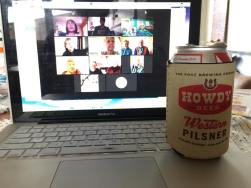
Community members get together for virtual happy hours, but it’s not the same as face-to-face gatherings.
There are some community members who view themselves as more bullet proof than others and are gadding about, much to the dismay of others who are much more vigilant and take the self-isolation mandates issued by the city of Boulder, Boulder County, and state of Colorado much more seriously.
There are exceptions from the mandate. Going to the food store is viewed as “essential.” I’ll be suggesting that all my fellow community members come up with a list of ingredients for their “last meals” and have the more cavalier neighbors go on food and beer runs for however long this pandemic lasts. The Black Death bubonic plague lasted five years.
What’s your “last meal” – you know the one you’d scarf down if you’re on death row and your fateful number finally pops up.
These days, as my personal movements are constrained by the local and statewide COVID-19 “stay at home” mandates, I have accumulated the fixings for my last meals, just in case.
Around the time time I was recovering from my death-defying illness back in 2014, King Soopers started home delivery. Back then a delivery was twenty bucks. At that time, for me, it was worth it. I resurrected my account and have food delivered to the house now, which is handy and also the price dropped to around $6.
Over recent years, I’ve been in and out of some harrowing situations and my last meal is always on my mind.

One weather-related risk I, as well as most anyone who’s lived in Wyoming have experienced, is winter driving. While I no longer live in Wyoming, I spend quite a lot of time on the road traveling around mostly to other towns there, and haven’t had any death-defying driving experiences nor any really close calls other than a couple 360 degree black ice spins and sliding off the highway after winter weather closed the road behind me.
On March 9, 2019, after attending the inaugural Boulder International Film Festival in Fort Collins, I took off for an uneventful Saturday drive through Fort Collins and north toward Wyoming for a community-building workshop presented by my friend and colleague Yana Ludwig at the Solidarity House Cooperative community in Laramie.
Before deciding to drive up to Fort Collins for the film festival, there was snow in southeast Wyoming. I was undecided if I wanted to make the trip, in the first place, but figured if I got on the road fairly early in the morning, there would be plenty of daylight if I had to turn back.
Do Mother and Father Nature plan for weather to drastically change at the Colorado / Wyoming state line?
The the trek suddenly became very eventful at Virginia Dale.
Early-morning sunlight glistened off 30 miles of the black ice encrusting the highway. Blowing and drifting snow buffed the icy road surface to an opalescent sheen from the state line to Laramie.
I didn’t eat anything before I left thinking I would get something along the way. Based on these road conditions, that may not happen. “What if my ‘last meal’ was nothing,” I thought to myself as I passed jack-knifed trailers and cars stuck on the sides of the road. Some nutty driver in a pickup going way too fast was fish-tailing his way up my tail pipe, before he slid off the road behind me.
That in turn, reminded me about a drive I made from Riverton to Laramie in November 2015.
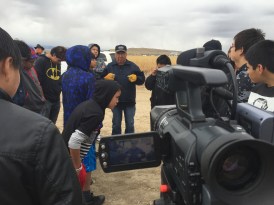
I was on the Wind River Indian Reservation documenting a traditional bison ceremony, which was a big success. That movie project stalled, but the content will be used in the documentary I’m working on now.
This was my third trip to the Wind River Indian Reservation in three weeks. It takes a while for the Arapaho to come to consensus, because it’s a very collaborative culture.
Indian time, as it is characterized, which i similar same as Hawaiian time.
It was a successful “hunt” and traditional ceremony. I was anxious to get back on the road, but didn’t think to check the road reports.
When I hit the road the next day, it was a typical November fall weather in 2015 when I was driving back from Riverton. The clime was pleasant with the skies a little overcast and the outside conditions requiring a light jacket.
As is my routine I made a stop in Rawlins for a gas and a pit stop. “You do know I-80 is closed both directions,” the clerk informed me as I paid for my bottle of diet Mountain Dew and bag of Lays potato chips.
What gives?

I-80 was officially closed when I was driving back from Riverton recently. White knuckle driving is an art form in Wyoming.
It’s calm, sunny and warm in Rawlins. The options were to turn around and return to Riverton or backtrack and go way out the way to Casper and Interstate 25, which would likely be worse. I stuck it out in Rawlins.
It was early and I decided to get a room before the truck traffic started to back up.
I didn’t want to give an arm and a leg for a nuisance stay-over and took a room at the Econo-Lodge.
Even as Econo-Lodges go, this one was stark. It’s nestled up against the north side of a bluff where it didn’t get much afternoon sun.
Might as well make the best of it.
I cruised around downtown Rawlins. The streetscape has drastically improved over the years. Before Rawlins created its Downtown Development Authority in 1991, it was a declining business district. The year I drove through, Rawlins was awarded the coveted Great American Main Street Award.

I stopped at this Tex Mex place in downtown Rawlins. I was impressed with the offering of TopoChico agua mineral.
I prefer local joints to the chains and tried a chili relleno at a small Mexican place called Rose’s Lariat. The meal was pretty good especially when I could wash it down with Topo Chico fizzy water out of the bottle, which is my go-to agua mineral when I’m in Mexico, and now available in the United States.
Globalization.
I made my way back to the room, if that’s what you want to call it. The Econo-Lodge was more of an Econo-Fridge. The heater hadn’t been on for quite some time. I flicked it on. The heater parts banged, clicked and finally whirred enough to spit out heated air.
While the room warmed up, I’d always wanted to take a look at the “Frontier Prison.” It was the old state penitentiary that was abandoned in 1981, but now a tourist attraction. As a kid one of the parental threats when I was scolded was, “You don’t want to end up in Rawlins making license plates, do you?” The prison made money from inmates stamping out car tags.
I pulled up to the now historic sandstone block building. By this time, it was snowing again and the attraction was closed, probably because of limited “winter hours.” It was getting late in the afternoon and I headed back to the room for good.
Closed roads are a growth industry in Wyoming.
The Department of Transportation closes the interstate because there are no more parking spaces along the route to accommodate any more trucks, let alone passenger cars. All the cities lining the road sell out motel rooms from Cheyenne, Laramie, Rawlins, Wamsutter, Green River, Rock Springs to Evanston.
Pizza Hut advertises on the plastic room keys. Bored, I decided to order my “go to” Canadian bacon and mushroom thin crust with extra cheese. I’ve been eating that combo since my Hastings College roommate introduced me to it back in 1972 or so. I was able to eat half of it.
Rawlins has pretty good cable. There’s not much to do here on a school night in the dead of a snow storm.
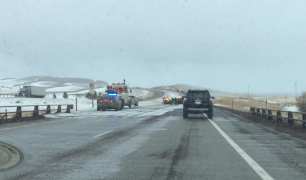
I dozed off with the TV on, and at 2am the “REEEEE REEEEE REEEEE!” screeched out on the TV speaker. The pre-recorded road report guy yelled out, “Interstate 80 is now open, but slick and slick in spots with snow and blowing snow.”
I would still wait to get out around 10am when the sun is higher.
After waking up, I gobbled most of the cold pizza and downed a warmed over cup of yesterday’s coffee before getting on the road.
It was a bumper-to-bumper parking lot from Wolcott Junction to Laramie. Traffic was stopped by an accident on the westbound lane. It took three hours to go 90 miles.
Wyoming winter driving takes practice – more like baptism by fire. If you can successfully drive in Wyoming during any small snowstorm, you can drive anywhere.
Riverton, like most other Wyoming communities, is centrally isolated from just about every place else when the weather gets nasty.

There aren’t any places to stop. In the event of road closures, there are lighted barriers like at a railroad crossing that prevent traffic from passing and drivers are required to turn back.
I grew up in Cheyenne and let me tell you, if you haven’t sat out a blizzard in southeast Wyoming, it’s quite the experience.
During certain times of year, it’s so windy, there’s no Final Net hair spray on any store shelf.
Add snow to that.
I always felt lucky about living in Lander and now Boulder, Colorado along the Front Range foothills.
It’s so nice to wake up, look out the window and notice that the snow has fallen into neat little piles on tops of fence posts and not rudely strewn about in seven-foot-high drifts.
I’ve met several people in my travels who have been to Wyoming. Besides having visited Yellowstone Park, the second most frequent comment is, “Oh, yeah, one winter I was stranded in Cheyenne on my way to California.”
Hmmm.
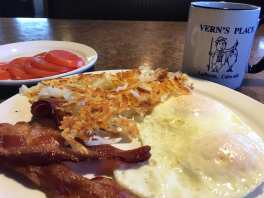
My last breakfast consists of eggs over easy and bacon from anywhere. This trip to Laramie, I ate at Vern’s Place in LaPorte, twice.
Under most circumstances, I’m a calm and collected driver, but when the interstate suddenly disappears in a puff of white, the highway turns into the “Snow Chi Minh Trail.”
Luckily, I didn’t get stranded this time. When that happened back in the days before cell phones and GPS, travel could get problematic. The seasoned drivers keep on plowing ahead since the weather will likely get worse before it gets better.
Back in those days, cassette tapes played music mixes through the stereo that soothed me while my car pounded through invisible snowdrifts and crept around 18-wheeler convoys near Elk Mountain.
White knuckles.
The road was open but barely navigable. Attempting to eat a pizza slice might be too distracting. Espying disgruntled travelers examining their jack-knifed u-Haul trailer and contorted semi-truck silhouettes in the highway median made me realize how out of control these drives can be.

My last lunch would be pork noodles. This bowl was at the 20th Street Cafe in Denver.
I couldn’t imagine being killed by a wild and crazy trucker or freezing to death knowing my last meal was cold pizza and day-old coffee.
My romanticism has me eating bacon, eggs over easy with a pancake for my last breakfast at the Luxury Diner in Cheyenne; Japanese-style pork noodles from the 20th Street Café in Denver as my last lunch; and a good steak from just about anywhere for my last dinner.
I sneaked up on occasional black ice right into Laramie. It was a relief to negotiate slushy roads in town.
By the time my workshop was over around 4pm, the sun had warmed the pavement and dissipated the ice and it was smooth sailing.
I pulled into the parking lot at Vern’s Place in LaPorte for a well-deserved prime rib dinner, hopefully, it won’t be my last.
My COVID-19 King Soopers run next week will includes, bacon and eggs. I always have T-Bone steaks in the freezer, and always a healthy supply of Japanese noodles in the cupboard.
If I catch the COVID-19, I hope my reaction doesn’t include loss of smell and taste.

This is what our bomb shelter looked like, particularly the separate wall that made for a vestibule.
Being self-isolated during the COVID-19 pandemic is a throwback to my childhood. In the cohousing community we’ve agreed upon how to support one another in the event of illness, lack of food, and when cleaning supplies are short.
The Cohousing Association of the US is sponsoring a series of webchats providing a way for communities to share their “secret sauces” about preventing the spread of COVID-19.
The community common house, and that of the cohousing community across the street would be good large-scale places for others in the neighborhood to shelter in place, if need be. More likely in the event of a bad storm.
As a course of our day-to-day cohousing lives, the community keeps stores of paper towels, toilet paper, and cleaning supplies on hand. When this coronavirus thing blows over, we’ll refine our civil defense protocol.
The mutual support that’s come about today is a lot like how things were back during the Cold War. My family and extended family were tight-knit enough to hunker down together while preparing for the impending nuclear holocaust.
We were the only household in the neighborhood to build a “fallout” shelter. In the 1964 Barry Goldwater favored the use atomic warfare to end the Vietnam war. I’m pretty sure my dad voted for Goldwater, which may be one reason behind our family civil defense project.
Similarly, during the early stages of the COVID-19 pandemic, there was a high degree of international and national tension. but soon friends and foes worked together to slow the viral spread.
As for COVID-19, it’s pretty easy to build consensus around stomping out a bad virus, since there are no people involved, and, for example, no disagreements around having to determine who are the good nazis compared to the bad nazis.
Baby Boomers and older likely remember October 1963 when Russia installed nuclear missiles in Cuba in response, in part to the botched Bay of Pigs invasion to take back Cuba from Fidel Castro. There was a political stand off between President John Kennedy and Russian premier Nikita Khrushchev. Lots happened after that, JFK was assassinated, some conspiracy theorists think that was somehow connected to the Bay of Pigs, and the missiles of October.
While I was growing up, Cheyenne had the highest concentration of nuclear missiles in the country. Francis E. Warren Air Force Base was the command center for the Atlas missile program following World War II. The Department of Defense figured out that a better way to deploy nuclear weapons was to install lighter weight nuclear warheads on rockets. Missile installation was a booming industry in middle-of-nowhere places like southeast Wyoming.
Not that we were any safer, but my parents decided to build a bomb shelter in the basement of our home in the Cole Addition, one of the suburbs on the east side of Cheyenne. Suburban growth was a result of the missile boom.
I imagine the bomb shelter was for peace of mind more than anything.
One of the guys who worked for my dad at the Coke plant was Bill Fisher. He was a veteran of World War II and the Korean War and lived in the basement of a house that was started but not built. Part of the foundation was completed, but there were dirt tunnels where he kept stuff. I was never quite sure what to make of Bill living underground in a series of tunnels.
He was a hermit, maybe that was PTSD-related, but very smart about science. He worked around the plant sorting bottles, helped on the production line, but his main job was working on the vending machine refrigeration systems.
His place was located across the street from the Coke plant. When I went to work with my dad on Saturdays, I goofed around inside the plant, but eventually made my way over to Bill’s.
He subscribed to “Things of Science” which was an educational program launched by the nonprofit news syndicate Science Service in November 1940. The program consisted of a series of kits available by subscription and sent by mail monthly.
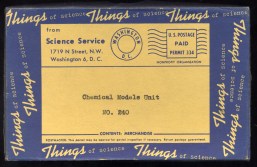
My interest in science was reinforced by the Things of Science kits given to me by Bill Fisher.
They were packed in a small blue cardboard box about the size of a portable hard drive with a yellow address label. Included inside was a simple science project. I remember one being a crystal radio set, and another was a small motor run on electromagnetic current – battery not included.
Bill had the little boxes categorized by year and stacked up on a ledge in a niche carved into the dirt wall of his of literal “man cave.”
One Christmas, he bought me a subscription – the cost was $5.00 for the year. He was a quiet guy. Since he had no family, Bill was always invited over to our place for Thanksgiving. On Christmas, we always stopped by to see him and drop off a gift and some food on our way to the grandparents’ for Christmases 2 and 3.
Anyway, Bill had done research about bomb shelters and helped build ours. Bill was also a very meticulous mason. He taught me how to mix mortar, and lay blocks, which are life skills I’ve used on occasion over the years.
Our shelter was located in the northeast corner of the basement at the bottom of the stairs, which made for easy access. There was also a window well that led to the outside. Bill welded together an air shaft from steel pipe that led from inside the shelter and vented to the outside.
There was a set of surplus bunk beds, a pantry where canned goods and water were stored, along with plates and table ware. The fallout shelter temperature was always the same and was a good place to hang out during hot summer days. There wasn’t a place to cook, but there was a Sterno camping stove that could heat up a can of soup in a small space. There was a downstairs bathroom, but in the shelter the toilet was a galvanized steel port-a-potty with a sealed cover.
The threat of nuclear attack was real, but largely theoretical. If Cheyenne was targeted, a missile that hit in Torrington, would be considered, “close enough.” The main reason for the shelter was protection from “fallout,” the residual radioactive dust spewed into the upper atmosphere following a nuclear blast and eventually fall back to earth. The amount and spread of fallout is based on the size of the weapon, the altitude at which it is detonated, and prevailing winds. Since Cheyenne is so windy, locals though any fallout would be blown to Nebraska and Colorado.
In school, we watched short Civil Defense movies and film strips about how to prepare for a nuclear attack, “Do not look at the fireball,” we were warned. There were air raid drills similar to fire drills, except we sheltered in place. One exercise was to dive under our desks and cover our heads with our hands or a pulled over garment.
We also practiced exiting the classroom and going down into the school boiler room that was manned by the custodian, Mr. Costello.

I collected cards like this Roger Maris from the backs of a Post cereal boxes. This particular one was a “giveaway” from a LIFE magazine ad.
During the summer time, I liked to go to the grocery store with my mom. Not that I like shopping, I stood in the cereal aisle looking at the backs of all the Post cereal boxes that had panels of baseball cards looking for the ones that had the most New York Yankees players – particularly Mickey Mantle and Roger Maris.
After returning home from the store, one of my jobs was to rotate the bomb shelter canned goods out and replace them with the new stock. The cans were dated using a magic marker. I’m still a food hoarder based on those days. Rather than buying one can of Beeferoni, I get four.
My dad and I spent Saturdays making the rounds at the local war surplus , Goodwill, and Salvation Army stores looking for items that would make living in the bomb shelter with some of the creature comforts, like extra can openers, and cooking utensils. That’s a habit a learned from my dad. I don’t have one tool kit, I have five – one in the car, house, garage, and two in my office – one dedicated to the camera equipment.
One item was a manual air circulator. I don’t think that thing was ever hooked up.
After Khrushchev backed down to JFK and the nuclear weapons were removed from Cuba, tensions decreased, even though there continued to be an escalation in the arms race between the United States and Russia. While the threat of nuclear war was lessened, everyone was more aware and vigilant as a result of preparing for an unforeseen war.
At my cohousing community, early on, there were some who didn’t think the COVID-19 thing was any big deal. They attended the community dinners with hubris. There are others who have self-isolated since the beginning.
Since then the community approved a set of guidelines concerning use of the common house. Most of my neighbors have come around, don’t go out much, and observe social distancing when talking to neighbors. If the governor orders Coloradoans to stay home, our cohousing community has been observing much of how that’s being handled in California. Since we’re all over 60 here and a “vulnerable” demographic, we may get more flexibility. I saw that Safeway now offers “senior hours” from 7am to 9am on Tuesdays and Thursdays.
Today, we’re celebrating one neighbor’s 80th birthday outdoors in the courtyard. Hopefully, the prevailing winds will keep any airborne COVID-19 away from the party. Even if they don’t, I have peace of mind knowing that there is a stash of toilet paper in the common house basement.
I’ll be at the birthday party in spirit.

